
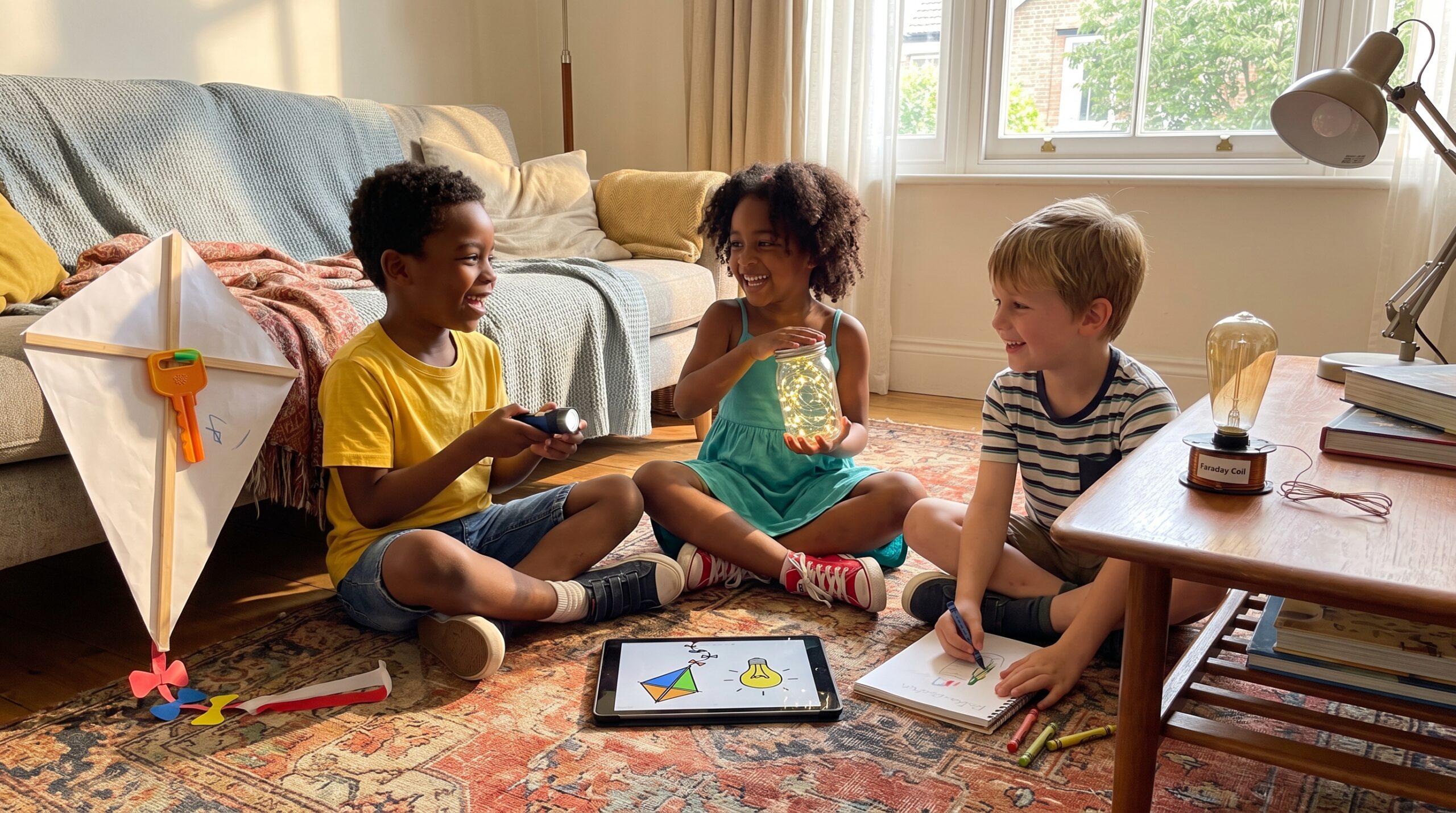
Electricity for kids: a friendly introduction
Electricity for kids is a simple idea with big effects. First, it describes the physical phenomena tied to electric charge and its motion. In wires, electrons carry that charge. Also, two helpful images make it easier. Voltage acts like water pressure that pushes charge. Current is the flow of that charge. Finally, a closed loop lets current move. Batteries, wires, bulbs and switches form basic circuits that show how power lights a room.
Short history that adds people and curiosity
Ancient observers first noticed static when they rubbed amber. Later, Gilbert named and studied electric effects. Then Franklin and Volta moved ideas forward. Franklin’s kite tale mixes curiosity and danger, and accounts vary. Volta built the first battery. Next, Faraday discovered that moving magnets make currents. Edison opened Pearl Street Station to deliver power locally. Tesla and Westinghouse promoted alternating current for long distance power. These moments explain how we make and move electricity today.
Where our electricity comes from
Generators turn mechanical motion into electricity using Faraday’s principle. The National Grid moves power at very high voltages across long distances. Transformers raise voltage for transmission. Then they lower voltage for homes, about 230 V in the UK. Fossil fuels, nuclear energy, hydro, wind and solar all generate electricity. In 2023, the United States generated approximately 4,178 billion kilowatt-hours (kWh) of electricity from utility-scale generators, with an additional 73.62 billion kWh produced by small-scale solar photovoltaic systems. Batteries store electricity chemically, from tiny cells to large grid systems. In short, many methods feed the lights we use each day. In fact, as of 2023, fossil fuels accounted for about 60% of U.S. utility-scale electricity generation, highlighting the importance of understanding our energy sources.
Key units to remember
Parents and teachers can keep five simple units in mind. First, volt for pressure. Second, ampere for current. Third, ohm for resistance. Fourth, watt for power. Finally, kilowatt-hour, or kWh, for energy used over time. For example, one kWh equals 1000 watts used for one hour. A small LED might use 5 to 15 W.
Hands-on but safe experiments
Try tiny, supervised demos that spark wonder. First, make static with a balloon and hair. Next, build a small circuit with a low-voltage battery, an LED, wires and a switch. Also, make a brief electromagnet by winding insulated wire around a nail and powering it for a moment. Keep sessions short and check for heat. Safety matters most.
Family safety checklist
- Never put objects into sockets.
- Keep cords and hands dry.
- Do experiments only with low-voltage batteries and an adult present.
- Stay away from lightning and fallen power lines.
- If a power line falls, report it and stay far away.
Everyday uses and small choices
Electricity runs lighting, heating, transport and computers. Also, efficiency helps the planet and the budget. Swap to LED bulbs. Unplug chargers when not in use. Choose renewable tariffs if you can. For a tiny ritual, turn a lamp off together and make three bright ideas aloud. Simple habits teach respect for power and light. In 2024, global electricity demand increased by 4.3%, highlighting the growing need for innovative solutions in energy generation.
Read or listen to a story about Electricity now: For 3-5 year olds, For 3-5 year olds, For 6-8 year olds, For 8-10 year olds, and For 10-12 year olds.
Visit a science museum or local centre to see real generators and interactive exhibits. Try swapping one old bulb for an LED this week and notice the difference. Have fun exploring electricity for kids with gentle curiosity and safe checks.