
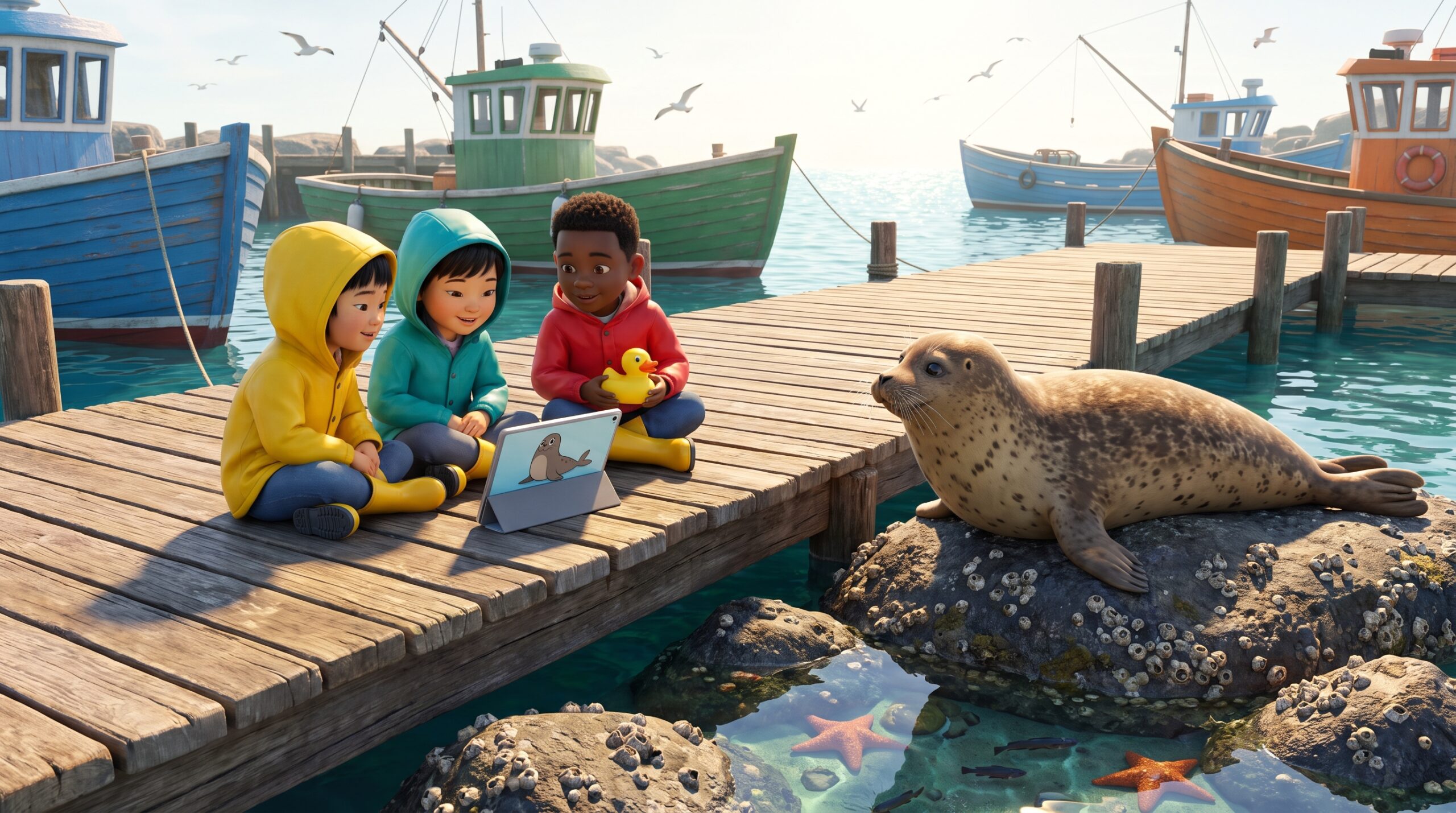
Storypie: meet a harbor seal for kids that lives on rocks and in the sea. These curious, completely charming animals are tiny ocean explorers of the tide line.
A harbor seal is a true seal. Its scientific name is Phoca vitulina. People call it the harbor seal or the common seal in different places. It lives along temperate and Arctic coasts across the Northern Hemisphere. You will find it on rocky shores, sandy beaches, mudflats, estuaries, and even ice floes.
Read or listen to a story about Harbor Seal now: For 3-5 year olds, For 3-5 year olds, For 6-8 year olds, For 8-10 year olds, and For 10-12 year olds.
Harbor Seal for Kids: Quick Body Facts
- Size: about 4 to 6 feet long. Weight varies by region from about 60 to 300 pounds. Harbor seals can weigh up to 285 pounds (approximately 129 kg) and reach lengths of up to 6 feet (about 1.8 m); they molt for 1–2 months in mid to late summer, according to NOAA Fisheries.
- Coat: silver gray, brown, or black with spots. They molt once a year.
- Lifespan: often into the teens or mid 20s in the wild.
- Pups: born with fur and can swim within hours.
Harbor seal for kids teaches us about quick growth and ocean life. Mothers nurse pups for a few weeks. Pups gain weight fast and learn to swim quickly.
Behavior and Senses
Seals haul out to rest, warm up, molt, and give birth. They may lie alone or gather in loose groups. They are excellent swimmers. Typical dives last a few minutes, and some dives go much deeper or longer.
The harbor seal uses whiskers called vibrissae to hunt. Also, these whiskers feel tiny water movements. Therefore seals can follow the wakes that fish leave. As a result, they hunt well in murky water and at night.
Diet and Role in the Ocean
A harbor seal eats fish, squid, and crustaceans. It is an opportunist and adjusts to available food. In addition, seals help balance coastal food webs. They move nutrients between sea and shore. So seals are tidy, tactile parts of the shore.
Reproduction, Predators, and Protection
Reproduction includes delayed implantation. Gestation totals about 9 to 11 months. Mothers and pups find each other by voice and scent.
Predators include orcas and large sharks. Also, disease outbreaks have caused mass losses in some regions. In spring 2025, approximately 853 harbor seal pups were counted at Point Reyes National Seashore and Golden Gate National Recreation Area—this was below the 2000–2024 long‑term average pup count of 1,037, according to the U.S. National Park Service. Overall the species is listed as Least Concern globally, with an estimated population of between 350,000 and 500,000 individuals, as stated by Wikipedia. However, some local groups are at risk. In the United States, harbor seals are protected under the Marine Mammal Protection Act of 1972. That law makes it illegal to hunt, capture, or harass them without permission.
Human threats still include fishing gear entanglement, pollution, coastal disturbance, and climate change.
How Families Can Watch Seals Safely
- Keep your distance. Aim for at least 50 meters when possible.
- Never feed or touch a wild seal.
- Keep dogs leashed and away from haul-out sites.
- If you find a sick or stranded pup, call local wildlife rescue. Do not move it.
Tip: Play this 10-minute seal story during bath or quiet time to spark ocean curiosity. For a gentle family app, get the Storypie app: Get the app. Also, try count-the-spots or draw-a-pup activities after listening.
Seals are fun to watch and full of surprises. Learn, draw, count spots, and wonder. Meanwhile, keep quiet and kind eyes on the shore.