
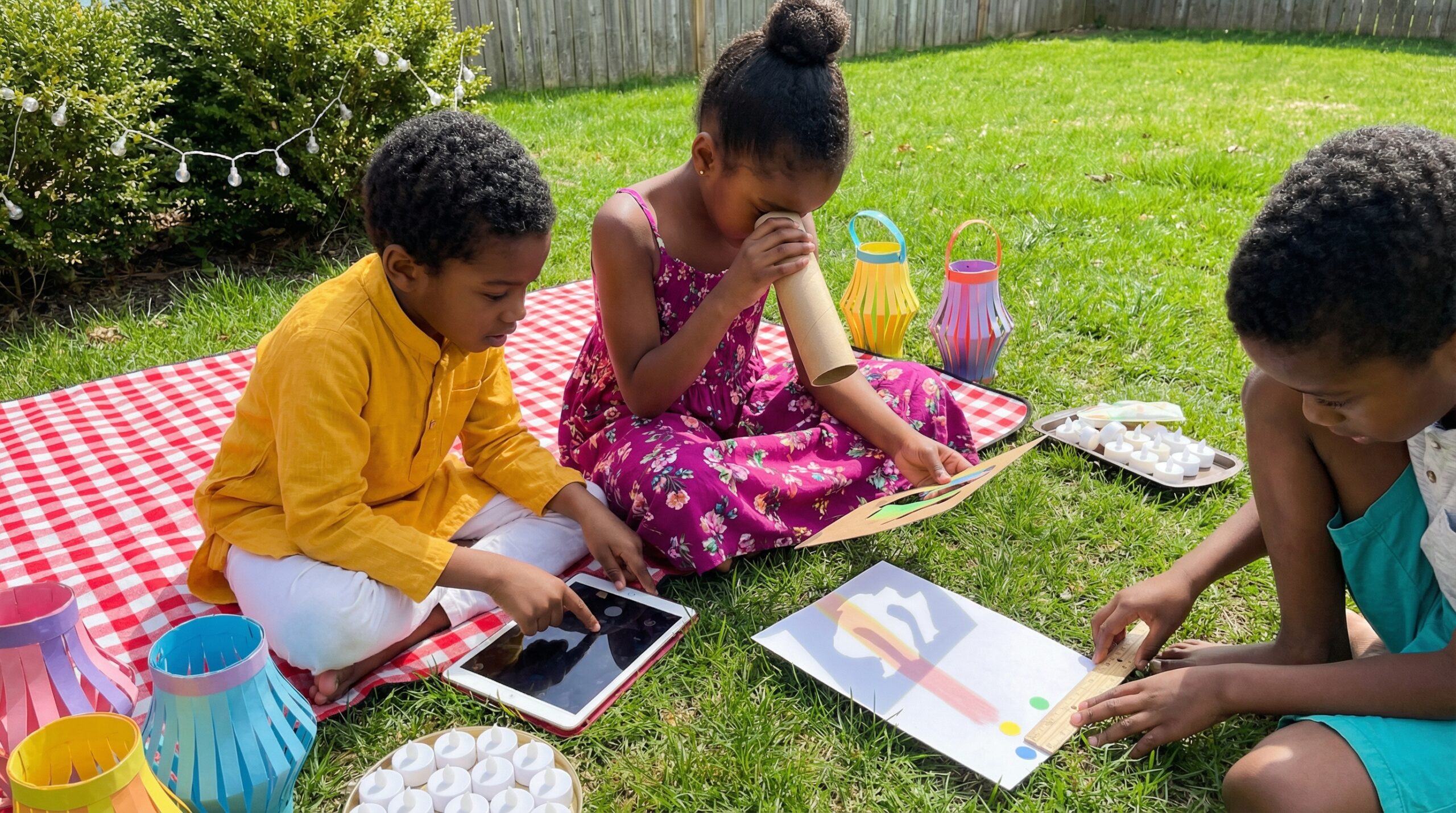
A sunny, playful light and shadows activity can turn a backyard into a tiny science lab. First, grab chalk and a timer. Then invite a child to watch, trace, and wonder.
Light and Shadows Activity: Backyard Hunt
This simple activity runs in ten minutes. Set a start line, place a toy or a person, and trace the shadow. Every two minutes, trace again and note length and direction. Ask: did the shadow grow or shrink? This quick ritual boosts observation and makes patterns pop.
What is light and how shadows form
Light is the part of the electromagnetic spectrum our eyes can see. Visible light runs roughly from 380 to 740 nanometers. Light travels very fast; in a vacuum, it moves about 299,792,458 meters per second, a defined value used to define the metre. When light travels in straight lines and meets an opaque object, the object blocks rays. As a result, a shadow appears behind it.
How shadows work
A shadow shows regions of less light. The darkest part is the umbra where light is fully blocked. Next is the penumbra, a softer edge where some rays still reach you. Under special geometry, an antumbra can appear in eclipses. A small or distant light source makes sharp shadows. A large or close source makes fuzzy edges. Outdoors, sky light and reflections often fill shadows with color. For example, shadows often pick up a soft blue tint from the sky. Interestingly, during the upcoming total solar eclipse on April 8, 2024, the Moon’s umbral path of totality across North America will range about 108–122 miles wide, allowing for a unique opportunity to observe shadows created by celestial bodies.
Try a 10-minute backyard shadow hunt
Gather three simple items. You only need chalk or tape, paper and crayons, and a stopwatch or phone timer. Then follow these steps.
- Pick a small outdoor area and draw a start line.
- Set a 10-minute timer and place a toy or person at the line.
- Trace the shadow on the ground. Mark the time with each trace.
- Every two minutes trace again. Note the shadow length and direction.
- Try colored cellophane over a flashlight to make tinted shadows.
- Find a fuzzy shadow and a sharp shadow. Compare edges and explain why.
Safety first. Never look directly at the Sun. Instead, use pinhole projections or a shaded projection box for safe solar experiments. Additionally, it’s important to consider that light pollution has risen rapidly, with a 2023 study highlighting a ~10% per-year increase in sky-background brightness from 2011 to 2022. This underscores the impact of artificial light on our environment, relevant for discussions about light and shadows.
Quick indoor demos
You can also explore light and shadows indoors. First, use one small flashlight for crisp silhouettes. Next, use a desk lamp for fuzzy edges. Then hold two flashlights to make double shadows. These tiny demos show how source size and angle change shadow shape.
Short history and playful sparks
People used camera obscura to watch upside down images long before tiny cameras existed. Ibn al Haytham studied vision and ran early experiments. Later, lenses and photography leaned on the same ideas of light and shade. Today sensors in phones turn light into pixels, and films simulate shadows with techniques like ray tracing. Along the way, shadows helped shape cameras, movies, and modern imaging.
Also, turn traces into art by shading around them. Measure the ratio of shadow length to object height for a quick math twist. Tell the story of inventors like Ibn al Haytham for a gentle history moment. These cross-curricular sparks keep curiosity alive.
Find more playful prompts on Storypie. Read or listen to a story about Light and Shadows now: Read or listen to a story about Light and Shadows now: For 3-5 year olds, For 6-8 year olds, For 8-10 year olds, and For 10-12 year olds.
Try this tonight. Set the timer and make a game of measuring. Let curiosity lead and enjoy the delight of discovery. Also, visit Storypie to explore related stories and gentle prompts.
Glossary
- Light – visible electromagnetic radiation.
- Shadow – region with less light.
- Umbra – full shadow.
- Penumbra – partial shadow.
- Wavelength – distance that sets color.
- Reflection – bounce of light.