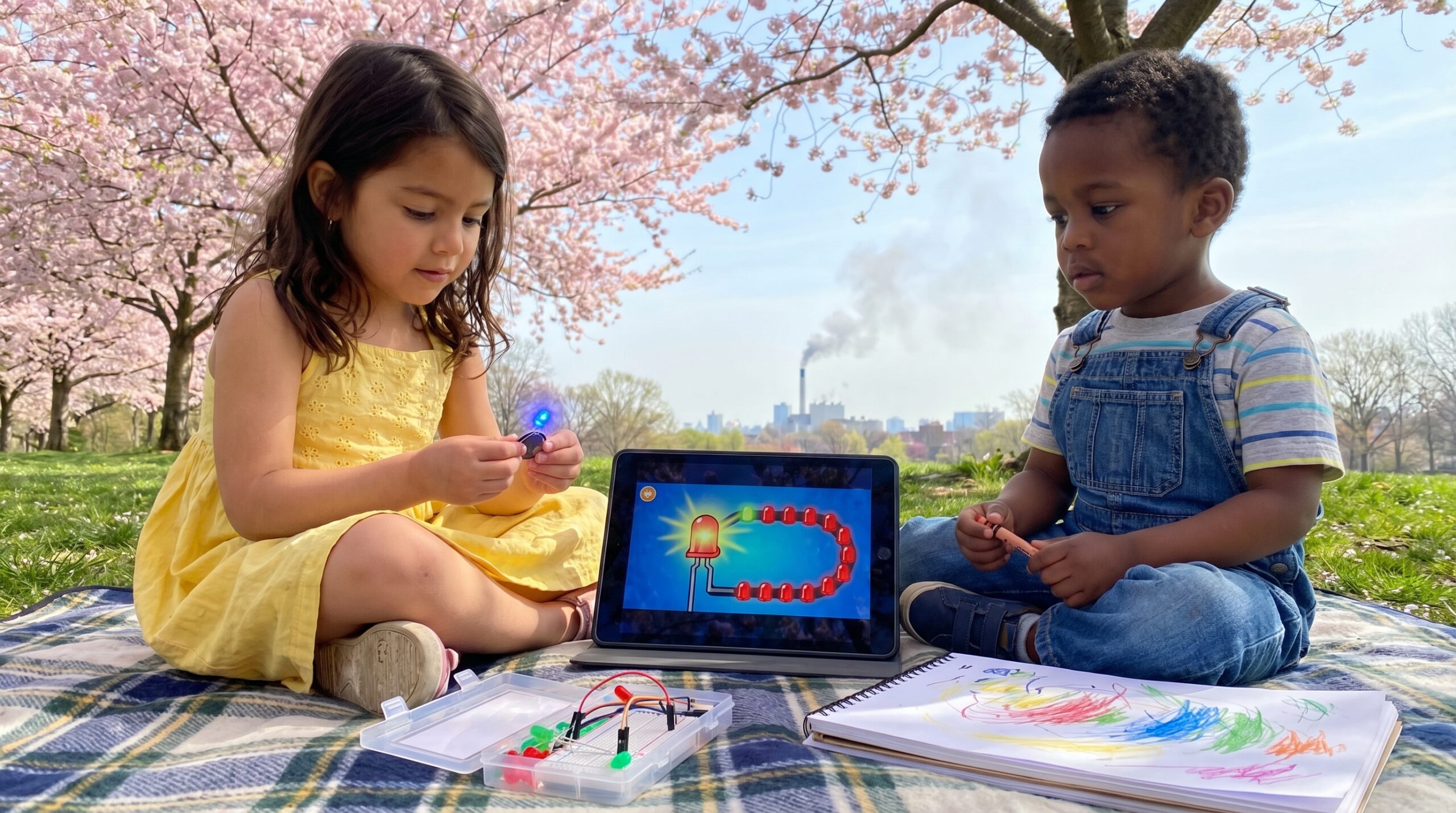
Light Emitting Diode (LED) is a tiny piece of technology that makes light when electricity flows. It sounds like a small miracle, and it behaves like one too. For parents and teachers, the Light Emitting Diode sparks curiosity in kids of all ages.
Read or listen to a story about Light Emitting Diode now: For 3-5 year olds, For 6-8 year olds, For 8-10 year olds, and For 10-12 year olds.
What a Light Emitting Diode (LED) is
An LED is a small electronic light. Inside it sits a p-n junction made from semiconductor materials. When current pushes electrons and holes together, they recombine and release photons. This glow is called electroluminescence. Different materials make different colors.
Why LEDs make color
Color depends on the material band gap. Some LEDs produce red or green directly. For a long time blue was hard to make. However, scientists solved it with gallium nitride. That blue breakthrough let us make white light easily. For instance, white can come from mixing red, green, and blue. Or, a blue LED can shine into a phosphor. The phosphor then makes yellow light. Together, they look white to our eyes.
Quick history kids will like
People noticed light from electricity long ago. In 1962 we saw the first visible red LED. Infrared LEDs came about a year earlier. Finally, in the early 1990s, the blue LED problem fell. The discovery earned the 2014 Nobel Prize. I like telling that story at bedtime. It feels like a tiny hero tale.
Everyday places you see LEDs
You find LEDs in many places. For example, indicator lights, phone screens, TVs, traffic signals, holiday strings, and car lights all use LEDs. They also power bright grow lamps for plants. LEDs use much less energy than old incandescent bulbs, using at least 75% less energy and lasting up to 25 times longer, as noted by the U.S. Department of Energy. This efficiency is crucial, with potential U.S. energy savings from LED lighting estimated to top 569 terawatt-hours (TWh) annually by 2035. So they save energy and trips to the store.
Easy things to notice with kids
Look at brightness and color temperature. Warm white sits near 2700K. Daylight begins around 5000K and higher. Also check CRI to see how true colors look under a lamp. Try comparing a small flashlight LED and a kitchen lamp. Ask which one makes a toy look more like real life. Those small observations spark big conversations.
A safe, tiny experiment
With careful supervision, a coin cell and a low current LED make a simple demo. Teach that the longer leg is the anode. Never plug LEDs into mains. Keep it safe and short. Kids love watching electronics light up.
Why this small thing matters
I think tiny sparks lead to big curiosity. A Light Emitting Diode can start a child’s interest in how things work. So ask your child which color they would invent to spark wonder. Then explore the idea together on Storypie. For more ideas and stories, visit the Storypie learning page for this invention: Read or listen to a story about Light Emitting Diode now. You will find short, kid-friendly versions and playful reads for every age group.
Finally, I will share more cool bits soon. I love this stuff and think you will too. The global LED market is projected to grow from $85.46 billion in 2024 to $93.3 billion in 2025, reflecting a compound annual growth rate (CAGR) of 9.2%, highlighting the increasing importance of LEDs in our daily lives and environments, according to The Business Research Company.