
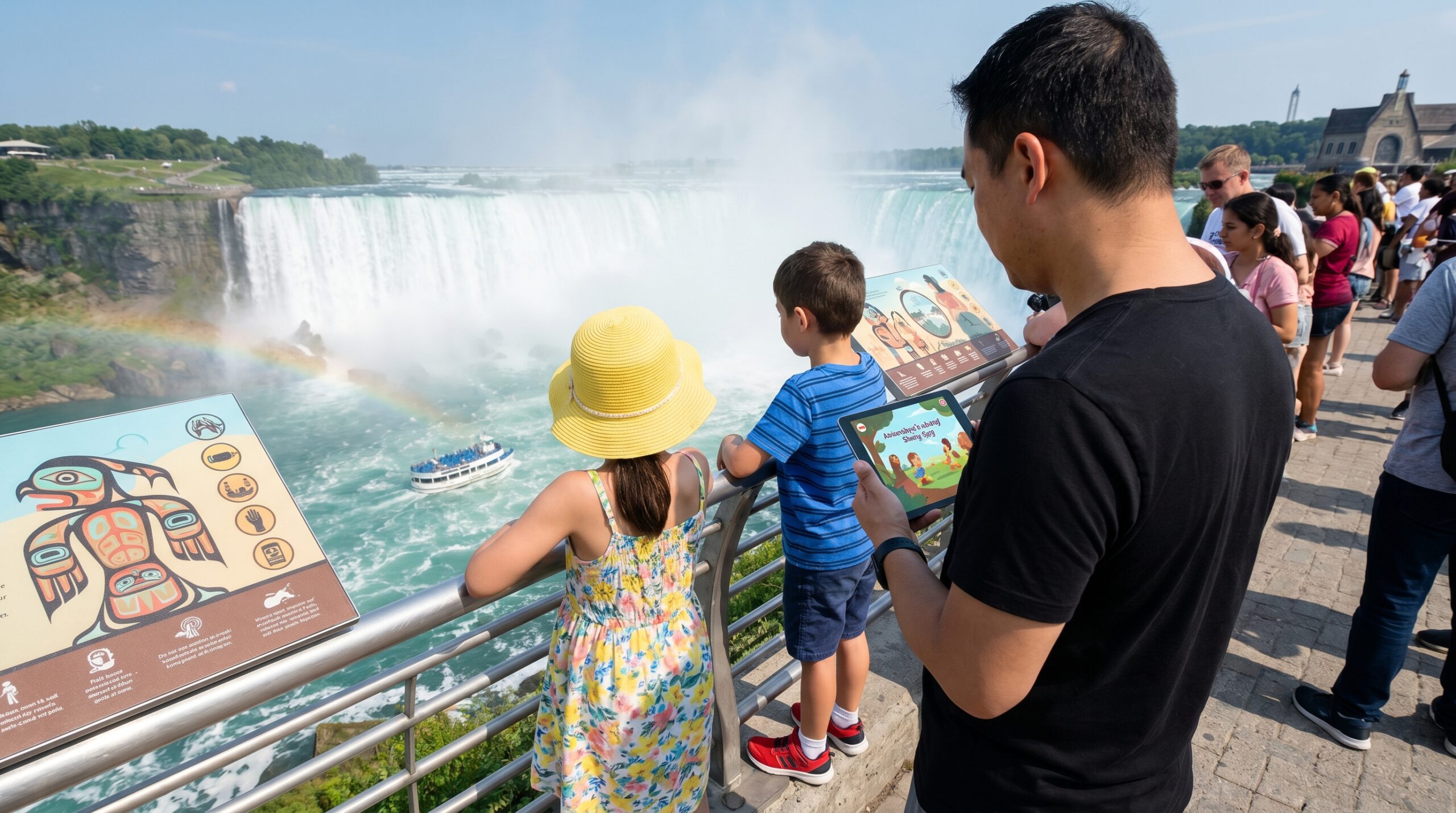
Niagara Falls family guide begins with thunder and mist. Imagine spray glowing in sunlight and rainbows arching over a roar you feel in your chest. The falls feel glacier-born, loud, and impossibly persistent. Today they hold stories, engineering, and natural wonder. In fact, Niagara Falls is approximately 12,000 years old, formed after the retreat of the Wisconsin Glacier.
How the falls were made
Glaciers melted and left huge meltwater flows. Rivers carved a path from Lake Erie to Lake Ontario. Hard cap rock sat above softer shale. Then water undercut the soft layer and the cap rock collapsed. Over time the falls moved upstream and the Niagara Gorge formed. For kids, try this simple line: glacier, river, hard rock over soft rock, undercut, collapse, gorge.
Why the falls feel so big
Start with volume. Approximately 3,160 tons of water flow over Niagara Falls every second. This enormous flow creates mist, pushes air, and slowly wears away rock. The largest Horseshoe Falls measures roughly 57 meters (188 feet) high and 790 meters (2,590 feet) wide. The American Falls and Bridal Veil are smaller. Also, human flow controls and rock work have slowed erosion. The 1950 “Diversion of the Niagara River” treaty requires a minimum flow over Niagara Falls of 2,832 cubic metres per second (100,000 cubic feet per second) during daytime tourist hours. However, the gorge still tells a long story of movement.
A respectful note on place and people
The Niagara region has been home to Haudenosaunee nations for thousands of years. Place names and stories carry deep meaning. If you visit, look for Indigenous programming, museum exhibits, or signage that shares local voices and history. Respect is the simplest way to learn.
Top 5 things for families at Niagara Falls
- Boat tour to the base of the falls, poncho provided.
- Lookouts and towers for sweeping views.
- Journey Behind the Falls for a different angle.
- Walk Niagara Falls State Park and short gorge trails.
- Evening lights and seasonal fireworks for small eyes.
Short timeline
Long ago: Indigenous peoples live here. About 12,000 years ago: glaciers shape the land. By the 1800s: tourists and daredevils arrive. Late 1800s to 1900s: hydroelectric power begins. Today: parks, power stations, and conservation shape the area.
Wildlife, conservation and clean power
The river supports fish and many birds. Conservation work focuses on water quality and shoreline protection. Also, the falls feed major hydroelectric stations on both sides of the border. These stations supply clean electricity to the region. For families, these facts show how nature and human systems connect. Niagara Falls attracts about 30 million visitors annually, highlighting its role as a popular destination.
Family activities to spark curiosity
- Spot all three falls from different viewpoints.
- Count rainbows in the spray.
- Listen to the roar and imagine water traveling from Lake Erie to Lake Ontario.
- Read or listen to a story about Niagara Falls now: Read or listen to a story about Niagara Falls now: For 3-5 year olds, For 6-8 year olds, For 8-10 year olds, and For 10-12 year olds.
Safety and good sense
Stunts are illegal and very dangerous. Stay on marked paths and supervise children. Wear waterproof layers and sturdy shoes. Also, respect wildlife and park rules. Simple choices keep visits joyful and safe.
Practical planning
Bring waterproof jackets and sturdy shoes. Some viewpoints are stroller and wheelchair friendly. However, steep trails may be challenging. Check park accessibility guides for specifics before you go.
Niagara Falls teaches geology, history, and wonder. Bring curiosity and a camera. Then make small discoveries together each time you visit.
For more family-friendly stories and local learning, visit Storypie.