Pablo Picasso for kids: quick intro
Pablo Picasso for kids is a friendly way to meet one of the most adventurous artists. He was born in Málaga, Spain on 25 October 1881. Later he lived much of his life in Barcelona and Paris. He trained early with his father, who taught art. As a result, drawing came fast and natural to him.
Life, places, and a playful studio
Picasso moved often and changed his work many times. First he painted the Blue Period around 1901 to 1904. Those paintings feel quiet and blue. Next came the warm Rose Period with pink tones and circus people. Then he looked at African masks and Iberian sculpture. That study led to Les Demoiselles d’Avignon, a turning point in his work.
What came after
After that, Picasso and Georges Braque created Cubism. In analytic Cubism they broke objects into facets. Then in synthetic Cubism they rebuilt images and added collage. In 1937 Picasso painted Guernica, a large black and white mural about a bombing. The Old Guitarist remains a famous Blue Period work.
Works, materials, and museums
Picasso worked in painting, drawing, printmaking, sculpture, ceramics, collage, and stage design. He mixed odd materials and tried new tools. As a result, he made thousands of pieces. Major collections include Musée Picasso in Paris, Museu Picasso in Barcelona, Museo Picasso Málaga, and Museo Reina Sofía in Madrid where Guernica resides. In fact, in 2023, the Museo Picasso Málaga attracted a record 779,279 visitors, surpassing its previous high by nearly 60,000 attendees, highlighting the ongoing popularity of Picasso’s work.
How to show Picasso to children
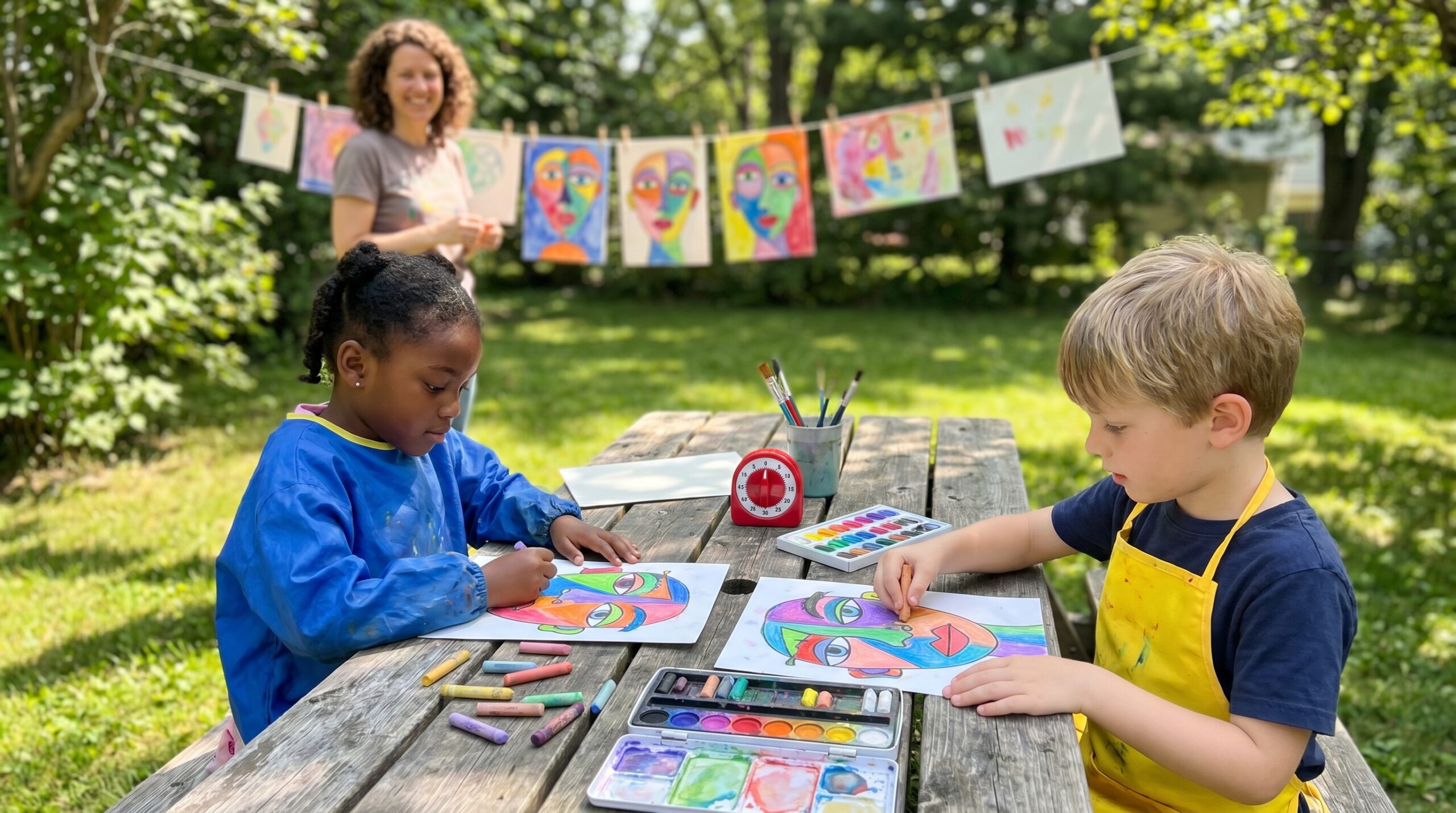
Keep visits short and hands on. Try ten minute sketch sessions. For example, pick a toy and draw it twice, front and side. Then glue the views together into one picture. That small exercise makes a tiny Cubist experiment.
Simple vocabulary to use
- Cubism means many viewpoints.
- Collage means bits glued together.
- Period means a phase in an artist’s life.
- Medium means the material an artist uses.
Age notes and honest talking points
Picasso’s art is brilliant and sometimes strange in the best way. However, he was a complicated person with criticized relationships. For little kids, focus on color, shape, and play. For older kids, ask how we separate art from the artist and whether fame excuses bad behavior.
Quick activities to try tonight
- Ten minute sketch: draw, name, and tell one sentence about it.
- Tiny cubist collage: combine front and side views.
- Clay pinch pot: make a tiny cup and decorate boldly.
Read or listen to a story about Pablo Picasso now: Read or listen to a story about Pablo Picasso now: For 3-5 year olds, For 6-8 year olds, For 8-10 year olds, and For 10-12 year olds.
Visit tips and a gentle finale
If you visit a museum, point out color and shapes in real paintings. For older kids, ask why Picasso showed many angles at once. In addition, the “Celebración Picasso 1973-2023” program, which commemorates the 50th anniversary of Picasso’s death, concluded in April 2024 with over 6 million visitors across 46 exhibitions worldwide, underscoring the global impact of Picasso’s legacy. Finally, end by asking your child to title their drawing. Celebrate the odd, the brave, and the playful.
Also explore more stories and activities on Storypie to save favorites for later. Enjoy a short sketch tonight and make a playful memory with your child.