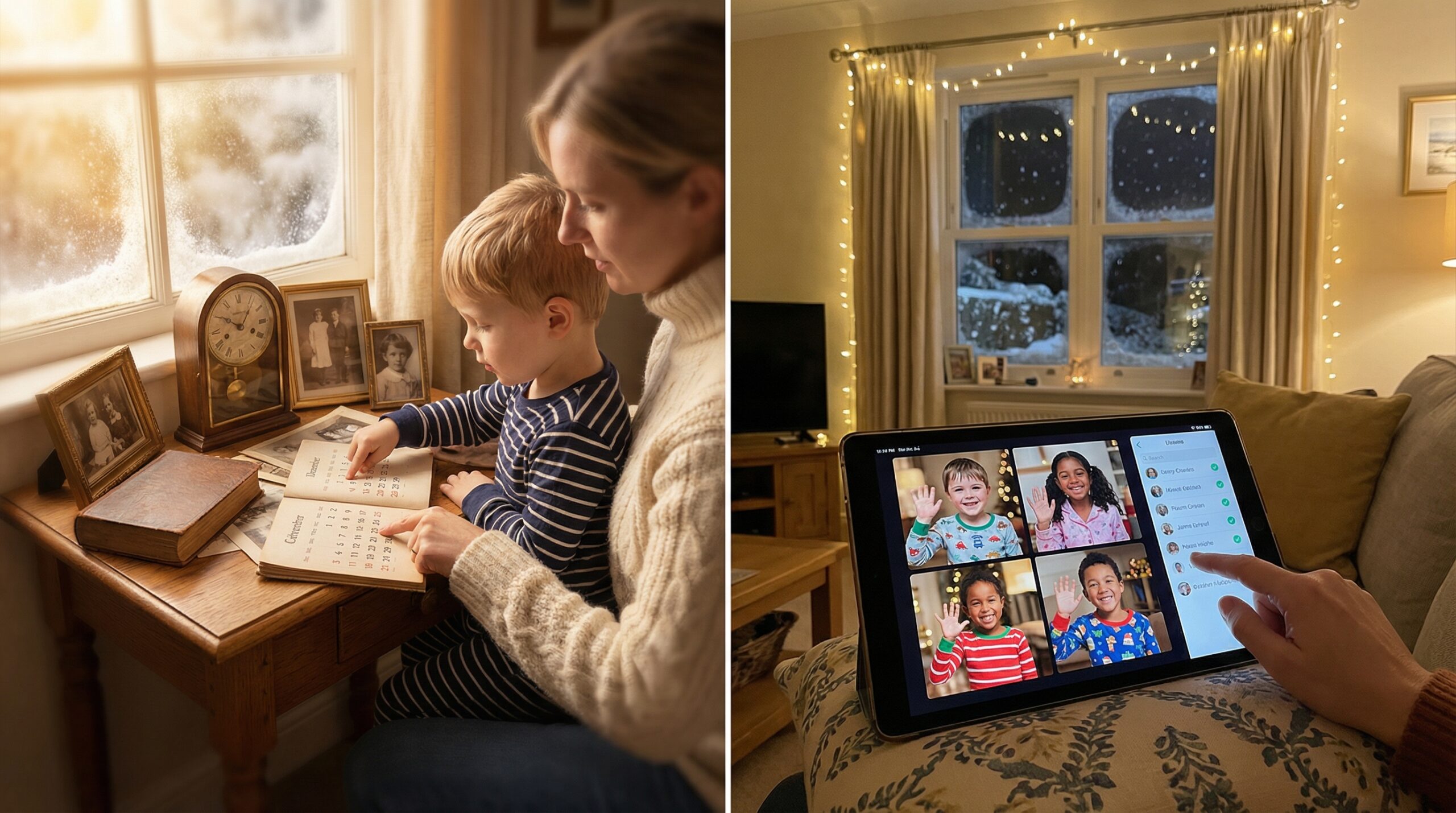
A winter morning can teach a little history. Frost rims the window and a kettle hisses. A child points to the calendar and beams. That tiny moment links now and memory. This is past and present for children in miniature.
What past and present for children means
The phrase describes how children hold memory and the present at once. The past is personal memory and shared stories. The present is what a child senses, feels, and does right now. Moreover, calendars and clocks help those two worlds talk to one another.
Historically, societies used seasons and festivals to mark time. For example, farmers tracked solstices and harvests. Also, calendar reforms, from the Julian to the Gregorian system, made dates more predictable. In addition, inventors like Christiaan Huygens improved clocks with the pendulum in the 1650s. As a result, daily life, school, and travel became more scheduled. This kind of progress reflects broader changes in society; for instance, in 1900, approximately 31% of boys and 23% of girls of primary school age were enrolled in primary education worldwide, while by 2023, these rates had increased to 91% for boys and 89% for girls, showcasing the dramatic progress in global education access for children according to Our World in Data.
How family stories and memory connect
Family stories shape identity and language. Autobiographical memory begins in toddlerhood and grows richer with retelling. Researchers find that when adults talk about past events, children build sequence and vocabulary. Also, sleep helps lock these memories into place. Therefore small acts of remembering have lasting effects. However, memory is constructive and changes with each retelling. Accuracy is not the only value. Instead, the bond created by shared remembrance matters most. In other words, remembering together builds belonging and emotional understanding.
Reflecting on the past is crucial, especially when considering the historical context of childhood. For instance, between 1950 and 2024, nearly 1 billion children died globally, illustrating the challenges faced in the past compared to current improvements in child health and survival. In 1950, approximately 20 million children under the age of five died globally, with a child mortality rate of 23%. By 2024, this number had declined to about 5 million deaths, corresponding to a child mortality rate of 3.6% as reported by Our World in Data.
Age-related characteristics of past and present
Toddlers rely on sensory cues and single moments. Preschoolers begin to name who, what, and where. School-age children notice cause, sequence, and change. For example, explaining that calendars once changed helps older children see how societies adapt. Thus the concept of past and present for children shifts with development.
Tools, marks, and everyday signs
Families often use photos, jars of notes, or calendars to mark time. Those items become anchors between then and now. Also, little rituals tied to the calendar help children compare seasons and years. Over time, these small signs form a living map of a child’s life.
Storypie supports this kind of memory-making. Read or listen to a story about Past and present now: For 3-5 year olds, For 6-8 year olds, For 8-10 year olds, and For 10-12 year olds.
Final thought
The relationship between past and present for children is quiet but powerful. Small, repeatable moments add up into identity and memory. If you want a gentle tool to gather family stories, see Storypie. It offers a warm place to collect and play back memories with children. As we recognize the shifts in societal norms and health awareness, such as the decline in smoking rates from approximately 51% of men and 41% of women in Great Britain in 1974 to about 12% for men and 10% for women in 2023 according to Our World in Data, we can better appreciate how the past shapes our present and future.