
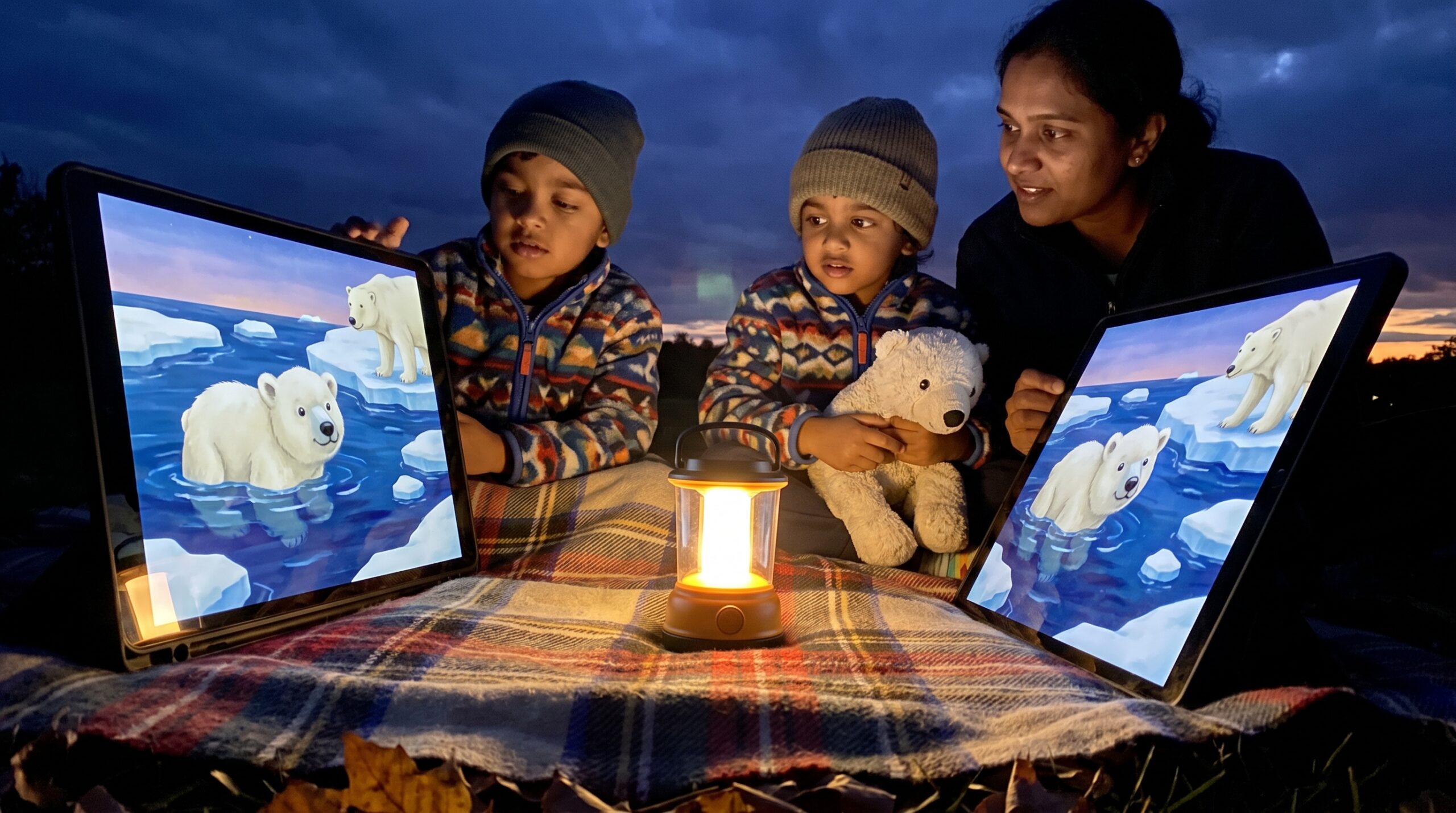
At Storypie this early fall evening we share Nanuk and simple polar bear facts for kids. Meet an Arctic swimmer with warm blubber, big paws, and a mama who taught him to hunt. What a marvel and a cozy companion for storytime.
Where polar bears live and why sea ice matters
Polar bears live around the Arctic Ocean and nearby seas and coasts. Countries include Canada, Greenland, Norway, Russia, and Alaska. Sea ice is their platform for travel, rest, and hunting. Since 1979, Arctic sea ice extent at the September minimum has declined by 13.4 percent per decade relative to the 1981–2010 average, highlighting the alarming rate of sea ice loss that is critical for polar bear habitat.
Right now the sea ice is melting. Because of that, food is growing scarce for bears like Nanuk. Fewer ice platforms mean fewer chances to catch seals. That makes every floe precious.
How polar bears are built for cold and swimming
Polar bears are amazing animals. Their scientific name is Ursus maritimus, which means bear of the sea. They wear thick blubber for warmth. Their hollow fur looks white but helps hide them on ice.
Under the fur their skin is black to soak up sun warmth. Their huge, slightly webbed paws act like paddles. They also spread weight on thin ice. Polar bears can swim for many hours and travel long distances. In Alaska, the largest male polar bears can exceed 1,700 lbs, with an average male weight of 600–1,200 lbs and female weight of 400–700 lbs, making them truly impressive creatures.
Polar Bear Facts for Kids: Hunting and diet
Polar bears mainly hunt seals. For example, they wait at breathing holes or sneak up on seal pups. Their sense of smell is superb. They can detect seals from very far away.
Seals give the high fat meals polar bears need. When seals are scarce, bears scavenge whale carcasses, take eggs, or find birds. Sometimes they investigate human food. Energy matters a lot to these gentle giants.
Family life and growing up
Mothers give birth in snow dens during winter. Cubs are tiny and blind at birth and weigh under one kilogram. A mama teaches her cubs to hunt and survive for about two to three years.
Cubs learn from patient lessons. Polar bears are mostly solitary except when mothers care for cubs.
Threats and simple actions families can take
Polar bears are listed as Vulnerable and many populations are declining. The U.S. Fish and Wildlife Service listed the polar bear as a threatened species in 2008 due to the loss of its sea ice habitat, underscoring the importance of conservation efforts. The main threat is climate change and loss of sea ice. That forces bears into longer swims and makes hunting harder.
Pollution, shipping, and oil development also pose risks. Thankfully, small family actions can help build lasting habits.
Try one small family eco-action this week
- Turn off lights when you leave a room.
- Choose one meat-free dinner night.
- Reuse a bag or say no to single-use plastic.
- Read a short book about the Arctic together.
Safety, learning, and stories
If you ever visit the Arctic, travel with guides, store food securely, and keep a safe distance from wildlife. For families who want more, explore picture books and simple crafts.
Read or listen to a story about Polar Bear now: For 3-5 year olds, For 3-5 year olds, For 6-8 year olds, For 8-10 year olds, and For 10-12 year olds.
Also, get the Storypie app to meet Nanuk in a gentle, true-life adventure. Visit Get the Storypie app for family-friendly listening and reading.
Final thought
Polar bears are both mighty and vulnerable. With playful stories and one small action each week we can teach children to care. Tiny choices add up, and that is amazing. The Southern Beaufort Sea subpopulation of polar bears is estimated to number around 900 individuals, highlighting the need for conservation efforts. Share Nanuk’s tale, ask a question, and watch curiosity grow.