Discover the Dorothy Vaughan biography for kids in this short, friendly read. Dorothy Vaughan used math to help planes fly. Then she taught others when machine computers arrived. Her story is brave, steady, and quietly brilliant.
Dorothy Vaughan biography for kids: Early life and school
Dorothy Johnson Vaughan was born on September 20, 1910, in Kansas City, Missouri. She loved numbers from a young age. After school, she earned a mathematics degree at Wilberforce University. Then she taught math for many years. Later, she guided Black students with calm care and high expectations.
Joining Langley and NACA
In December 1943, she moved to Langley Field. There she joined the National Advisory Committee for Aeronautics, known as NACA. Her job title said human computer. That meant she used pencils, paper, and slide rules to do precise calculations. Her work helped engineers build safer and faster planes.
Work at Langley and leadership
At Langley she worked with the West Area Computers. This was a segregated group of Black women mathematicians. Still, their work was exact and vital. They processed wind tunnel numbers, flight test data, and performance charts. Every number mattered.
Then in 1949, Dorothy Vaughan became the head of the segregated West Area Computing Unit, becoming NACA’s first African American supervisor, a position she held until 1958. Her promotion gave leadership and visibility to women who had been overlooked. She led with patience and strength.
From human computer to programmer
In 1958 NACA became NASA. Soon after, large electronic computers arrived. Dorothy Vaughan learned how these machines worked. She also learned programming and the language FORTRAN. Next, she taught her colleagues to use IBM mainframes. Therefore, she turned a threat into an opportunity. Her willingness to learn kept her team central to important research.
Why her work matters
Dorothy Vaughan spent nearly three decades at Langley, working until 1971. Her life spans classrooms, wartime labs, and the dawn of modern computing. For parents and teachers, her story shows persistence, curiosity, and generosity. Importantly, she mentored other Black women so they could follow her path.
Simple experiments that echo her work
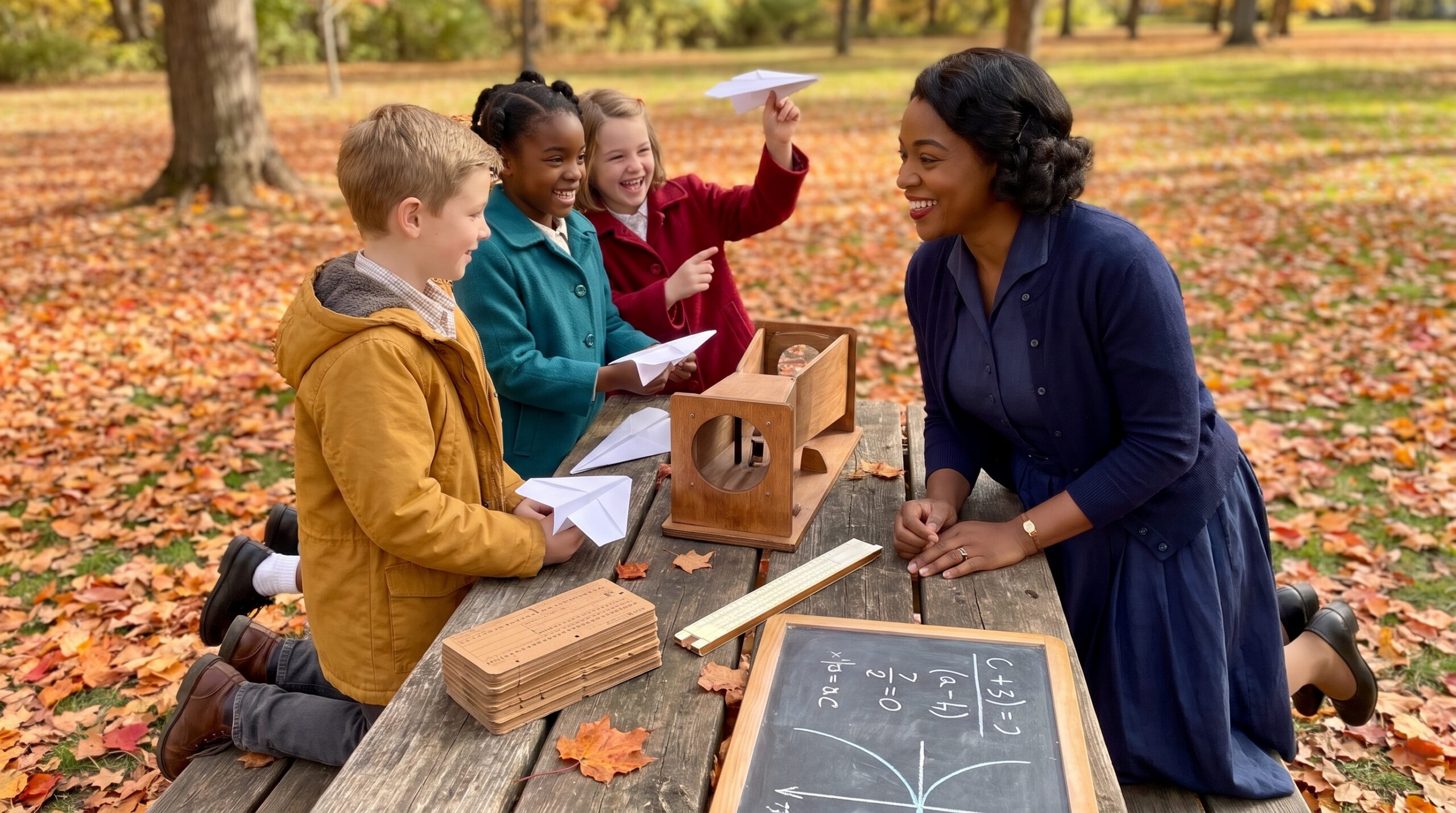
Try a tiny experiment for kids. First, time a paper airplane flight three times. Then record the times and take the average. Finally, talk about why repeating and measuring helps us learn. This small loop is playful and scientific. It echoes the careful calculations Dorothy Vaughan made every day.
Her life reached more families through the book Hidden Figures and the 2016 film, where Octavia Spencer portrays her. Today she stands as a clear role model for kids who love math or who learn to adapt to new tools.
Additionally, on July 19, 2024, NASA’s Johnson Space Center officially renamed Building 12 the ‘Dorothy Vaughan Center in Honor of the Women of Apollo,’ highlighting her legacy and contributions.
Read or listen to a story about Dorothy Vaughan now: For 3-5 year olds, For 3-5 year olds, For 6-8 year olds, For 8-10 year olds, and For 10-12 year olds.
Also, visit Storypie for more biographies and gentle listening options. Share her story with a child today. It may spark a lifelong love of learning.