
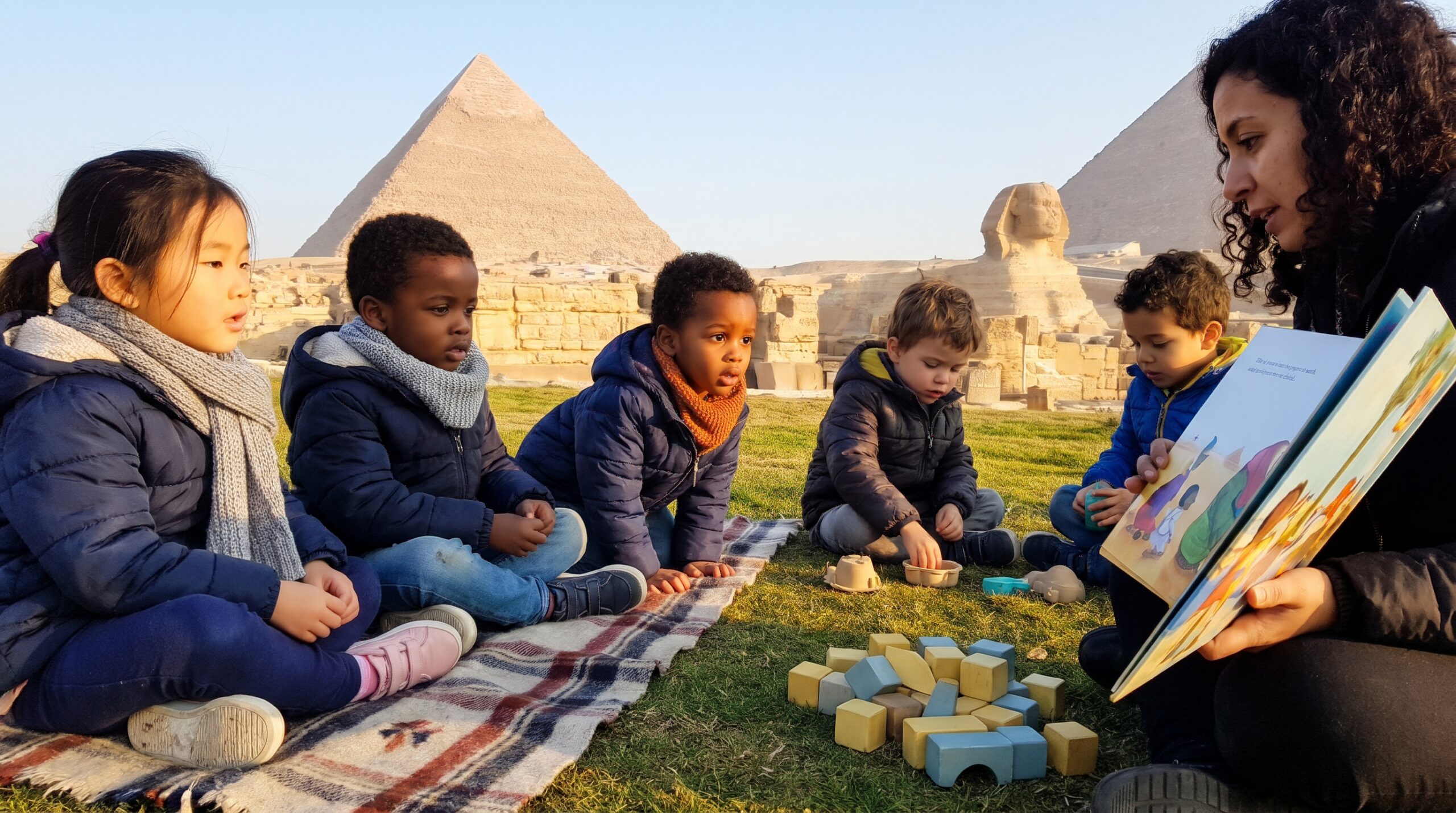
Pyramids of Giza for kids feel like a giant storybook on the Giza Plateau. First, three main pyramids rise near Cairo. They spark wonder and many questions.
Pyramids, Pharaohs, and the Sphinx
The three big pyramids date to Egypt’s Fourth Dynasty, about 4,500 years ago. The largest belongs to Pharaoh Khufu. The middle one belongs to Khafre. The smallest is Menkaure’s. Nearby, the Great Sphinx watches across the sand. These structures served as royal tombs to help a pharaoh in the afterlife.
How the Pyramids of Giza were built
The Great Pyramid originally rose to about 146.6 meters over a base of about 230 meters per side, and it is composed of approximately 2.3 million stone blocks. Today it stands around 138.8 meters high, having lost about 10 meters (33 feet) in height since its original construction during Egypt’s Old Kingdom. Archaeologists estimate that many blocks weigh one to two tons. Inside are the King’s Chamber, the Queen’s Chamber, and the Grand Gallery. There is even an unfinished subterranean chamber.
Builders used limestone for most of the pyramids. They used granite for key inner chambers. The outer casing once gleamed with polished Tura limestone. Modern studies show skilled craftsmen and organized labor lived nearby. Excavated bakeries, tools, and graves support this view. Exactly how ramps and lifting methods worked remains debated. That mystery keeps the story lively. Interestingly, a 2026 study found that the Great Pyramid has withstood earthquakes for nearly 4,600 years due to a mismatch between the pyramid’s natural vibration frequency and that of the surrounding soil, as well as its robust shape and internal chamber design, emphasizing the engineering prowess of ancient Egyptians.
Fast facts and little wonders
- The Great Pyramid was the tallest man-made structure for nearly 3,800 years.
- The Sphinx is carved from bedrock and stretches about 73 meters long.
- The pyramid sides align very closely to true north with amazing precision.
Conservation and visiting the site
Giza is a UNESCO World Heritage site and needs careful care. Pollution, visitor wear, and groundwater cause challenges. If you plan a visit, check official visitor rules and ticketing. Access to interior spaces changes often.
Hands-on activities to spark curiosity
Try simple activities at home or in class. They build vocabulary, sequencing, and imagination.
- Build a small pyramid from blocks or cardboard. Then count how many pieces make a side.
- Measure height with footsteps or stacked books. Compare those measures to the pyramid’s scale.
- Sequence the building story: quarry stone, transport, build, then bury. Ask children to retell the steps in three sentences.
Also, invite children to imagine being ancient architects. Ask them to plan food, tools, and time. It is playful and practical.
Read or listen to a story about Pyramids of Giza now: For 3-5 year olds, For 6-8 year olds, For 8-10 year olds, and For 10-12 year olds.
Storypie invites kids to hear the Great Pyramid’s own tale. Listen together, then ask one question. For example, “What would you build?” This little prompt encourages sharing and imagination.
Final thought
The Pyramids of Giza teach engineering, ritual, and teamwork across time. They feel both tiny and mighty in their lessons. Invite children to listen and imagine. Then let them tell a short pyramid tale. It is a wonderful way to build language and curiosity together.
Learn more on Storypie for gentle, age-ready stories about ancient places.