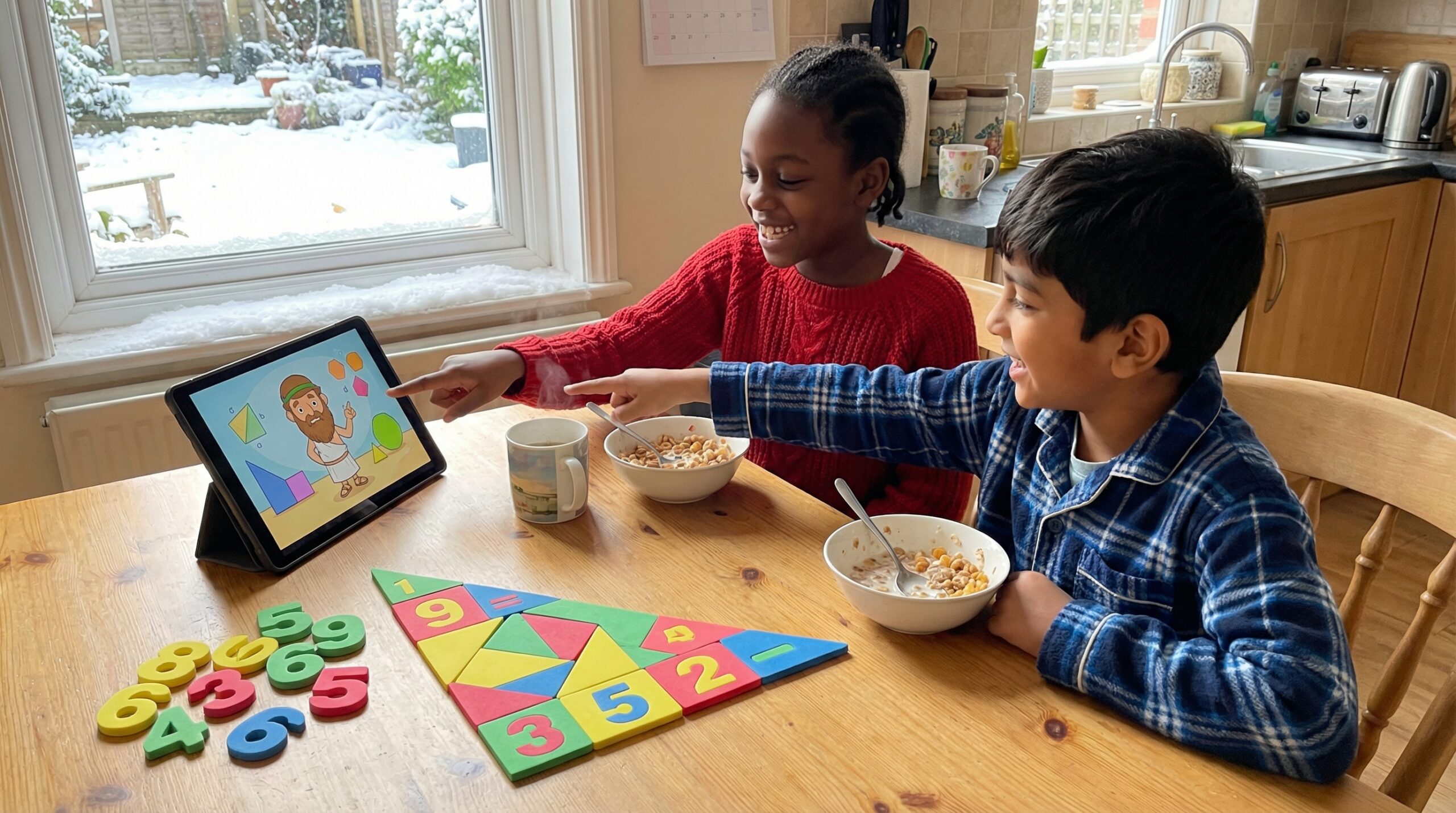
Pythagoras for kids begins with a friendly name and a tiny, brilliant puzzle.
Pythagoras for kids: who he was
Pythagoras lived around 570 to 495 BCE. He was born on the island of Samos, Greece, and died around 500–490 BCE in Metapontum, Italy. He later moved to Croton and founded a close community that mixed numbers, music, and shared rules. Historians treat some stories as legend. Still, his influence on thinkers like Plato and Euclid is clear. According to Encyclopaedia Britannica, Pythagoras’s contributions to mathematics and philosophy have had a lasting impact throughout history.
The theorem made simple
The Pythagorean theorem says that a squared plus b squared equals c squared. In other words, the two small squares on the short sides add to the large square on the diagonal. Interestingly, this theorem, stating that in a right-angled triangle the square of the hypotenuse equals the sum of the squares of the other two sides, was known to Babylonian mathematicians as early as 1900–1600 BCE, over a thousand years before Pythagoras was born. For kids, a hands-on demo makes it pop. For example, build a 3 by 4 right triangle and count five pieces along the diagonal. This shows the famous 3-4-5 triple.
Pythagorean triples and playful examples
Try other triples like 5-12-13 and 8-15-17. Also, fold colored paper squares to show area. Or tune two strings at different lengths to feel simple musical ratios. These tidy examples help children see number patterns and harmony. Notably, evidence suggests that the Pythagorean relation (Pythagorean triples) was known centuries before Pythagoras, including the Babylonian clay tablet ‘Plimpton 322,’ dated to about 1800 BCE, which contains numbers interpreted as Pythagorean triples, as detailed by Columbia Magazine.
Pythagoras for kids: numbers, music and community
Pythagoreans arranged dots into triangular and square shapes. They studied even and odd numbers and simple ratios such as 2 to 1 and 3 to 2. These ratios linked numbers to pleasing musical intervals. Later, one member found that not every length fits a neat ratio. That discovery hints at irrational numbers like the square root of two.
Everyday connections and quick activities
The theorem matters outside history. Builders, surveyors, designers, and programmers use it today. A standard modern compilation lists 370 distinct proofs of the Pythagorean theorem, showcasing the theorem’s significance and the extensive mathematical exploration it has inspired, according to ERIC / U.S. Dept. of Education. Point out a room corner, a ladder leaning on a wall, or pixels on a screen to make the idea useful. Then, test the child’s memory. If they rebuild the triangle without prompting, a joyful aha moment has arrived. Recent developments in 2023–2024 include two students who presented work at an American Mathematical Society meeting, reporting five trigonometric proofs of the Pythagorean theorem, demonstrating ongoing research and interest in this fundamental concept, as noted by Mathematical Association of America.
Read or listen to a story about Pythagoras now: For 3-5 year olds, For 3-5 year olds, For 6-8 year olds, For 8-10 year olds, and For 10-12 year olds.
Pronunciation tip for grown ups: try saying pith a GOR us or pith a GAH rus with wonder. Also, play the Storypie ‘Hello, I am Pythagoras!’ audio to start curiosity at breakfast. Visit Storypie for more biography stories and audio.
The test is simple, playful, and generous. Share the small experiment. Watch a child’s face light up when numbers become a tiny, brilliant puzzle they can touch and name.