
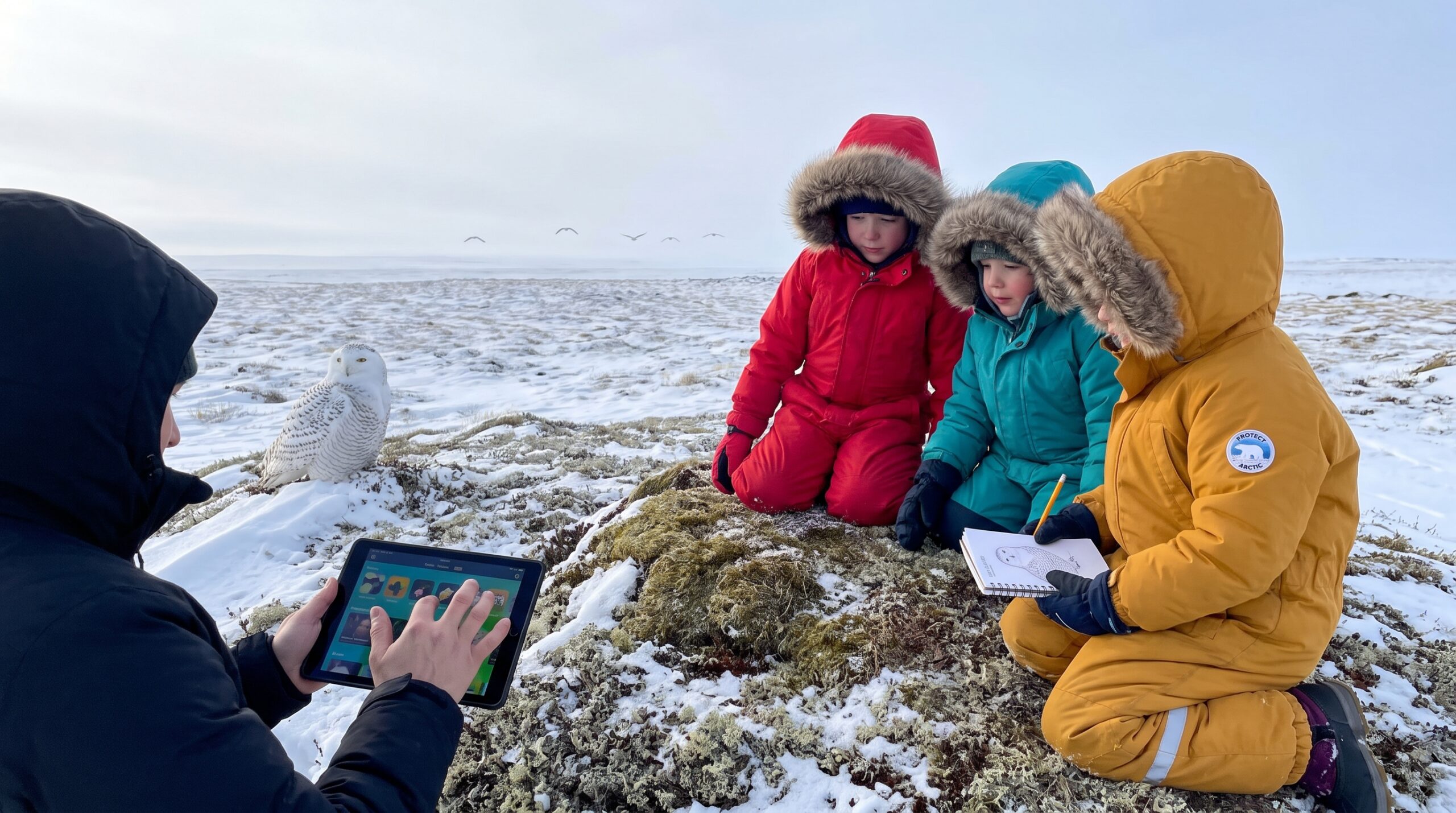
Snowy owl facts for families: quick basics
Snowy owl facts for families start with a clear image. They look bright white like fresh snow, and they have big round eyes. Their scientific name is Bubo scandiacus, and they belong to the typical-owl family Strigidae. Say the name together. It feels like winter and wonder.
Where they live
Snowy owls breed on the Arctic tundra across northern North America, Greenland, northern Europe and Asia. In summer they stay near the tundra, and in winter they roam. Some years they travel south into southern Canada and the northern United States. They do not follow fixed routes. Instead, they wander where food leads. The Canadian population of mature Snowy Owls is estimated at between 13,000 and 16,000 individuals, with about 90–95% of the North American breeding population occurring in Canada, highlighting their significance in this region according to the Government of Canada.
Appearance and staying warm
Adults are mostly white. Males often become almost pure white. Females and young keep more dark bars and spots. They are large birds. Adults measure about 52 to 71 cm long, with a wingspan ranging from 4.2 to 4.8 feet (1.3 to 1.5 meters), which enhances their flight capabilities according to National Geographic. Thick feathers keep them warm. Even their feet are feathered. Adult male Snowy Owls weigh between 700 and 2,500 grams (1.5 to 5.5 pounds), while females weigh between 790 and 2,950 grams (2 to 6.5 pounds) according to the Owl Research Institute. Their vision and hearing are sharp, and their flight is soft and steady so they can sneak up on prey.
What they eat and how they hunt
Lemmings play the leading role in their diet in many places. During the breeding season, lemmings can represent up to 95% of the Snowy Owl’s diet according to the Government of Canada. However, when lemmings are scarce they switch to voles, rabbits, ground squirrels and birds. Snowy owls hunt by day and night, especially during the Arctic summer when daylight lasts all day. They perch on a low rise or fly slowly across open tundra. Then they glide in and pounce quickly.
Breeding and life cycle
Snowy owls nest on the ground, often on a small rise or in a scrape. Clutch sizes change with food. They range from about three eggs to as many as eleven when lemmings are abundant. Eggs incubate for roughly 28 to 35 days. Chicks hatch in white down and both parents feed them. Young owls fledge after a few weeks, but they may stay nearby while parents still bring food.
Irruptions and nomadic winters
Some winters bring dramatic irruptions. Large numbers move far south in surprising waves. Causes include low prey at home or big breeding cohorts that push juveniles outward. In long-term aerial surveys conducted on Alaska’s Arctic Coastal Plain from 2007 to 2024, annual population indices for total Snowy Owls observed ranged up to approximately 3,000–4,000 individuals in peak years according to the US Fish & Wildlife Service. These movements delight birdwatchers and make winters memorable.
Adults versus juveniles
Juveniles wear heavy dark markings. Males lighten with age and can look nearly all white as adults. It is fun to sketch this change with kids. Start darker, then add more white step by step.
Humans, conservation and helping
Snowy owls are listed as Vulnerable by the IUCN. Populations have declined in recent years. Climate change alters tundra and lemming cycles, and that harms these owls. In addition, human disturbance at nests, collisions, poisons and habitat changes add pressure. We can help in small ways. For example, reduce pesticide use and keep cats indoors. Also support Arctic habitat protection when you can.
Watching safely and family actions
Stay back and use binoculars or a spotting scope. Do not call or approach nests. Teach children to observe quietly. If you find an injured bird, contact a licensed wildlife rehabilitator rather than moving the bird yourself.
Try a small family ritual. For example, serve hot cocoa, share a blanket, and read together. Draw the plumage changes. Count lemmings in a picture. Small acts build care and wonder.
This summer on Storypie, a Snowy Owl born on the Arctic tundra in 2012 tells her life story. She shares white feathers for camouflage, daytime lemming hunts, nomadic winters and the 2013-14 irruption. Vulnerable since 2017, she asks us to protect her home. Tip: Listen together tonight to spark kids empathy.
Read or listen to a story about Snowy Owl now: For 3-5 year olds, For 6-8 year olds, For 8-10 year olds, and For 10-12 year olds.
Finally, keep the wonder gentle. Snowy owls belong to a wide wild place. Respect and curiosity are the best gifts you can teach a child. For more family stories visit Storypie.