
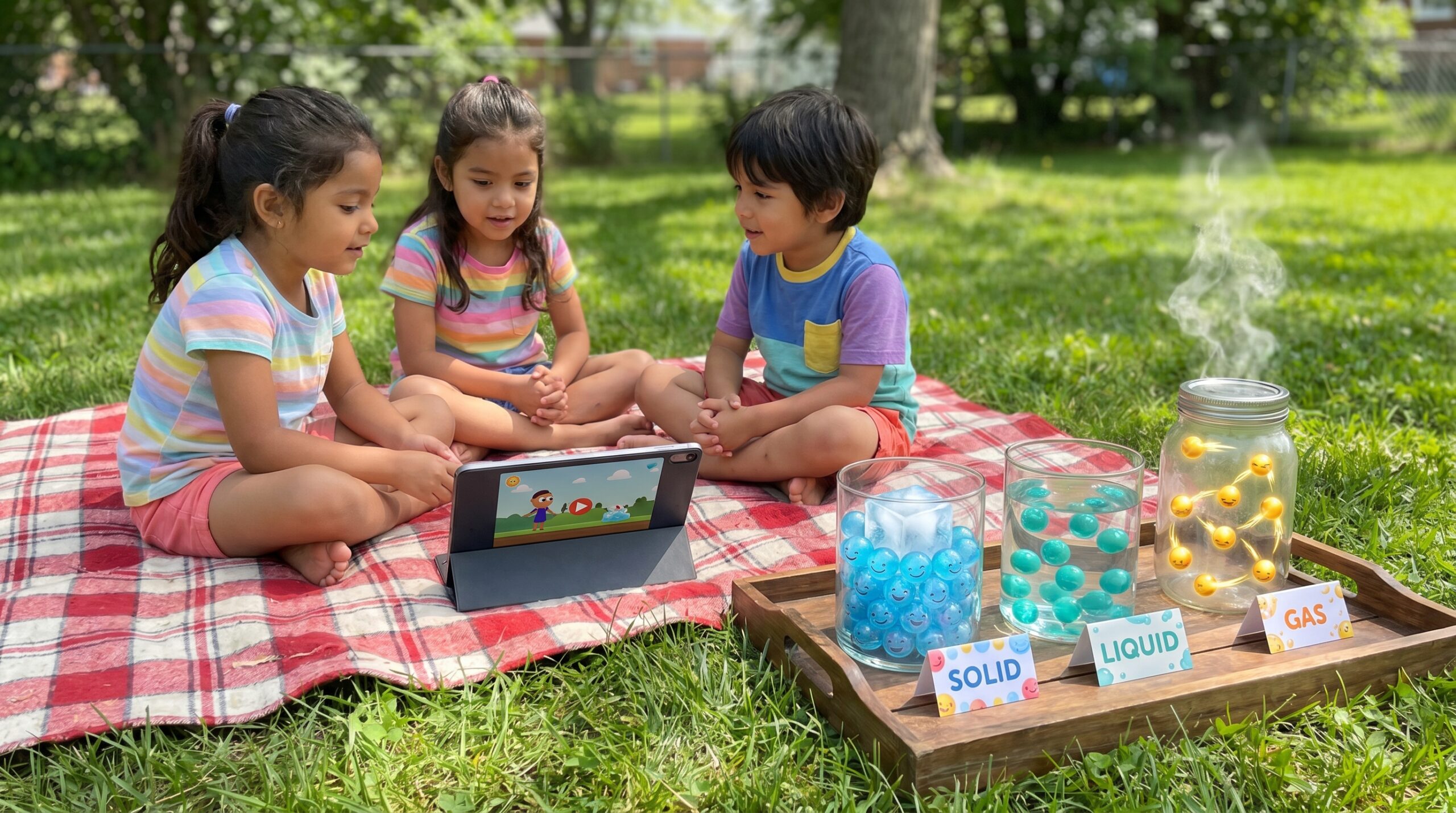
States of Matter for Kids introduces solids, liquids and gases in a short, playful way. It uses touch, sight and tiny demos to spark wonder. Kids can see atoms do a busy dance in a simple ritual.
What solids, liquids and gases look like
Solids hold their shape. For example, ice, a metal spoon, or a wooden block feel firm. They resist squeezing and keep form.
Liquids take the shape of their container. Water, syrup and milk flow. They keep the same volume but not the same shape.
Gases spread out and fill a space. Air in a balloon and kettle vapor move freely. Gases are easy to compress and they float around.
Plasma and other special states
Plasma is an ionized gas that conducts electricity. You see it in lightning, neon signs and stars. In fact, plasma is the dominant observable state of ordinary matter in the universe, making up over 99% of the observable matter, according to NASA. Also, for older kids, scientists study Bose Einstein condensates, superfluids and odd forms like glass. The first laboratory atomic Bose–Einstein condensate (BEC) was created in June 1995 by cooling a rubidium gas to about 1.7 × 10^(−7) K (≈170 nanokelvin) above absolute zero, as noted by Encyclopaedia Britannica.
How particles behave
Temperature measures how fast particles move. Warmth makes them speed up. Cold slows them down. Bonds between particles act like tiny springs.
Strong springs keep solids in place. Looser springs let liquids flow. Very loose springs let gases roam free. This explains why heat changes matter so much.
Phase changes and names to know
Phase changes have simple names. Melting and freezing change solid to liquid and back. Evaporation and condensation switch liquid and gas.
Also know sublimation and deposition. Sublimation turns solid to gas. Deposition makes vapor become frost. Remember that visible steam is tiny liquid droplets. Invisible vapor is different.
Quick demos and a tiny ritual
Try three safe demos with an adult. First, watch an ice cube melt at room temperature. Then, hold a cold glass and spot condensation. Next, mix warm water and ice in a larger bowl to make a fog bowl.
For a dramatic demo only with an adult, show dry ice sublimating with gloves. Keep demos short. Ask one clear question before starting. That tiny ritual frames curiosity and feels delightful.
Read or listen to a story about States of Matter now: For 3-5 year olds, For 6-8 year olds, For 8-10 year olds, and For 10-12 year olds.
Measurements and why they matter
Water freezes at 0 C and boils at 100 C at one atmosphere. Also, the triple point and critical point are special combinations of temperature and pressure. The critical point of carbon dioxide (CO2) is Tc = 304.1 K (≈31.0 °C) and Pc = 7.38 MPa (≈73.8 bar, ≈1,070 psi), as reported by the National Institute of Standards and Technology. Scientists use absolute zero as the coldest reference point.
Everyday connections
States of Matter for Kids explains puddles, clouds and cooking. Weather and the water cycle are everyday phase changes. Technology uses plasma in screens and scientists explore strange states in labs.
Safety and learning tips
Never touch hot pots or dry ice without an adult. Keep demonstrations short and repeat them. Use sensory words like cold, slick, flowing and puffy.
Ask open questions. For example, What will happen if we leave this ice in the sun? Rotate activities and offer simple notes for different ages. Gentle guidance helps curiosity grow.
Find the Storypie audio tale and playful extras at Storypie to extend learning. Read or listen to a story about States of Matter now: Read or listen to a story about States of Matter now.