
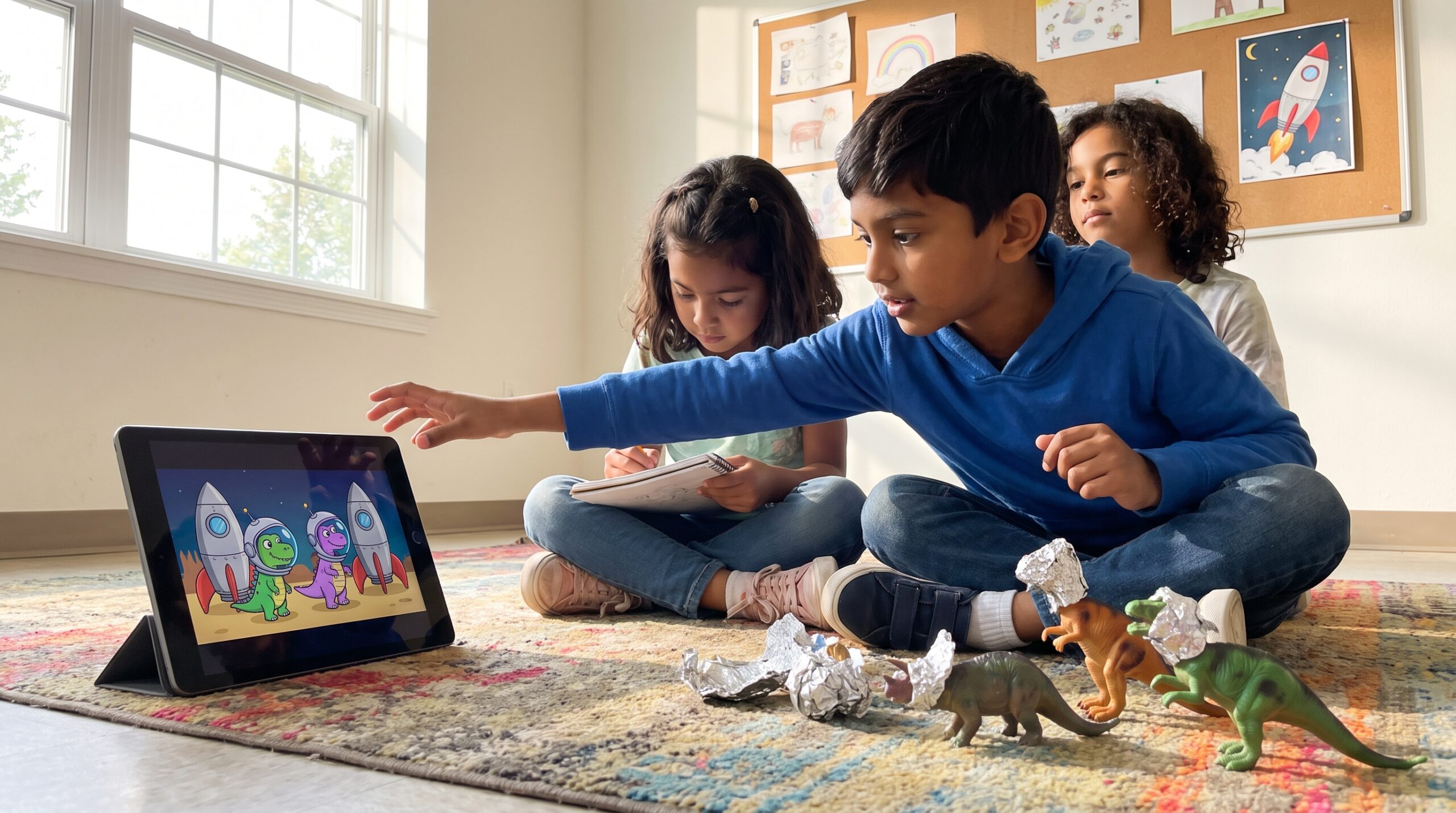
Story mash-up dinosaurs meet astronauts lights up kids fast. It mixes two powerful fascination magnets. Parents and teachers can use it to spark curiosity after school.
Why story mash-up dinosaurs meet astronauts feels familiar
The idea goes way back to pulp science fiction and midcentury movies. Those stories loved prehistoric beasts and shiny rockets. Today, the mash-up shows up in children s books, cartoons, and apps. It feels playful, dramatic, and instantly visual.
How the mash-up looks on screen
Often you see rockets, spacesuits, alien worlds, and ancient giants. Brave explorers meet big creatures. The images are bold and easy to imagine. That clarity helps young listeners dive right in.
Dinosaurs: quick facts to share
Dinosaurs first appeared about 245 million years ago in the Triassic period. Most nonavian dinosaurs went extinct about 66 million years ago. The word dinosaur was coined in 1842 by Sir Richard Owen.
- Major groups: sauropods, theropods, and ornithischians.
- Size notes: T. rex measured about 12 meters long and 3 to 4 meters tall at the hips.
- Brachiosaurus types reached 20 to 25 meters long and stood over 12 meters high.
- For scale, a Saturn V rocket stood about 110 meters tall. That contrast helps kids picture scale.
- On July 29, 1985, a few bones from a Maiasaura fossil were taken into orbit aboard the Space Shuttle by astronaut Loren Acton.
- In May 2020, a shiny, stuffed dinosaur plush toy accompanied NASA astronauts Doug Hurley and Robert Behnken on SpaceX’s historic launch to the International Space Station.
Space basics that pair well with the mash-up
Rockets move by throwing mass backward at high speed. This idea follows Newton s third law of motion. You can show it with a simple balloon rocket experiment.
- Yuri Gagarin orbited Earth in 1961.
- Apollo 11 landed on the Moon in 1969.
- The International Space Station has been habitated continuously since 2000.
- According to the Canadian Space Agency, astronauts’ skeletons in microgravity during a six-month ISS mission exhibit bone loss comparable to nearly 20 years of aging on Earth.
- Space brings vacuum, microgravity, big temperature swings, and more radiation than Earth.
Why real dinosaurs in space belong to fiction
DNA does not survive intact for tens of millions of years. Studies show DNA half life in bone lasts centuries, not millions of years. So recovering a complete dinosaur genome is not possible today.
Moreover, space is harsh. Animals need pressurized habitats, oxygen, food systems, temperature control, and heavy radiation shielding. Large animals would need massive protection. That makes real dinosaur space travel impractical now.
Furthermore, a current full NASA Extravehicular Mobility Unit (spacesuit) weighs approximately 113 kg (about 250 lb) on Earth, and when combined with the Manned Maneuvering Unit, the total mass reaches around 148 kg (about 326 lb) during spacewalks. This gives insight into the technology used by astronauts, which can be contrasted with the ancient technology of dinosaurs.
Education and play with this mash-up
The story mash-up dinosaurs meet astronauts works as a cross curricular hook. It invites talk about timelines, mass, scale, propulsion, and fossils. Keep facts short, clear, and mark the make believe.
Try this quick prompt tonight: which dinosaur would fix a rocket and why? Then ask what problems that dinosaur would face in space. Simple questions like these spark big thinking.
Quick tips and a gentle call to action
- Play a 10-minute episode right after school to spark curiosity.
- Invite a drawing or a one minute skit about a dinosaur astronaut.
- For ready-made episodes, visit Storypie and try a mash-up today.
Explore Storypie for more playful episodes and ideas. For example, get the app and watch a short mash-up tonight: Get the Storypie app.
Story mash-up dinosaurs meet astronauts is joyful fuel. Use it to start a conversation, spark a drawing, or launch a tiny experiment. Short, simple, and wildly satisfying.