Sydney Opera House for Kids begins with a bright image. The shells sit on Bennelong Point and glow like white sails near the Harbour Bridge. Parents and teachers can point out the shiny tiles, the big concert hall, and the clever way the shells were made. In its 50th-anniversary year of 2023, the Sydney Opera House welcomed more than 10.9 million visitors onsite, hosted over 1,800 performances attended by more than 1.4 million people, and its social value increased by 38% over the preceding decade to an estimated AUD 11.4 billion, highlighting its significant cultural and economic impact in Australia.
Sydney Opera House for Kids: The idea and the builders
A Danish architect named Jørn Utzon won an international competition with the bold shells idea. At first the roofs seemed impossible. Then Utzon and engineers at Ove Arup found a clever fix. They treated the shells as slices of a single imaginary sphere. That allowed builders to cast repeated concrete ribs and panels. The iconic “sails” of the Opera House cover roughly 1.62 hectares and are adorned with exactly 1,056,006 white ceramic tiles; these tiles are individually hand-checked every five years by a team of six engineers and abseilers. Next, workers assembled them like a three dimensional jigsaw. The result looks tidy and a little giggle-worthy.
Dates, drama, and the finished building
Work began in 1959. Builders poured a massive concrete podium first. Then they made and raised the shells through the 1960s. Interiors followed into the early 1970s. The Opera House officially inaugurated on 20 October 1973 by Queen Elizabeth II. However, costs and schedules ran over early estimates. Political fights led to Utzon resigning in 1966. He left Australia before the opening. Even so, his idea became the building people love. Since then, the site has hosted over 100,000 performances and welcomed well over 100 million visitors in total, showcasing its long-standing popularity.
What you see inside and why it matters
Inside, the building is more than a pretty roof. There is a large Concert Hall and the opera theatre now named the Joan Sutherland Theatre. Also, Opera Australia and the Sydney Symphony Orchestra are resident companies. Music, theatre, and family-friendly events happen year round, with the Opera House staging up to 2,500 performances and events each year, drawing about 1.5 million patrons and attracting approximately 4 million visitors annually. The shells wear over a million ceramic tiles that shimmer pearly in different light. The whole structure rests on concrete and steel sitting on a strong podium.
Cultural depth and recognition
In 2007 UNESCO listed the Opera House as a World Heritage Site. Today it stands as a symbol of Australia and a masterwork of 20th century architecture. The point itself is named for Woollarawarre Bennelong. He was an Eora man who met early settlers. That gives the place extra cultural depth to share with older children.
Simple family visits and a tiny craft
Travel by ferry to Circular Quay for a small harbour adventure. Picnic on the forecourt and catch free forecourt events. Also, book a short guided tour, a family performance, or a backstage tour. School programs and family shows run often.
- Ferry ride: a short, exciting trip
- Forecourt picnic: watch boats and people
- Short tour: quick facts and big views
Try a simple paper craft to show the shells idea. Cut a circle into slices. Move the slices away from the centre and lift them. The paper shell shows how one ball becomes many matching pieces. Try this tonight and ask your child to name a musician or builder inside the shell. It is playful and memorable.
Read or listen to a story about Sydney Opera House now: For 3-5 year olds, For 3-5 year olds, For 6-8 year olds, For 8-10 year olds, and For 10-12 year olds.
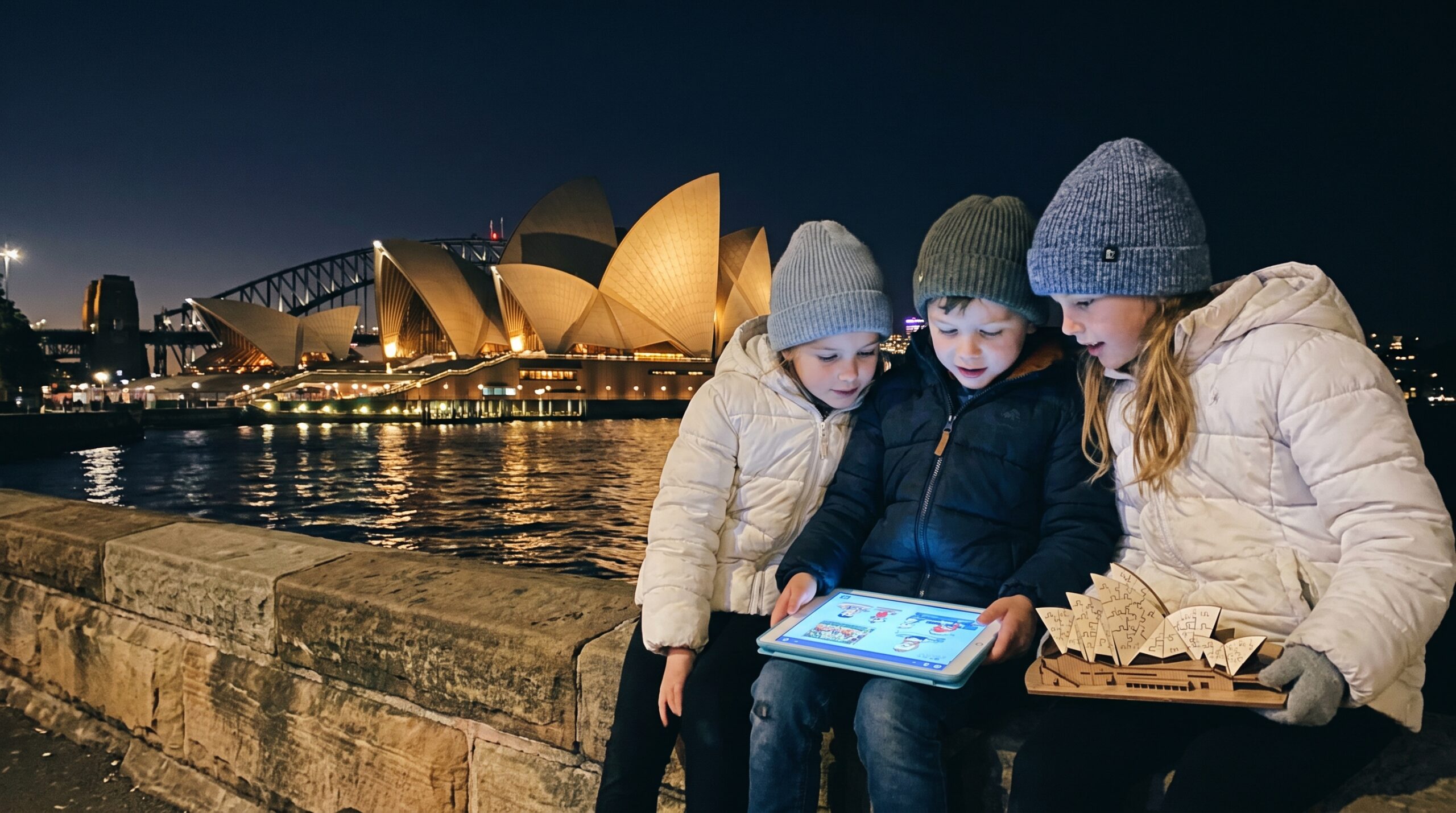
Finally, Storypie brings the Sydney Opera House to life on a winter night. Play a short concert clip and turn a story into a tiny making moment. For a gentle app link, visit Storypie to find the right story for your child.