
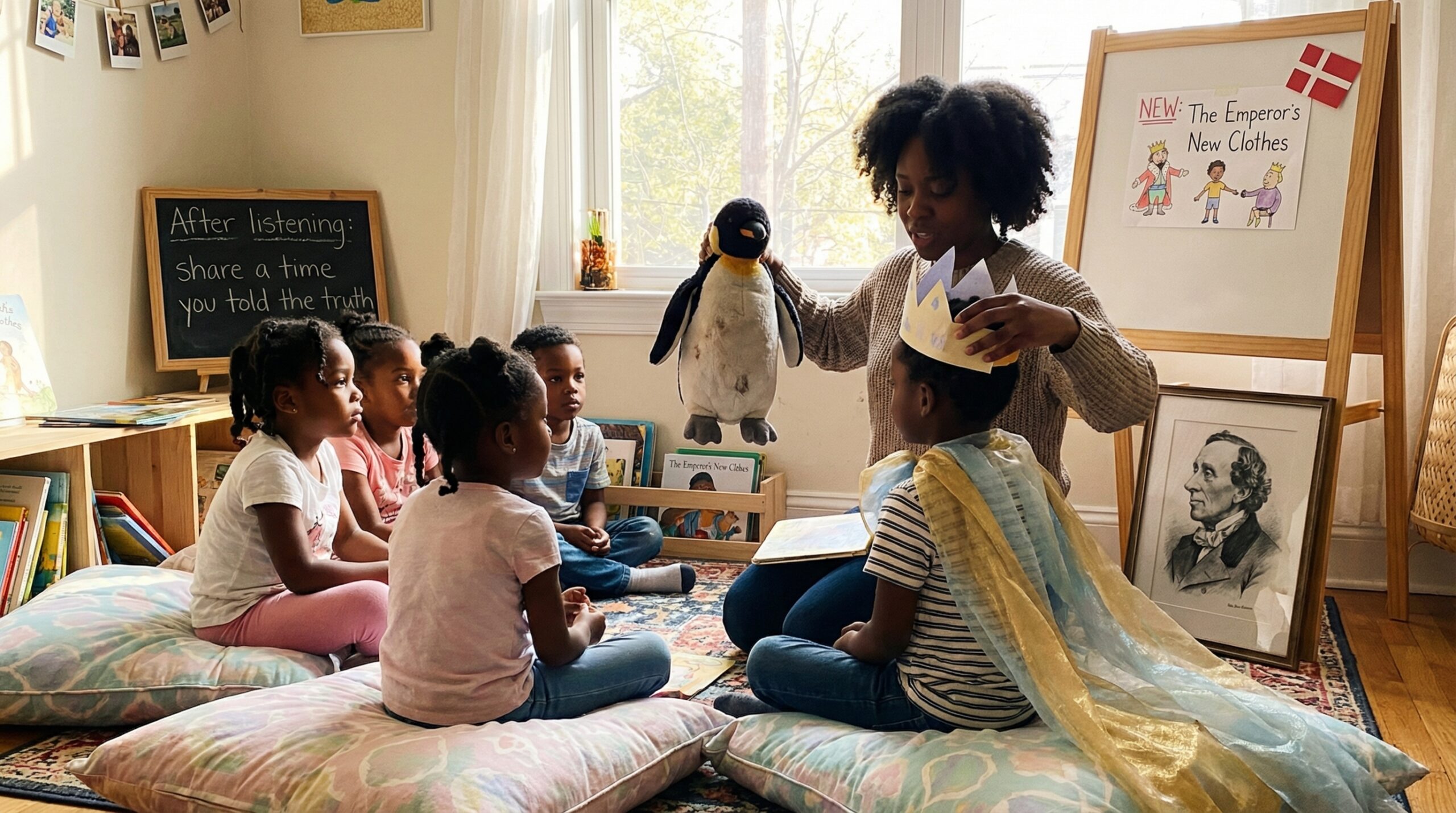
Introduction
The Emperor’s New Clothes – Danish is Hans Christian Andersen’s tiny, brilliant tale from 1837, first published on April 7, 1837, in Copenhagen, Denmark. It opens with two swindlers and ends with one child’s clear voice. The story lands with a delicious sting of truth. It pokes fun at vanity and polite lies. It rewards plain, brave honesty.
Why The Emperor’s New Clothes – Danish still matters
Andersen wrote Kejserens nye Kl?der in Danish. He was born in Odense in 1805. Andersen became Denmark’s best known teller of fairy tales. His style mixes satire with plain language. In this tale, courtiers pretend to see a suit. They fear being called foolish. Then a child cries out the obvious line Men han har da ikke noget p? That shout becomes the story’s turning point. Today the phrase the emperor has no clothes shows up in cartoons and everyday speech. Notably, “Kejserens nye klæder” was published as part of Andersen’s Eventyr, fortalte for Børn — Første Samling. Tredie Hefte, and appears as the fairy-tale entry number 17 in the H.C. Andersen Centre’s registry, underscoring its importance in Andersen’s body of work.
Plot and characteristics of The Emperor’s New Clothes – Danish
The plot is small and perfectly shaped. Two tricksters promise an emperor a suit that only the competent can see. People pretend they see it. The emperor parades, believing he wears grand clothes. No one speaks the truth at first. Then a child says the plain sentence. The tale values childlike candor and social courage. It uses crisp detail and a sharp final laugh.
Formats, language, and public domain status
The Emperor’s New Clothes – Danish appears in many formats. You will find picture books, illustrated editions, and bilingual Danish English books. Interestingly, there exist more than forty different picture-book editions of “Kejserens nye klæder”. Also look for short dramatized audio and simple stage scripts. Because it is public domain, printable scripts and free audio editions exist. Therefore teachers and families often reuse the tale in classes and at home.
Where to read or listen
Read or listen to a story about The Emperor’s New Clothes – Danish now: For 3-5 year olds, For 6-8 year olds, For 8-10 year olds, and For 10-12 year olds. You can also explore the main story page at Storypie for full details and versions.
Significance for parents and teachers
The Emperor’s New Clothes – Danish sparks short, clear conversations. It helps children name truth and spot group pressure. In addition, it offers a memorable phrase to discuss honesty in everyday life. Keep the tone gentle. The tale surprises adults and delights children with its simple bravery.
Andersen’s tale was translated into English soon after its original publication, with translations appearing as early as 1846. Explore more classic tales and language editions on Storypie. Enjoy the small, sharp laugh that ends this evergreen story.