The Starry Night for kids and families begins with a bright, swirling sky. Van Gogh painted this famous scene in mid-June 1889 while confined at the Saint-Paul-de-Mausole asylum in Saint-Rémy-de-Provence. He worked in oil on canvas, which measures 73.7 cm in height and 92.1 cm in width (about 29 × 36¼ inches). Today the painting lives at the Museum of Modern Art in New York, where it has been part of the permanent collection since 1941, acquired through the Lillie P. Bliss Bequest.
Where and why Van Gogh painted it
Van Gogh painted The Starry Night while staying at Saint-Paul-de-Mausole in Saint-Rémy-de-Provence. He looked from his room and also used memory. Sharp hills, a quiet village, and a tall cypress reach into the sky. The sky steals the show with glowing stars and a bright moon.
Look and feel
The Starry Night for kids and families shows movement. Van Gogh applied oil paint thickly, so the surface makes ridges. Short, energetic brushstrokes create motion. Stand close and you can almost feel the wind. He changed shapes and colors to show feeling, not to make a photograph. The swirling night sky fills approximately three-quarters (75%) of the painting’s composition, emphasizing its dramatic and dominant feature.
Main elements to spot
Point out these parts with your child. Then ask a simple question about each one.
- Dark cypress in the foreground
- Rolling hills behind the village
- Small church steeple and calm houses
- Swirling night sky with big stars and a moon
Try a tiny ritual
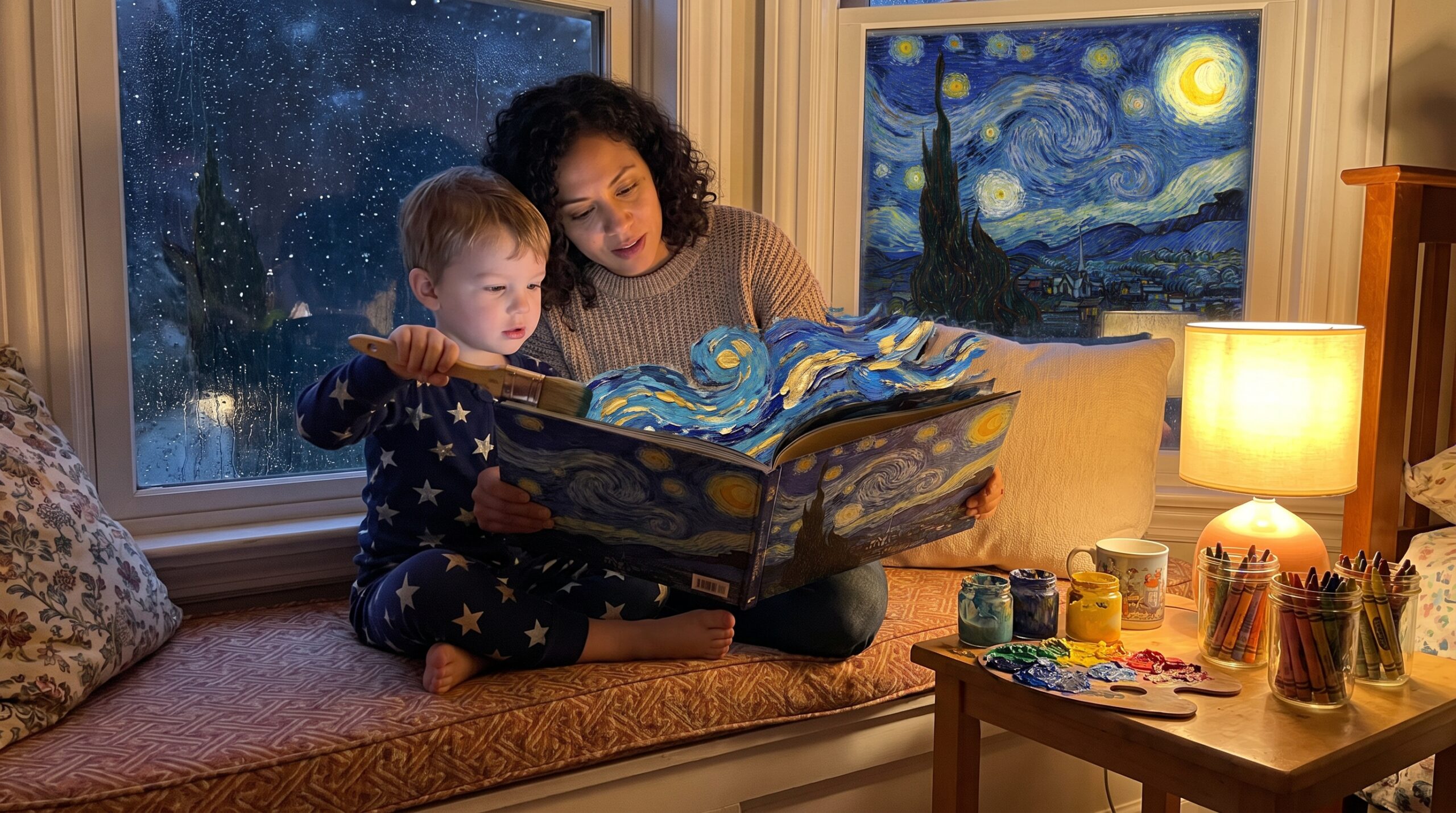
Make looking at the painting a soft ritual. Dim a lamp. Put down a cushion. Count the big stars together. Trace a swirl with a finger in the air. Ask: Which swirl looks like a wave and which looks like a ribbon?
History and legacy
The Starry Night belongs to Post-Impressionism. Van Gogh was 36 and exploring color and emotion. He wrote letters to his brother Theo about stars and the night. He also painted other night scenes, such as Café Terrace at Night. Van Gogh painted The Starry Night while hospitalized, just 13 months before his death at age 37 in July 1890. Over the 20th century, the painting grew into one of modern art’s best-known images.
MoMA acquired the work in 1941 through the Lillie P. Bliss Bequest. Since then people have reproduced the image everywhere. Because it is in the public domain, teachers and families can share it freely.
Simple activities to try together
- Paint a small night using only three blues and one yellow.
- Draw swirls with crayon, then rub a finger to blend.
- Tell a one-sentence story about the biggest star.
Caregiver note
Keep it tiny and kind. Make it a short ritual before bed. Ask: Which color would you use to paint hope? Then settle in and listen, or share a quick reply.
Read or listen to a story about The Starry Night now: For 3-5 year olds, For 3-5 year olds, For 6-8 year olds, For 8-10 year olds, and For 10-12 year olds.
The Starry Night keeps teaching. It makes a simple doorway to wonder tonight.