
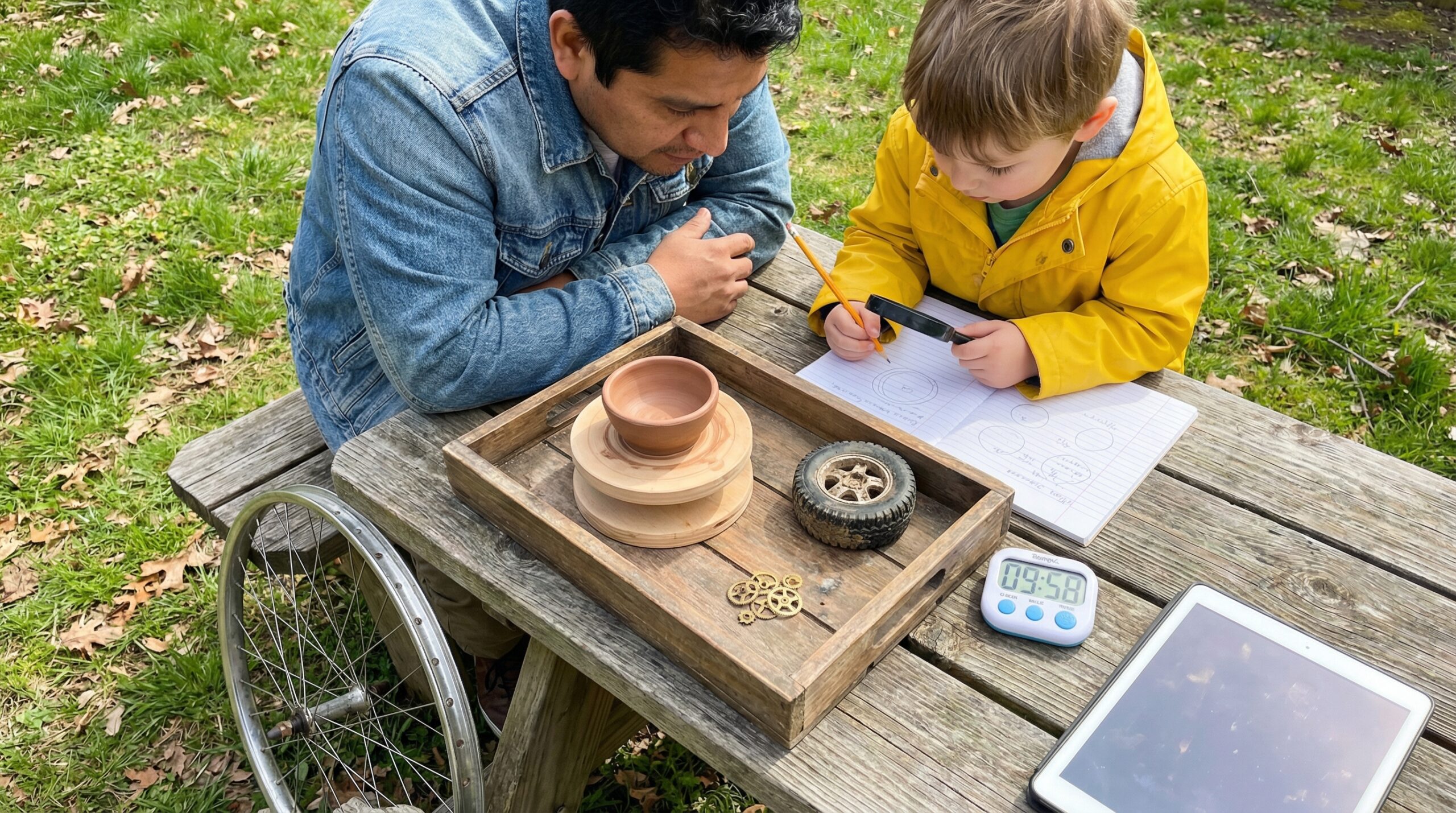
This spring morning, Storypie shares the wheel for kids, its journey from a potter’s tool to car tires and tiny watch gears. Read on for short history, clear facts, and playful ideas to try together.
What is the wheel?
A wheel is a round object that turns around an axle to cut friction. Together they form a simple machine. They let heavy things roll instead of being dragged. So people move people, goods, and ideas with less effort.
A brief history of the wheel for kids
One of the earliest rotating tools was the potter’s wheel. People in Mesopotamia used it near 3500 BCE, primarily for pottery making; it wasn’t until approximately 300 years later that it was adapted for transportation. Research shows that this invention was a significant technological advancement, enabling the development of carts and chariots for transportation, as noted by Scientific American. Soon after, humans added wheels to carts. Wheeled vehicles appeared between 3500 and 3000 BCE in the Near East and parts of Europe. The oldest known wooden wheel, discovered in the Ljubljana Marshes of Slovenia, is between 5,100 and 5,350 years old, highlighting the ancient origins of the wheel, as mentioned on Wikipedia. Later, spoked wheels, invented around 2000 BCE, made carts lighter and faster, allowing for the construction of more efficient vehicles, according to Britannica. Those changes helped chariots, trade, and travel.
Key advances
- Potter’s wheel first made rotating tools common.
- Axles and spokes reduced weight and friction.
- Metal rims and pneumatic tires boosted speed and comfort.
How the wheel works
Think of the axle as the wheel’s friend. The axle holds the wheel and lets it spin. Rolling reduces friction and spreads force. In simple terms, larger wheels roll over bumps better. Also, a wheel and axle can change force or speed. Bearings and better axles cut rubbing and wear. These ideas power everything from bikes to watches.
Types, materials, and small wonders
Wheels come in many shapes and materials. They include wooden disks, spoked bicycle wheels, pneumatic tires, flywheels, pulleys, gears, and waterwheels. Materials changed from wood and stone to bronze, iron, steel, rubber, and modern composites. For example, John Boyd Dunlop popularized the pneumatic tire for bikes in 1888. That idea changed travel in a big way.
Why the wheel matters
The wheel reshaped daily life. It sped up transport and boosted trade. It helped farms move crops and powered mills and factories. Also, it gave us gears for clocks and watches. Even toys and carnival rides use wheels. Altogether, wheels teach balance and motion in small and big ways.
A curious note
In some regions, people made wheeled toys but not full carts. That happened where draft animals were rare or the land made wheels less useful. For instance, the Lchashen wagon, a 3,500-year-old covered oak wagon from the Late Bronze Age, was discovered in a cemetery in Lchashen, Armenia, showcasing an archaeological find that illustrates the historical use of wheels in transportation, as reported by Live Science. Archaeology and museums show these differences. They also make great family visits and learning moments.
Try this: a 10-minute wheel hunt
Take a short walk or room search with your child. Count spokes on a bike wheel. Compare big and small wheels. Look at tire tread and listen to wheel sounds. Ask, “How many wheels do we see?” or “Which wheel rolls fastest on the pavement?” Small adventures spark big questions.
DIY: cardboard wheel and axle
Use a cardboard circle, a wooden skewer for an axle, and bottle cap wheels. Adults should help with cutting and poking holes. Test rolling on carpet and tile. Notice wobble, balance, and how added weight changes motion. It is simple, safe, and super fun.
Read or listen to a story about The Wheel now: For 3-5 year olds, For 3-5 year olds, For 6-8 year olds, For 8-10 year olds, and For 10-12 year olds.
Safety and next steps
Keep small wheels away from babies and supervise cutting. Always use helmets for bikes and scooters. For more stories and guides, visit Storypie and try related lessons in the app. Gentle curiosity leads to joyful learning.
Final thought: The wheel is a tiny marvel that keeps rolling through history. Spotting three wheels today could spark a whole rolling adventure. Hooray!