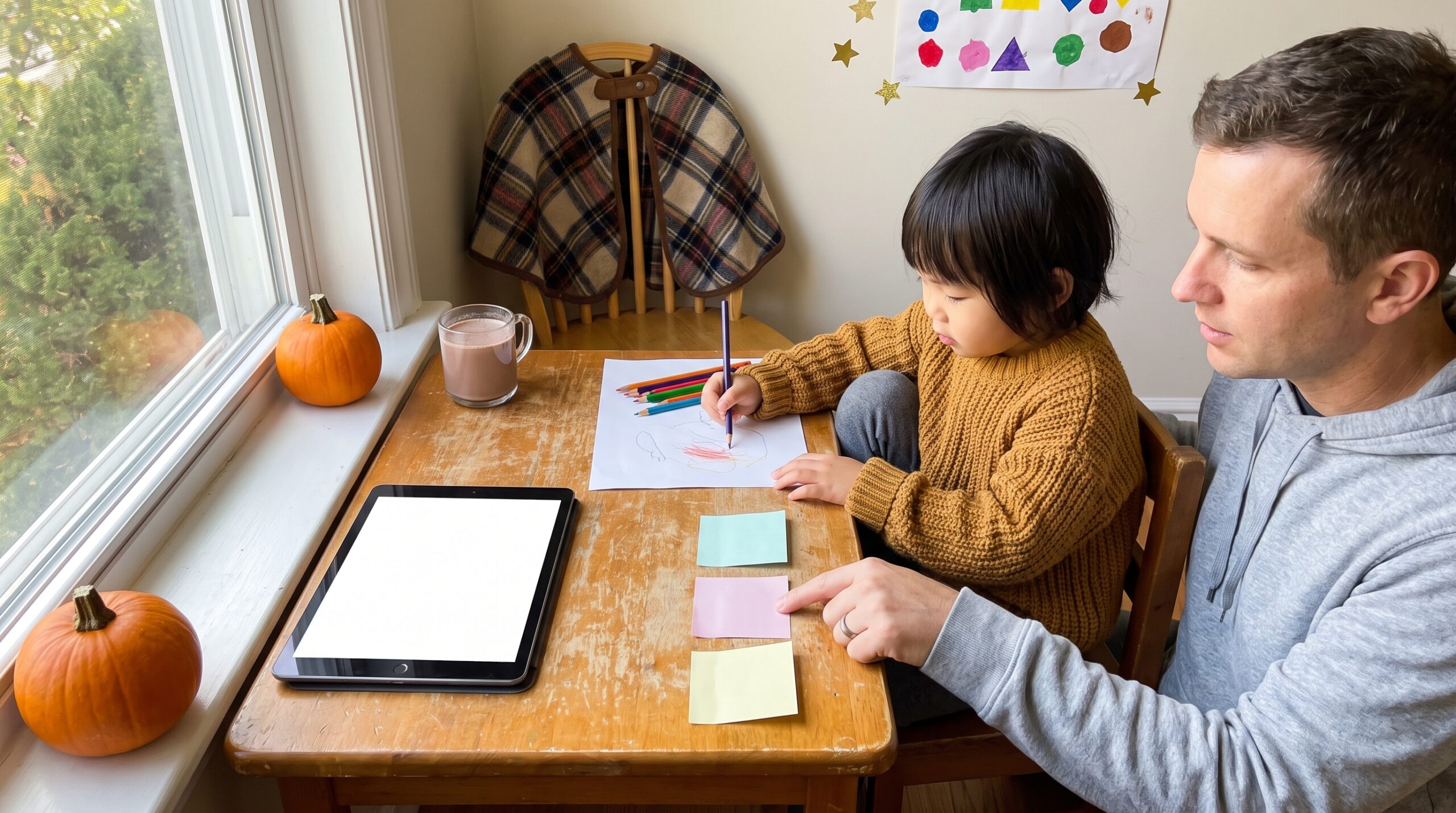
Try the weekend imagination challenge: create your own hero with your family this weekend. It is fast, joyful, and confidence-building for kids. In fact, according to the C.S. Mott Children’s Hospital National Poll on Children’s Health, on a typical day at home, 68% of parents say their child (ages 1–5) is very likely to engage in make-believe or pretend play, highlighting the prevalence of imaginative play among young children.
What this weekend imagination challenge is
This challenge is a short family activity. Over one session or a relaxed weekend, children invent an original hero. They pick powers, a name, one sketch, a mission, and a safe weakness. The structure stays simple and repeatable. Parents and teachers love how doable it is. Engaging in such creative activities is beneficial; a 2025 YouGov survey reported that 92% of children (ages 6–12) said being creative boosts their confidence, and 65% said engaging in a creative activity makes them feel happy.
Quick structure and steps
First, keep time short. Then follow a clear, five-part routine. Finally, finish with a tiny performance or show-and-tell.
- Brainstorm three powers. Say verbs out loud.
- Pick a short name.
- Sketch one power with simple lines.
- Design a costume or tool with stickers or fabric scraps.
- Define a mission and one non-violent weakness.
Materials and timing
Materials are basic. You need paper, crayons or markers, optional stickers or fabric scraps, a timer, and a phone to record. A short run takes 15 to 30 minutes. A deeper project can stretch to 45 to 90 minutes across the weekend.
Why this challenge works
The weekend imagination challenge creates a focused, playful task. It sparks new words, careful pencil strokes, and proud performances. Also, first-person play helps children claim their ideas. When a child says I, the idea sticks. Research shows that structured creative activities, like this challenge, can significantly enhance children’s imaginative skills. A 2025 study involving 300 children aged 4–6 found that a 16-week intervention using digital games significantly improved both drawing innovativeness and storytelling plot richness.
Developmental and social benefits
Sketching aids fine motor control and early writing. Moreover, small drawing details train hand-eye coordination. Naming powers grows vocabulary. Describing feelings builds empathy and sequencing. Choosing a weakness teaches problem-solving and resilience. Furthermore, a meta-analysis published in December 2026 found that adult-guided play produced a medium effect size on creativity for elementary-aged children, illustrating how adult involvement in play can enhance creative outcomes.
Age-friendly variations
Adjust the challenge by age. For preschoolers, keep prompts concrete and brief. For early elementary kids, aim for three powers, one weakness, and a one-sentence mission. For older kids, add an origin detail, gadgets, or a short comic panel. Each version stays short and satisfying.
Inclusion, safety, and variety
Encourage diverse heroes. Suggest strengths beyond physical power, such as curiosity, kindness, or coding. Also, keep themes non-violent and problem-solving focused. Try family variations where everyone makes a hero and invents sidekicks. It’s important to foster this creativity; in 2024, the Institute of Imagination reached 17,620 children and supported 1,071 educators, resulting in a 100% increase in children’s creative thinking.
Share and preserve the moment
Display drawings and perform a tiny scene. Record a reading on your phone for memory. If you want a digital complement, try the Storypie app to save voice and images and keep the real drawing moment central. Use Storypie as a safe archive for your family creations.
A tiny final rule
Timebox the activity. Keep choices small. Praise specifics. Above all, focus on confidence, not perfection. Celebrate loudly.