English

Aristarchus of Samos
Aristarchus of Samos was an ancient Greek astronomer and mathematician who is credited with being the first…
Reads at Grades 3–5 Listens at Grades 1–5
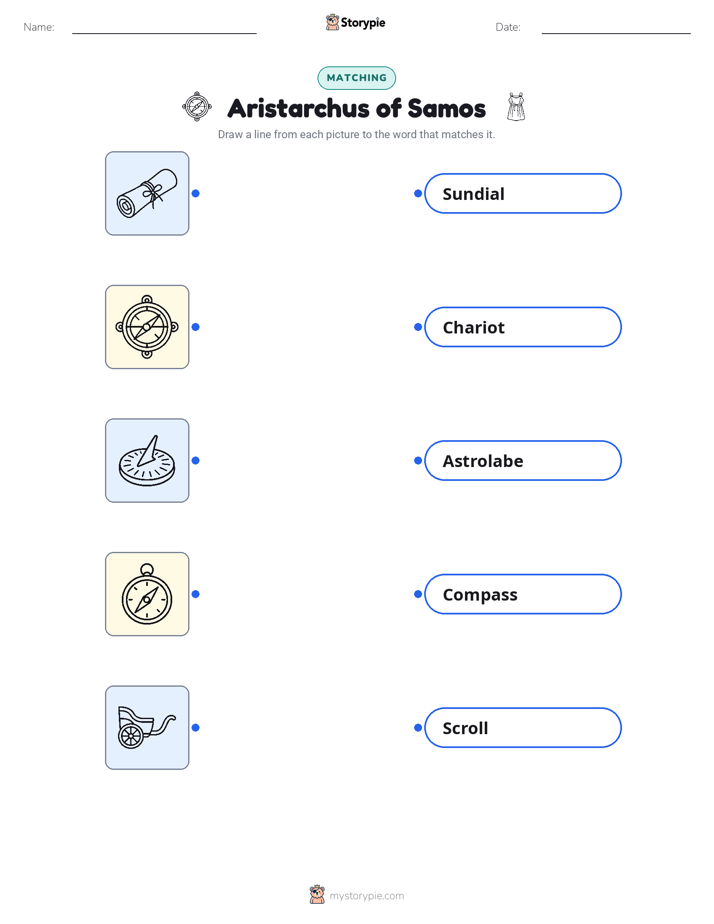
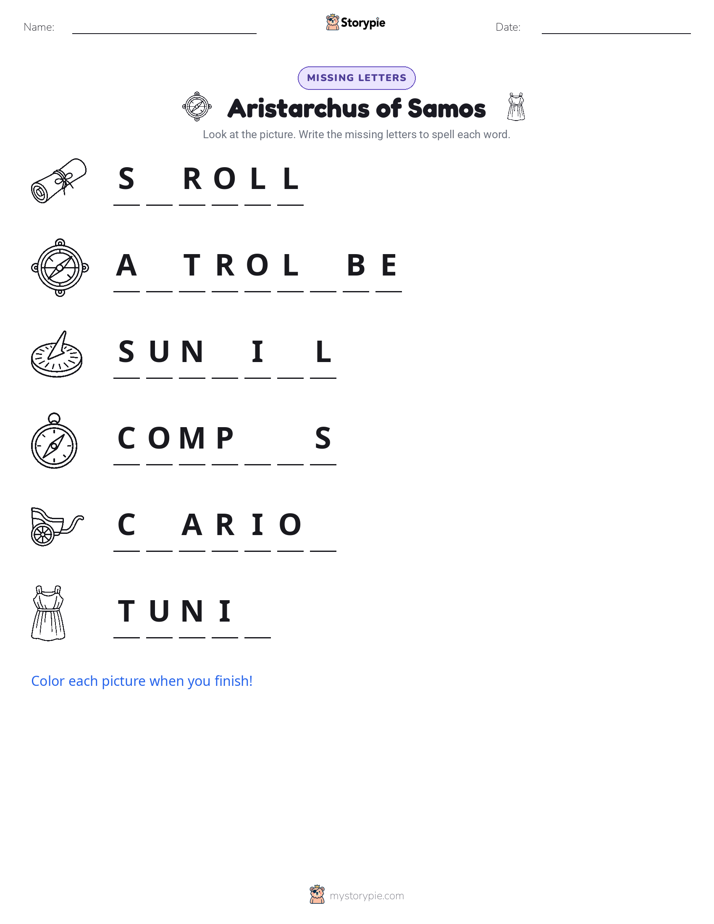
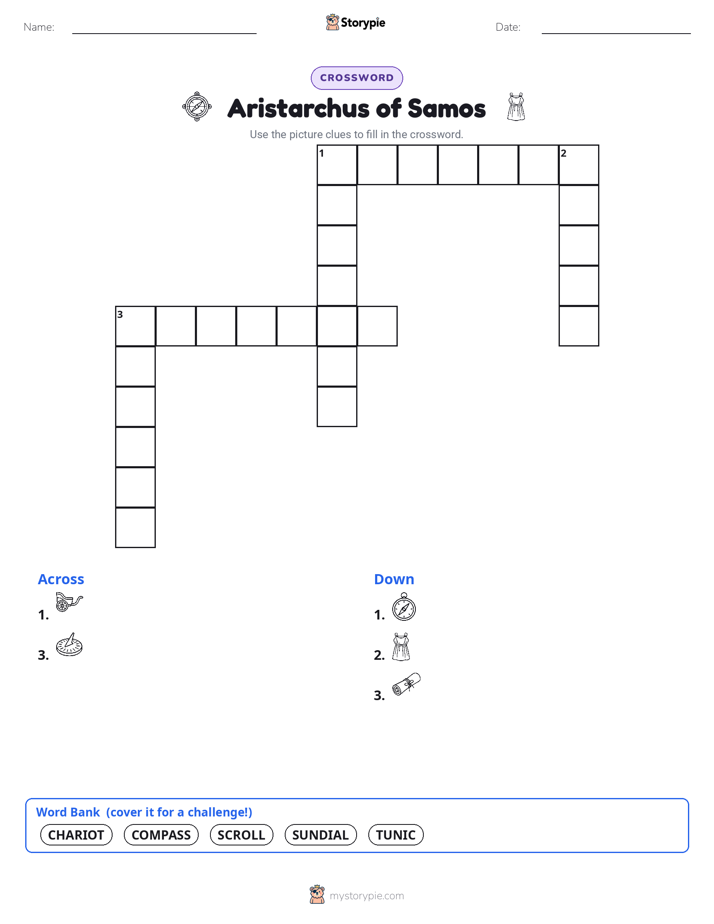
Print & create
Answer keys·No prep·Free with an account
28 worksheets · answer keys · full story · quiz · Ages 8-10 · CEFR B1
Plus adds 244,000+ more stories in 27 languages, audio for every one, and printables for all of them.
Just want Aristarchus of Samos?
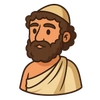
Hello, my name is Aristarchus of Samos, and I was an astronomer who lived a very long time ago. I was born on a beautiful Greek island called Samos around the year 310 BCE. Ever since I was young, I was fascinated by the sky above. I would spend countless hours at night, just looking up and watching the stars, the Moon, and the Sun move across the heavens. In my time, nearly everyone believed a simple idea: that our Earth was the center of everything. They thought the brilliant Sun, the glowing Moon, and all the twinkling stars moved in perfect circles around us. It was a comfortable thought, but as I watched and measured, I began to wonder if it was the whole story. I felt a pull to understand the true design of the universe, and that curiosity set me on a path of discovery.
I didn't just look at the sky; I used mathematics to understand it. Geometry, the study of shapes and angles, was my most important tool. I carefully observed events like a half-moon, when the Moon is lit exactly in half by the Sun. I used the angles between the Earth, Moon, and Sun to try and calculate how far away they were from us and from each other. My calculations weren't perfect, but they revealed something incredible. They showed me that the Sun was not just a small light in the sky; it was enormous, much, much bigger than our own Earth. This was a stunning discovery, and it led me to a revolutionary thought. If the Sun was so huge and fiery, and the Earth was so much smaller, did it really make sense for the giant Sun to travel around the tiny Earth? What if it was the other way around? What if the giant Sun was the center, and our smaller Earth was the one moving?
Aristarchus of Samos: The Ancient Astronomer
Hello, my name is Aristarchus of Samos, and I was an astronomer who lived a very long time ago. I was born on a beautiful Greek island called Samos around the year 310 BCE. Ever since I was young, I was fascinated by the sky above. I would spend countless hours at night, just looking up and watching the stars, the Moon, and the Sun move across the heavens. In my time, nearly everyone believed a simple idea: that our Earth was the center of everything. They thought the brilliant Sun, the glowing Moon, and all the twinkling stars moved in perfect circles around us. It was a comfortable thought, but as I watched and measured, I began to wonder if it was the whole story. I felt a pull to understand the true design of the universe, and that curiosity set me on a path of discovery.
I didn't just look at the sky; I used mathematics to understand it. Geometry, the study of shapes and angles, was my most important tool. I carefully observed events like a half-moon, when the Moon is lit exactly in half by the Sun. I used the angles between the Earth, Moon, and Sun to try and calculate how far away they were from us and from each other. My calculations weren't perfect, but they revealed something incredible. They showed me that the Sun was not just a small light in the sky; it was enormous, much, much bigger than our own Earth. This was a stunning discovery, and it led me to a revolutionary thought. If the Sun was so huge and fiery, and the Earth was so much smaller, did it really make sense for the giant Sun to travel around the tiny Earth? What if it was the other way around? What if the giant Sun was the center, and our smaller Earth was the one moving?
Around the year 270 BCE, I presented this new idea to other thinkers. I explained that the Earth was not the center of the universe. Instead, I proposed that the Earth and the other planets all traveled in circles around the giant, fiery Sun. We now call this the heliocentric model, with 'helios' being the Greek word for Sun. However, this idea was very difficult for people to accept. For centuries, famous thinkers like Aristotle had taught that the Earth was the unmoving center of everything. His ideas were respected and trusted, so my theory seemed strange and wrong to most people. It was too different from what everyone had always believed, and they were not ready for such a big change in their understanding of the world. Sadly, most of my writings were lost over time. My only book that survived through history is called 'On the Sizes and Distances of the Sun and Moon', which explains some of the mathematical methods I used to make my discoveries.
My heliocentric idea was mostly forgotten for a very long time after I presented it. I lived a long life for my time, to be about 80 years old, and I passed away around 230 BCE. For nearly 2,000 years, the world continued to believe that the Earth was the center of the universe. But my work wasn't lost forever. Many centuries later, an astronomer named Nicolaus Copernicus was studying the ancient Greek texts and read about my work. He was inspired by my idea and used it as a starting point for his own observations. He eventually gathered the proof needed to show that the Earth and other planets do indeed circle the Sun. Today, I am remembered as the first person known to have correctly mapped out our solar system, all by using careful observation and the power of math. My story shows that even if an idea isn't accepted right away, the truth can wait a long time to be rediscovered.
Wow facts
About
Aristarchus of Samos was an ancient Greek astronomer and mathematician who is credited with being the first person to propose a heliocentric model of the universe, placing the Sun at the center.
Take a Quiz
Question 1 of 5
What discovery made Aristarchus think the Sun might be the center of the universe?
Explore next


Want to do even more?
Go beyond exploring. Unlock tools that turn every story into real learning.

Storypie Plus for families
Full stories, quizzes, and printables. Nights and car rides, sorted.
- Unlimited audio stories
- Create Mode: your child stars in the story
- Offline downloads
- Printable worksheets & coloring pages

Why Storypie for Schools
Students engaged. Prep in seconds. Evenings back to you.
- Worksheets & Quizzes
- Classroom Management
- Formative Assessment
- Custom Curriculum & Lesson Plans
- 27 Languages

Why Storypie for Homeschool
Curriculum done. They'll ask for more. Hours back in your day.
- Worksheet Generator
- First-Person Audio Stories
- Built-in Comprehension Quizzes
- Custom Curriculum & Lesson Plans
- Print & Go Activities