English

Comparing Numbers (More, Less, Equal)
The fundamental mathematical concept of determining whether one quantity is greater than, less than…
Reads at Grades 6–8 Listens at Grades 4–8
Print & create
Answer keys·No prep·Free with an account
28 worksheets · answer keys · full story · quiz · Ages 10-12 · CEFR B2
Plus adds 244,000+ more stories in 27 languages, audio for every one, and printables for all of them.
Just want Comparing Numbers (More, Less, Equal)?
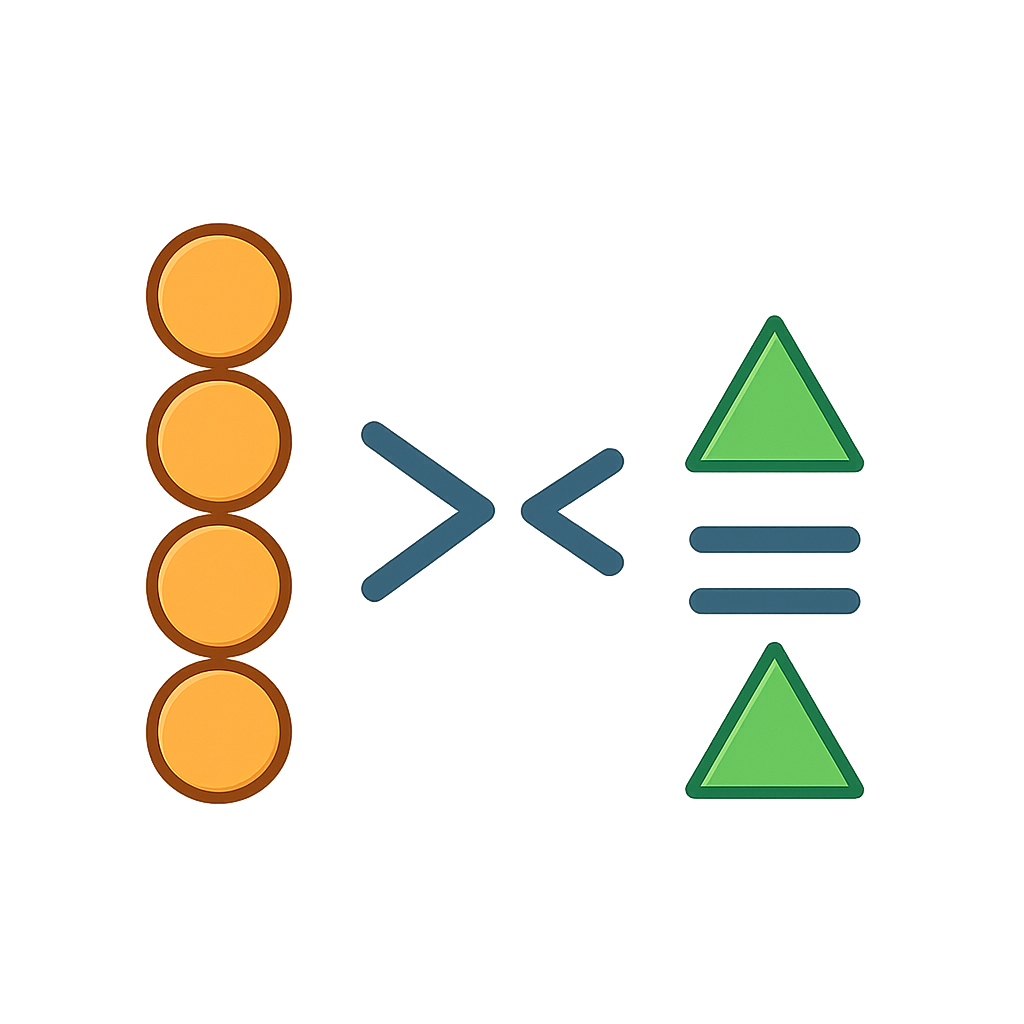
Have you ever stood back-to-back with a friend, a thrill of competition in the air, to see who was taller? Or have you felt the surprising weight of a backpack stuffed with books and wondered if it was heavier than yesterday’s? Maybe you’ve carefully eyed two slices of pizza, your mind instantly calculating which one was bigger. That feeling, that quiet, split-second evaluation, is me. I am the question that buzzes in your mind: Which one is greater? Which one is smaller? Are they the same? I exist in the choices you make every single day. When you pick players for a team in the schoolyard, you might look for the group with more people. When you share a bag of chips, I am the instinct that helps you divide them so everyone gets an equal amount. I am the silent judge of fairness, the invisible scale that weighs your options, and the yardstick that measures the world around you. Before you even learned numbers, you knew me. You understood the difference between a full cup and an empty one, a loud noise and a quiet whisper. I am the idea of Comparing Numbers. You know me as More Than, Less Than, and Equal To.
I am ancient, far older than any city you’ve read about or any book on your shelf. I began as a simple, powerful instinct in the minds of the very first humans. I was there, helping them survive. I was the thought that guided a hunter to follow the larger herd of animals or helped a gatherer choose the bush bursting with more berries. I was the logic that told them which of two paths was shorter and safer. For thousands upon thousands of years, I was just a feeling, a practical tool without a written form. But then, something changed. Around 20,000 years ago, on the continent of Africa, someone carved a series of deliberate notches into a piece of bone, now called the Ishango Bone. These weren't just random scratches; archaeologists believe they might have been used not only to count but to compare things, like the phases of the moon. These were my first symbols, my first faint marks on the world. Millennia later, around 3500 BCE, I became the foundation for civilization itself in a place called Mesopotamia. The Sumerians, who lived there, were building the world’s first cities, and they needed me to organize their lives. They used small clay tokens to represent grain, livestock, and oil. They constantly asked questions that were all about me: Do we have enough grain to last the winter? Is this trade of barley for wool an equal exchange? I brought order to their markets and fairness to their laws. I was also hard at work in ancient Egypt. On a scroll known as the Rhind Papyrus, written around 1550 BCE, scribes wrestled with complex problems about how to equally divide loaves of bread among workers and how to measure land fairly after the Nile River flooded. I was the key to their solutions, the very concept of balance they relied on.
The Story of More Than, Less Than, and Equal To
Have you ever stood back-to-back with a friend, a thrill of competition in the air, to see who was taller? Or have you felt the surprising weight of a backpack stuffed with books and wondered if it was heavier than yesterday’s? Maybe you’ve carefully eyed two slices of pizza, your mind instantly calculating which one was bigger. That feeling, that quiet, split-second evaluation, is me. I am the question that buzzes in your mind: Which one is greater? Which one is smaller? Are they the same? I exist in the choices you make every single day. When you pick players for a team in the schoolyard, you might look for the group with more people. When you share a bag of chips, I am the instinct that helps you divide them so everyone gets an equal amount. I am the silent judge of fairness, the invisible scale that weighs your options, and the yardstick that measures the world around you. Before you even learned numbers, you knew me. You understood the difference between a full cup and an empty one, a loud noise and a quiet whisper. I am the idea of Comparing Numbers. You know me as More Than, Less Than, and Equal To.
I am ancient, far older than any city you’ve read about or any book on your shelf. I began as a simple, powerful instinct in the minds of the very first humans. I was there, helping them survive. I was the thought that guided a hunter to follow the larger herd of animals or helped a gatherer choose the bush bursting with more berries. I was the logic that told them which of two paths was shorter and safer. For thousands upon thousands of years, I was just a feeling, a practical tool without a written form. But then, something changed. Around 20,000 years ago, on the continent of Africa, someone carved a series of deliberate notches into a piece of bone, now called the Ishango Bone. These weren't just random scratches; archaeologists believe they might have been used not only to count but to compare things, like the phases of the moon. These were my first symbols, my first faint marks on the world. Millennia later, around 3500 BCE, I became the foundation for civilization itself in a place called Mesopotamia. The Sumerians, who lived there, were building the world’s first cities, and they needed me to organize their lives. They used small clay tokens to represent grain, livestock, and oil. They constantly asked questions that were all about me: Do we have enough grain to last the winter? Is this trade of barley for wool an equal exchange? I brought order to their markets and fairness to their laws. I was also hard at work in ancient Egypt. On a scroll known as the Rhind Papyrus, written around 1550 BCE, scribes wrestled with complex problems about how to equally divide loaves of bread among workers and how to measure land fairly after the Nile River flooded. I was the key to their solutions, the very concept of balance they relied on.
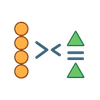
For most of history, people described me with words. They would write out long sentences like, 'The quantity of this pile of stones is greater than the quantity of that pile.' It worked, but it was slow and clumsy. Imagine trying to solve a complicated math problem if you had to write out every single step in full sentences. It would take forever. The world needed a shortcut, a clear and simple way to express me. My big moment finally came in 1557. A clever Welsh mathematician and physician named Robert Recorde was writing a book on algebra called 'The Whetstone of Witte.' He grew incredibly tired of writing the words 'is equal to' again and again. In a moment of brilliant simplicity, he decided to create a symbol. He drew two long, parallel horizontal lines, like this: =. Why? As he explained in his book, 'noe 2 thynges can be moare equalle.' Nothing can be more equal. The symbol was perfect, and I, the idea of 'the same as,' finally had a name tag. But that was only part of my identity. What about being bigger or smaller? That breakthrough came from an English astronomer and mathematician named Thomas Harriot. In a book published after his death in 1631, he introduced two new symbols: a 'V' on its side pointing right for 'More Than' (>) and one pointing left for 'Less Than' (<). The open side of the symbol always faced the larger number, making it beautifully logical. With these three simple signs—>, <, and =—my full power was unleashed. Suddenly, a person in England could communicate a precise mathematical idea to someone in Italy or Spain without a single shared word. I had become a universal language.
Today, I am everywhere, often working so quietly you don’t even notice me. I am the logic humming inside the computer code of your favorite video games, constantly checking if your score is 'greater than' the high score, or if your character's health is 'less than' zero. I am in the science laboratory, where researchers compare data from their experiments to see if a new medicine is more effective than an old one. I am with you when you glance at the thermometer in the morning to see if the temperature is greater than it was yesterday. You use me when you compare prices at the store to find the best deal or when you check the clock to see if you have enough time to finish your homework. I am not just a tool for mathematicians; I am a guide for making smart, logical decisions. Every time you weigh your options, compare two different points of view, or strive for fairness, you are using me. I am your partner in curiosity, the tool that helps you ask important questions about the world and find the answers that build a more logical, just, and understandable future.
Wow facts
About
The fundamental mathematical concept of determining whether one quantity is greater than, less than, or equal to another, and the history of its symbols.
Take a Quiz
Question 1 of 5
What is the main idea of this story?
Explore next



Want to do even more?
Go beyond exploring. Unlock tools that turn every story into real learning.

Storypie Plus for families
Full stories, quizzes, and printables. Nights and car rides, sorted.
- Unlimited audio stories
- Create Mode: your child stars in the story
- Offline downloads
- Printable worksheets & coloring pages

Why Storypie for Schools
Students engaged. Prep in seconds. Evenings back to you.
- Worksheets & Quizzes
- Classroom Management
- Formative Assessment
- Custom Curriculum & Lesson Plans
- 27 Languages

Why Storypie for Homeschool
Curriculum done. They'll ask for more. Hours back in your day.
- Worksheet Generator
- First-Person Audio Stories
- Built-in Comprehension Quizzes
- Custom Curriculum & Lesson Plans
- Print & Go Activities