English

Comparing Numbers (More, Less, Equal)
The fundamental mathematical concept of determining whether one quantity is greater than, less than…
Reads at Grades 3–5 Listens at Grades 1–5
Print & create
Answer keys·No prep·Free with an account
28 worksheets · answer keys · full story · quiz · Ages 8-10 · CEFR B1
Plus adds 244,000+ more stories in 27 languages, audio for every one, and printables for all of them.
Just want Comparing Numbers (More, Less, Equal)?
Have you ever stood back-to-back with a friend to see who is taller?. Or maybe you’ve carefully counted your Halloween candy to see who got the biggest haul?. Have you lined up your toy cars to find the longest one, or split a pile of cookies so that you and your sibling have the exact same amount?. That little spark in your mind that sizes things up, that helps you know if something is bigger, smaller, faster, slower, or exactly the same—that's me. I am the power behind every race, every shared snack, and every time you wonder if you have enough time to play before dinner. Hello, I'm the idea of Comparing Numbers, and I'm one of the oldest and most helpful ideas in the entire world. I've been helping people make sense of their surroundings since the very beginning of humankind, long before anyone ever thought to give me a name or a symbol.
For most of history, people didn’t have special symbols for me. Can you imagine a world where you had to use only words to explain that one thing was bigger than another?. Thousands of years ago, early humans needed me to survive. They had to know if a rival group had more hunters, or which tree had more fruit hanging from its branches. They would point and use hand signals and words to get my idea across. Fast forward thousands of years to ancient civilizations like the Egyptians. Around 1650 BCE, they were writing down complicated math problems on scrolls made from a plant called papyrus. But even they had to write everything out. If they wanted to say that 5 plus 5 was the same as 10, they had to write it in long phrases like 'is the same as' or 'is equal to.' It took up so much space and so much time. For most of human history, I existed only in spoken language and long, descriptive sentences.
The Story of Comparing Numbers
Have you ever stood back-to-back with a friend to see who is taller?. Or maybe you’ve carefully counted your Halloween candy to see who got the biggest haul?. Have you lined up your toy cars to find the longest one, or split a pile of cookies so that you and your sibling have the exact same amount?. That little spark in your mind that sizes things up, that helps you know if something is bigger, smaller, faster, slower, or exactly the same—that's me. I am the power behind every race, every shared snack, and every time you wonder if you have enough time to play before dinner. Hello, I'm the idea of Comparing Numbers, and I'm one of the oldest and most helpful ideas in the entire world. I've been helping people make sense of their surroundings since the very beginning of humankind, long before anyone ever thought to give me a name or a symbol.
For most of history, people didn’t have special symbols for me. Can you imagine a world where you had to use only words to explain that one thing was bigger than another?. Thousands of years ago, early humans needed me to survive. They had to know if a rival group had more hunters, or which tree had more fruit hanging from its branches. They would point and use hand signals and words to get my idea across. Fast forward thousands of years to ancient civilizations like the Egyptians. Around 1650 BCE, they were writing down complicated math problems on scrolls made from a plant called papyrus. But even they had to write everything out. If they wanted to say that 5 plus 5 was the same as 10, they had to write it in long phrases like 'is the same as' or 'is equal to.' It took up so much space and so much time. For most of human history, I existed only in spoken language and long, descriptive sentences.
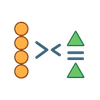
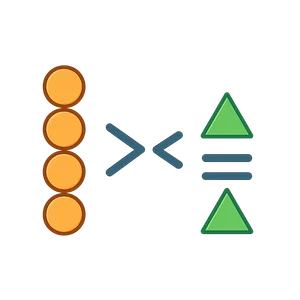
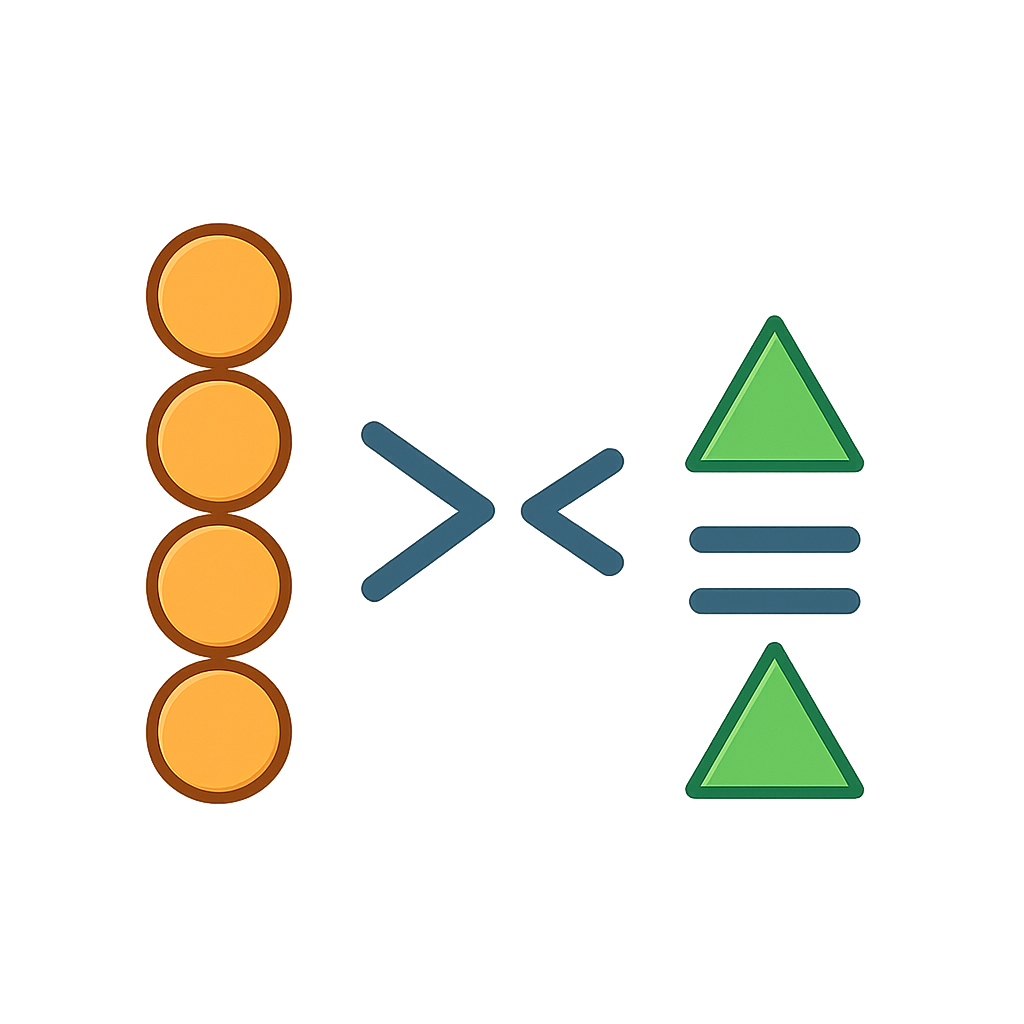
Then, after thousands of years of long sentences, I finally got some familiar faces. It all started with a clever man who was simply tired of writing so much. In the year 1557, a Welsh mathematician named Robert Recorde was writing a book called 'The Whetstone of Witte.' He got so weary of writing the words 'is equal to' over and over that he decided to invent a shortcut. He drew two short, parallel lines, one right over the other, to create the equals sign (=). He explained his choice by saying, 'noe .2. thynges, can be moare equalle.' He thought that nothing in the world could be more equal than two lines of the same length running side-by-side. A little later, my other famous symbols were born. An English mathematician named Thomas Harriot created the greater than (>) and less than (<) signs. His book with my new symbols was published in 1631, ten years after he had passed away. People loved these symbols because they were so easy to understand. You can imagine them as a hungry alligator’s mouth that always wants to chomp on the bigger number. Suddenly, math became much faster and clearer for everyone.
Today, my job is bigger than ever. I’m not just sitting in your math classroom; I am everywhere, working silently to make the world run smoothly. When a baker follows a recipe, they use me to check if they have more flour than sugar. When you save up your allowance, you use me to see if you have enough money to buy that new video game you want. I am even the secret helper inside computers and smartphones. Every time a program on your tablet or phone has to make a choice, it's usually because it's comparing numbers. For example, if your battery life is less than 20 percent, the program knows to show you a warning. I am a superpower for making smart choices, for understanding the world, and for making things fair. From sharing a pizza equally among friends to helping scientists launch rockets into space, I am always there, helping you see how everything measures up.
Wow facts
About
The fundamental mathematical concept of determining whether one quantity is greater than, less than, or equal to another, and the history of its symbols.
Take a Quiz
Question 1 of 5
Who invented the equals sign (=) and in what year?
Explore next



Want to do even more?
Go beyond exploring. Unlock tools that turn every story into real learning.

Storypie Plus for families
Full stories, quizzes, and printables. Nights and car rides, sorted.
- Unlimited audio stories
- Create Mode: your child stars in the story
- Offline downloads
- Printable worksheets & coloring pages

Why Storypie for Schools
Students engaged. Prep in seconds. Evenings back to you.
- Worksheets & Quizzes
- Classroom Management
- Formative Assessment
- Custom Curriculum & Lesson Plans
- 27 Languages

Why Storypie for Homeschool
Curriculum done. They'll ask for more. Hours back in your day.
- Worksheet Generator
- First-Person Audio Stories
- Built-in Comprehension Quizzes
- Custom Curriculum & Lesson Plans
- Print & Go Activities