English

Comparing Numbers (More, Less, Equal)
The fundamental mathematical concept of determining whether one quantity is greater than, less than…
Reads at Grades K-2 Listens at K–3
Print & create
Answer keys·No prep·Free with an account
28 worksheets · answer keys · full story · quiz · Ages 6-8 · CEFR A2
Plus adds 244,000+ more stories in 27 languages, audio for every one, and printables for all of them.
Just want Comparing Numbers (More, Less, Equal)?
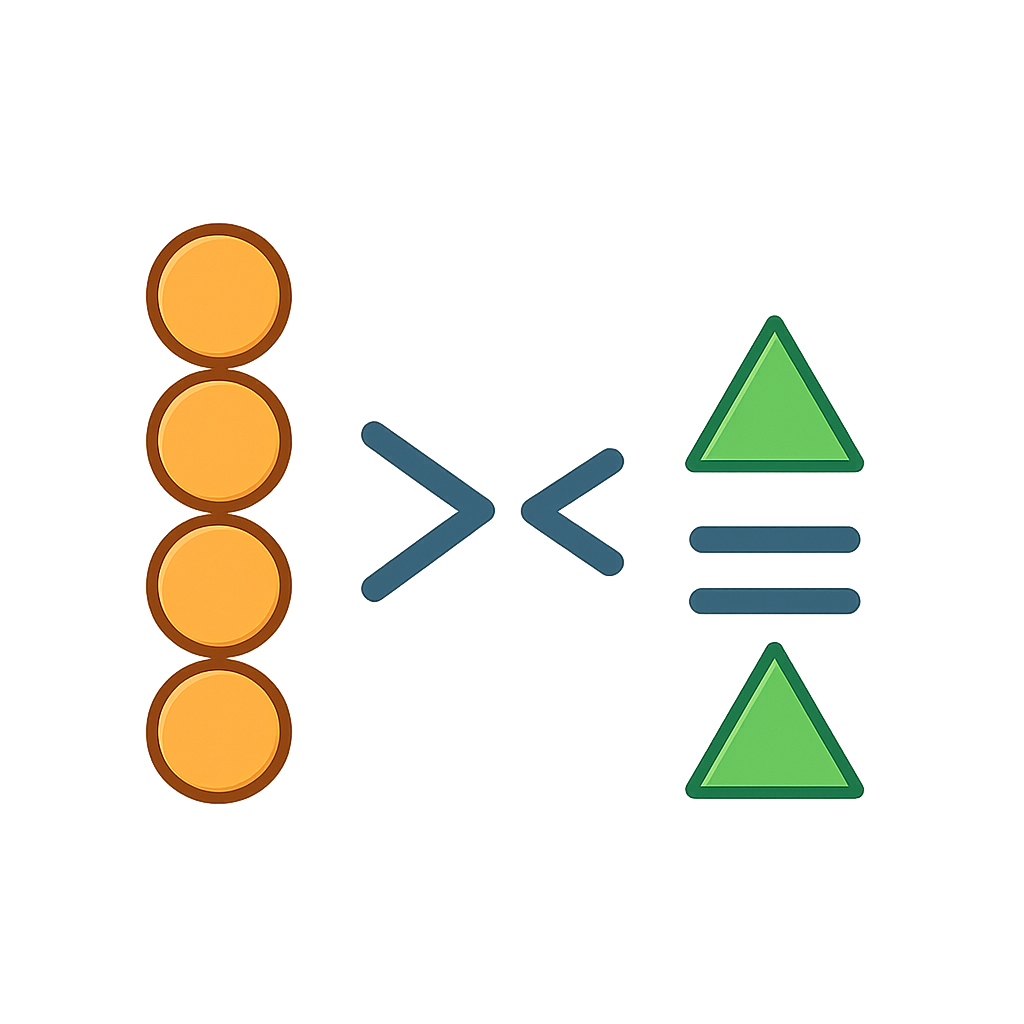
Have you ever looked at two piles of sparkly stickers and tried to figure out which one to choose. You probably wanted the pile with MORE. Or have you ever shared your crackers with a friend and made sure you both had the very same number. You were making the piles EQUAL. Maybe you felt sad if your sibling got a bigger scoop of ice cream, and you got LESS. When you do this, you are using me. I am a secret helper inside your brain that lets you look at groups of things and understand them. I don't have a color or a shape, but I am everywhere. I am in your toy box, on your dinner plate, and in every game you play. I am the idea of Comparing Numbers, and I help you know what is More, Less, or Equal.
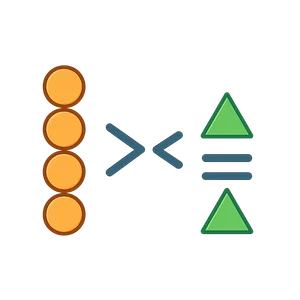
I am as old as people. A very long time ago, around 20,000 BCE, early humans would use me to make sure everyone in their family had food. They might scratch lines on a piece of bone, one for each person and one for each piece of fruit, to see if they had enough. Later, around 3500 BCE in a place called Mesopotamia, farmers used me to keep track of their grain. They would write down numbers on clay tablets to see if their harvest was MORE or LESS than the year before. The Ancient Egyptians, around 3000 BCE, also used me to build their amazing pyramids, making sure walls had an EQUAL number of blocks to be strong and sturdy. For thousands of years, people had to write out long sentences to explain me. But then, some clever people gave me my own symbols. In 1557, a mathematician from Wales named Robert Recorde invented the equals sign (=). He chose two little parallel lines because he said nothing could be more equal. Then, in 1631, a man named Thomas Harriot created my other two special signs: < (less than) and > (greater than). They look like hungry alligator mouths that always want to chomp the bigger number.
More, Less, and Equal: My Story
Have you ever looked at two piles of sparkly stickers and tried to figure out which one to choose. You probably wanted the pile with MORE. Or have you ever shared your crackers with a friend and made sure you both had the very same number. You were making the piles EQUAL. Maybe you felt sad if your sibling got a bigger scoop of ice cream, and you got LESS. When you do this, you are using me. I am a secret helper inside your brain that lets you look at groups of things and understand them. I don't have a color or a shape, but I am everywhere. I am in your toy box, on your dinner plate, and in every game you play. I am the idea of Comparing Numbers, and I help you know what is More, Less, or Equal.
I am as old as people. A very long time ago, around 20,000 BCE, early humans would use me to make sure everyone in their family had food. They might scratch lines on a piece of bone, one for each person and one for each piece of fruit, to see if they had enough. Later, around 3500 BCE in a place called Mesopotamia, farmers used me to keep track of their grain. They would write down numbers on clay tablets to see if their harvest was MORE or LESS than the year before. The Ancient Egyptians, around 3000 BCE, also used me to build their amazing pyramids, making sure walls had an EQUAL number of blocks to be strong and sturdy. For thousands of years, people had to write out long sentences to explain me. But then, some clever people gave me my own symbols. In 1557, a mathematician from Wales named Robert Recorde invented the equals sign (=). He chose two little parallel lines because he said nothing could be more equal. Then, in 1631, a man named Thomas Harriot created my other two special signs: < (less than) and > (greater than). They look like hungry alligator mouths that always want to chomp the bigger number.
Today, I am still with you, helping you make sense of the world. When you play a board game, you use me to see who has MORE points to win. When you help bake cookies, you use me to check if you have LESS than a cup of sugar. When you line up with your classmates, you can see if your line is EQUAL to the other line. I help make things fair, I help you make smart choices, and I make numbers feel like a fun puzzle. So next time you share your toys, count your birthday candles, or see who is taller, remember me. I am Comparing Numbers, and I’m here to help you understand your amazing world, one number at a time.
Wow facts
About
The fundamental mathematical concept of determining whether one quantity is greater than, less than, or equal to another, and the history of its symbols.
Take a Quiz
Question 1 of 4
Why did Robert Recorde choose two parallel lines for the equals sign (=)?
Explore next



Want to do even more?
Go beyond exploring. Unlock tools that turn every story into real learning.

Storypie Plus for families
Full stories, quizzes, and printables. Nights and car rides, sorted.
- Unlimited audio stories
- Create Mode: your child stars in the story
- Offline downloads
- Printable worksheets & coloring pages

Why Storypie for Schools
Students engaged. Prep in seconds. Evenings back to you.
- Worksheets & Quizzes
- Classroom Management
- Formative Assessment
- Custom Curriculum & Lesson Plans
- 27 Languages

Why Storypie for Homeschool
Curriculum done. They'll ask for more. Hours back in your day.
- Worksheet Generator
- First-Person Audio Stories
- Built-in Comprehension Quizzes
- Custom Curriculum & Lesson Plans
- Print & Go Activities