
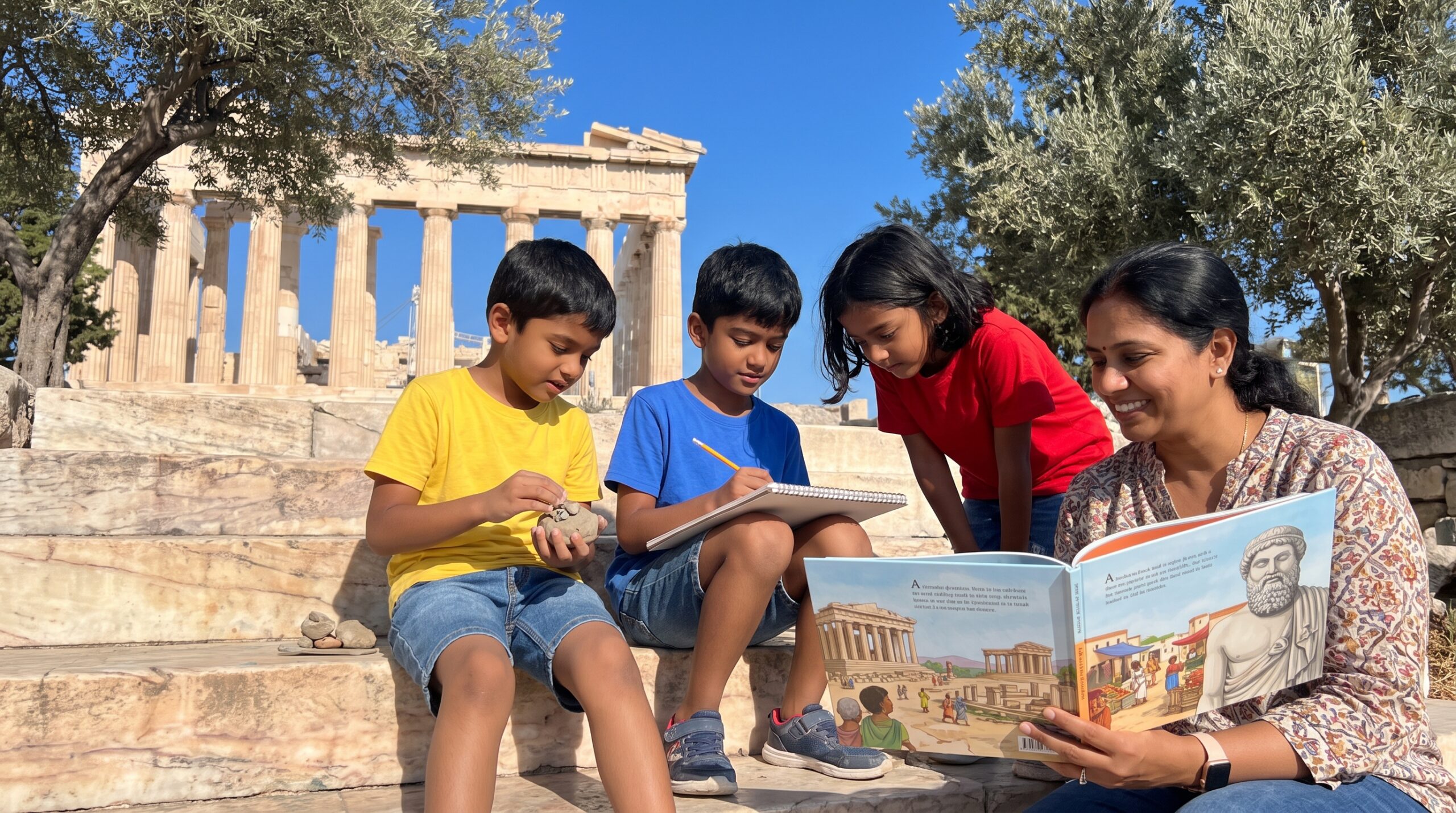
Ancient Athens for kids begins with a map and a story. First, hold a map and point to the Acropolis. Say the names out loud together: Athens, ah-KROP-uh-lis, PAR-thee-non, uh-GOR-uh, SAHK-ruh-teez. Short, playful practice helps words stick and sparks curiosity fast.
Quick timeline your child can follow
Start small. Then build on a few clear moments. Here is a simple timeline your child can follow:
- Mycenaean roots: people lived here very long ago.
- Archaic period: the city grows and the alphabet arrives, about 8th to 6th centuries BCE.
- Classical or Golden Age: the 5th century BCE. The Parthenon was built. Drama and philosophy flowered.
- After the Peloponnesian War: Athens lost power and the city changed.
What made Ancient Athens special
Athens was a polis, a small city-state with lively debates and laws. Around 508 to 507 BCE, Cleisthenes reshaped government and invited citizens to take part. The Assembly, called the ekklesia, let men vote on laws. Also, the Council of 500, the Boule, managed daily tasks. Big juries settled court cases, and sometimes citizens used ostracism to exile a rival for ten years. During this period, the population of Athens is estimated to have been between 250,000 and 300,000 inhabitants, showcasing its significance as a bustling center of culture and governance.
Buildings, art and loud festivals
The Acropolis sits high on a rocky hill and holds the Parthenon. Built from 447 to 432 BCE, the Parthenon shouts marble praise to the goddess Athena. The Acropolis of Athens, a UNESCO World Heritage Site since 1987, receives over 4 million visitors annually, highlighting its enduring legacy. Nearby, the Erechtheion has caryatid columns carved like women. Pottery shows black-figure and red-figure styles. Playwrights filled the Theater of Dionysus with tragedies and comedies. Can you imagine actors calling lines under the bright sun? It makes quite a picture.
Philosophy, schools and big questions
Socrates walked the Agora asking questions. He loved short, hard questions that made people think. His students include Plato and Aristotle. Their ideas still travel the world today. In brief lessons, try one Socratic question with your child, such as Why did the city choose this law? It will build curiosity like magic.
Daily life and rules to notice
Athens made money from olives, wine and silver from nearby mines. Approximately 90% of the citizen population in Athens around 600 BCE was partially or wholly dependent on wage labor, decreasing to about 55% by 322 BCE. Not everyone counted as a citizen. Free-born men with Athenian parents had political rights. Women, metics, and enslaved people lived differently. I explain this simply and age-appropriately so kids learn both wonder and limits.
A tiny activity and a gentle prompt
Try this six-minute drawing: pick one building, one statue, and one festival. Ask your child to name their favorite part and why. Next, record your child saying one sentence about Athens. Then save it on Storypie and play it back next week. Small acts help stories live.
Read or listen to a story about Ancient Athens now: For 3-5 year olds, For 6-8 year olds, For 8-10 year olds, and For 10-12 year olds.
Finally, explore more stories and activities at Storypie. Enjoy the adventure together.