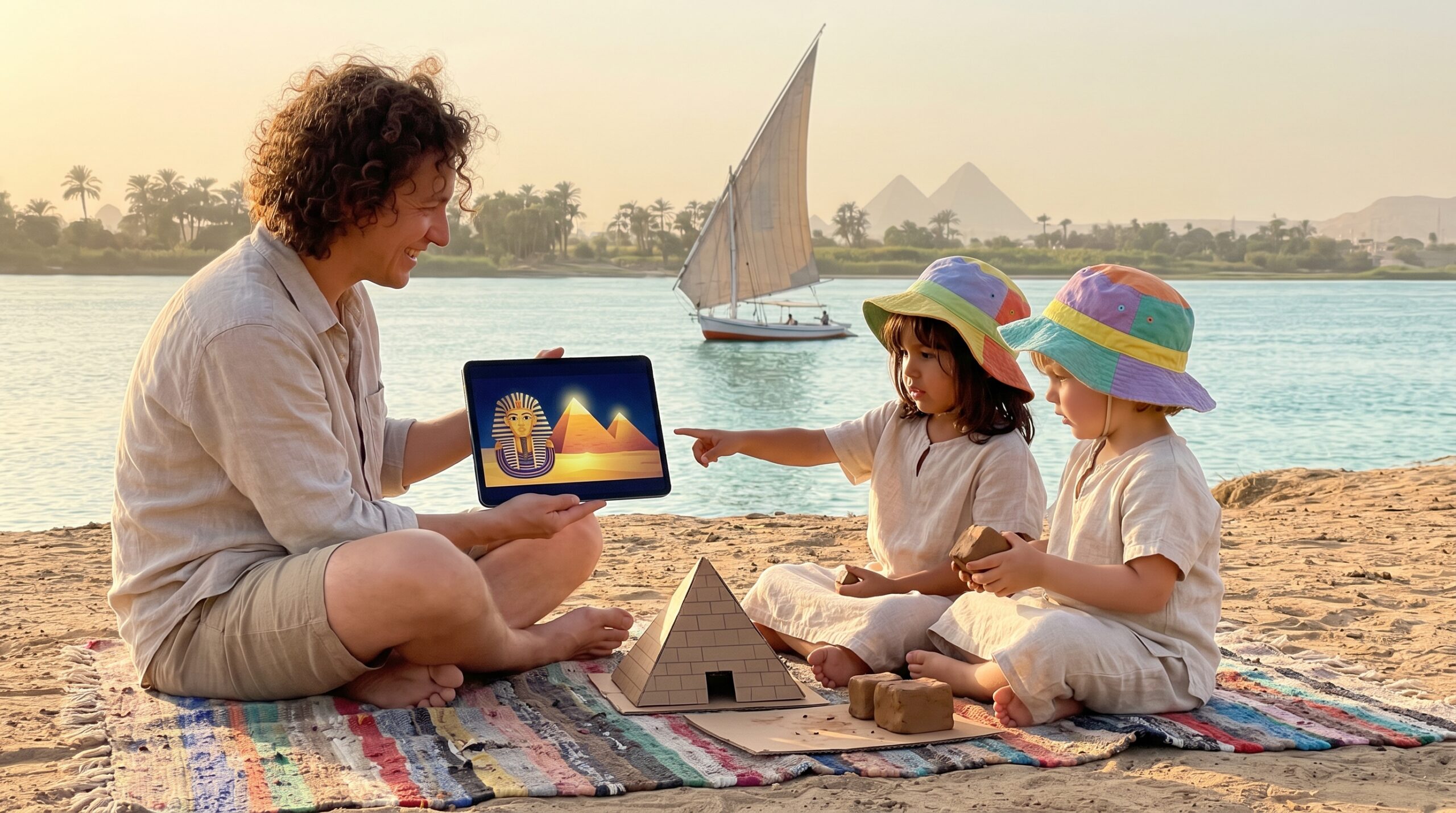
Ancient Egypt for kids begins by the Nile. Listen to warm air, reed rustle, and river birds. Imagine a late-summer afternoon with boats and mudbrick houses. Then, meet pharaohs and pyramids. Spark big questions and wide-eyed wonder.
Read or listen to a story about Egypt now: Read or listen to a story about Egypt now: For 3-5 year olds, For 6-8 year olds, For 8-10 year olds, and For 10-12 year olds.
Ancient Egypt for kids: The Nile and daily life
The Nile shaped everything. At about 6,650 km long, the Nile is the world’s longest river. It flows north to the Mediterranean. Floods left rich soil for farms. Farmers planted wheat, barley, and flax. The calendar followed the flood cycle. In short, the river set the rhythm of life.
Pharaohs, pyramids, and the Sphinx
Pharaohs ruled as kings who stood close to the gods. They mixed religion, law, and great building projects. Think Khufu and the Great Pyramid. Workers built the pyramids using skill and planning. Nearby, the Sphinx keeps guard with a lion’s body and a human face. In fact, these stones still inspire awe today.
Writing, religion, and knowledge
Religion filled daily life. Egyptians worshiped Ra, Osiris, Isis, Anubis, and many others. They believed the soul faced judgment after death. So people practiced mummification and packed tombs with food and goods. Those tomb items included amulets and pages from the Book of the Dead.
They wrote with hieroglyphs on stone and on papyrus. Papyrus came from the papyrus plant. Later, the Rosetta Stone helped scholars read hieroglyphs. Egyptians used a 365-day calendar. Also, they used math for surveying and architecture. Their medicine and engineering were advanced for the time.
Homes, cities, and children
Homes were made of mudbrick. Cities like Memphis and Thebes bustled with trade. Markets, crafts, and schools appeared in busy streets. Kids played and learned simple crafts. Food often included bread, beer, vegetables, dates, and fish. Families lived close to the river and its goods.
Modern Egypt today
Modern Egypt remains a living country of about 114.5 million people, with a median age of just 25 years, which reflects a youthful demographic that faces various social and economic challenges according to PopulationPyramid.net. The country’s Gross Domestic Product (GDP) in 2023 was $396 billion, with a growth rate of 3.76% as reported by Worldometer. Cities such as Cairo, Alexandria, Luxor, and Aswan buzz with life. Museums hold mummies and huge stones. Kids still love the stories of gods and pharaohs. For families and teachers, Egypt offers rich history and real places to explore.
Pronunciation and quick glossary
Say pharaoh as /ˈfɛərəʊ/ and Nile as /naɪl/. Glossary terms include papyrus, hieroglyph, mummy, and sarcophagus. These simple words unlock big ideas.
Hands-on ideas and conversation starters
Try simple activities at home. For example, build a small pyramid from cardboard. Or make “papyrus” from coffee filters. Also, map the Nile on a sheet of paper. Then ask: If you were a pharaoh, what would you build? What would you take to your tomb? These questions boost imagination and curiosity.
Finally, if you want stories that match ages, revisit the Storypie pages above. Also explore Storypie for related history stories. Enjoy the wonder of Egypt and share it together.