I tell bedtime stories for a living and I still get goosebumps at the Apollo 11 mission for kids. The human story feels simple and wow. Three people boarded one giant rocket. One tiny step felt enormous and hopeful. Also, the moment turns dates and names into real adventure for a child.
Apollo 11 mission for kids: A short human story
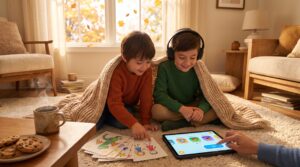
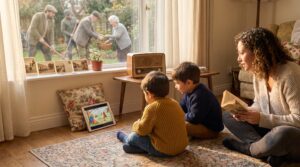
This summer, Storypie brings Neil Armstrong’s Apollo 11 story, perfect for curious kids. For parents, the story makes history friendly and bright. Then, ask your child what they would explore to spark imagination and conversation. Also, listening together makes the mission feel close and warm.
Quick facts parents can use
Here are fast, clear facts you can share at bedtime or at the kitchen table. Use them to answer curious questions simply.
- Apollo 11 was the first crewed mission to land humans on the Moon and bring them home safely.
- The crew: Commander Neil A. Armstrong, Command Module Pilot Michael Collins, and Lunar Module Pilot Edwin “Buzz” Aldrin.
- The rocket was a Saturn V and the command module was Columbia.
- The lunar lander was Eagle. Launch happened from Kennedy Space Center, Launch Complex 39A, on July 16, 1969, at 9:32 a.m. EDT.
- Eagle touched down in the Sea of Tranquility on July 20, 1969, at 4:18 p.m. EDT, with only 30 seconds of fuel remaining. Armstrong stepped onto lunar soil early on July 21, 1969 UTC.
- The mission lasted about eight days and ended with splashdown on July 24, 1969. The total duration of the Apollo 11 mission was 8 days, 3 hours, 18 minutes, and 35 seconds, during which the spacecraft covered a distance of 953,054 miles.
Major milestones and timeline
The mission moved in clear, dramatic steps. First came translunar injection, which sent them toward the Moon. Next, Columbia stayed in lunar orbit with Michael Collins onboard. Then, Eagle descended to the surface and landed at Tranquility Base. Armstrong left the ladder first and said the famous line, “That’s one small step for a man, one giant leap for mankind.” Also, Buzz joined him and they walked for about two and a half hours on their main EVA, during which they spent a total of 21 hours, 36 minutes on the lunar surface, collecting about 47.52 pounds (21.55 kilograms) of lunar samples. Finally, they spent about 21 to 22 hours on the surface before lifting off to rejoin Collins.
Experiments, moon rocks, and traces
The mission brought back 21.55 kilograms of moon rocks and soil. Also, the astronauts left experiments such as a passive seismic sensor and a laser ranging retroreflector. Scientists still use that device today to measure the exact distance to the Moon. They also left a small plaque and an American flag. Because the Moon has no wind, footprints and gear can remain in place for a very long time. Those tiny explorer traces feel like a frozen story on the lunar surface.
Read or listen and try a small challenge
Read or listen to a story about Apollo 11 Mission now: Read or listen to a story about Apollo 11 Mission now: For 3-5 year olds, For 6-8 year olds, For 8-10 year olds, and For 10-12 year olds.
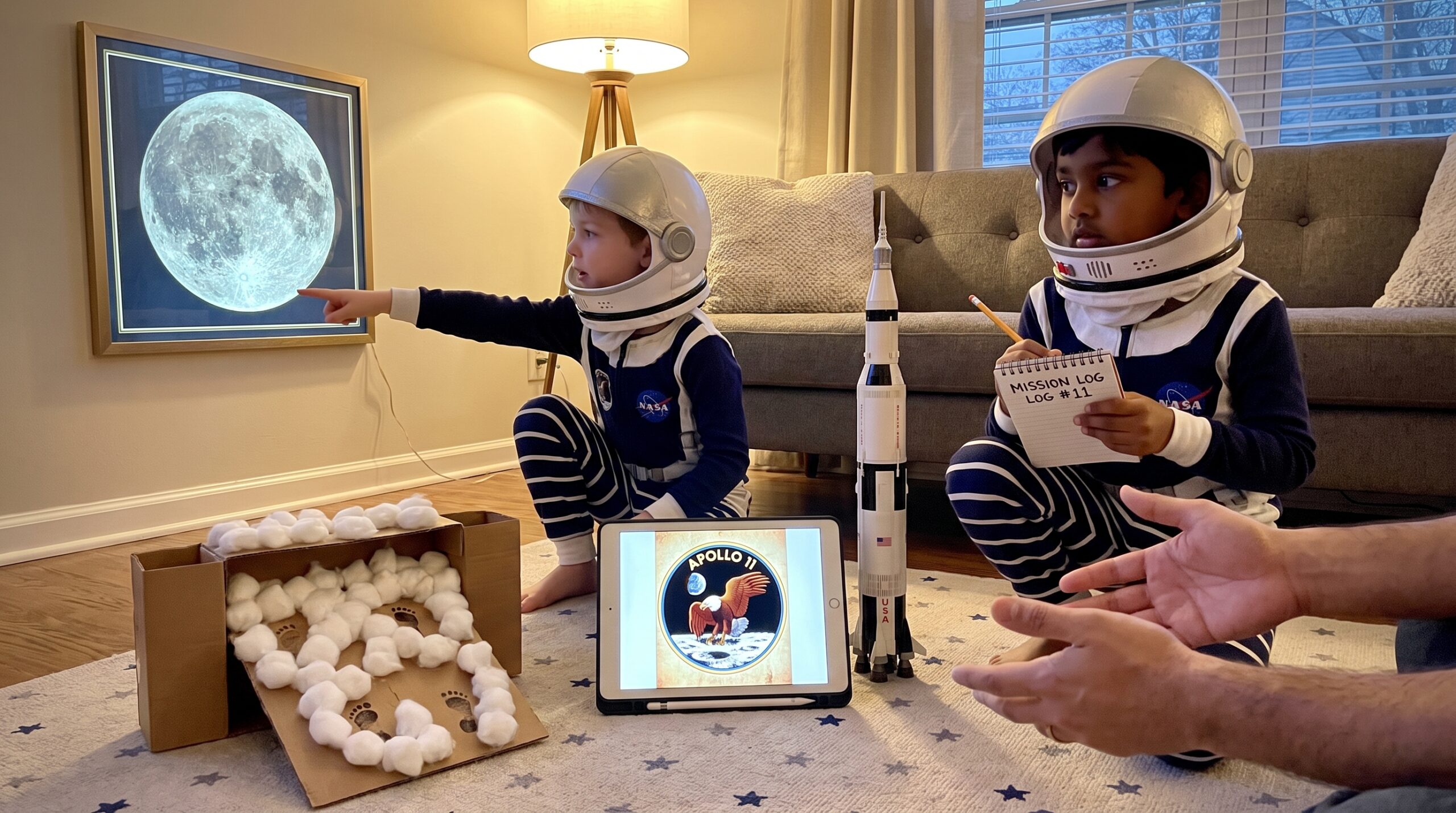
Try a simple at-home activity. Build a paper Saturn V or fold a tiny Eagle from cardboard. Make a table scale of Earth and Moon and count the steps to the Moon. Next, ask your child to pack a one-day Moon backpack with three items. Then, let them explain their choices. This playful work turns facts into curiosity and fun. Also, it creates a small family memory.
Why the Apollo 11 mission for kids still matters
Apollo 11 shows teamwork, careful planning, and courage. Thousands of people on the ground helped the three astronauts. Also, the mission changed how we study the Moon. Scientists still examine the rocks returned by Apollo 11. Meanwhile, the retroreflector remains useful for precise measurements today. The Command Module “Columbia” re-entered Earth’s atmosphere at 24,000 miles per hour (39,000 kilometers per hour) on July 24, 1969, creating a fireball as it heated to more than 5,000 degrees Fahrenheit, illustrating the dramatic conclusion of the mission.
Tonight, try a tiny challenge. Tell the Apollo 11 story in six sentences in your own voice. Record it. Save it. Then celebrate a small out-of-this-world win with your child. If you like, open the Storypie app to explore more space stories and episodes about explorers and science.