
Read or listen to a story about Asteroids now: For 3-5 year olds, For 6-8 year olds, For 8-10 year olds, and For 10-12 year olds.
Asteroids for kids opens a tiny door to the earliest days of our solar system. These rocky leftovers feel like time capsules. Also, they come in many surprising sizes. Some are pebbles. Some are nearly round worlds. Each one holds clues that are 4.6 billion years old.
Asteroids for Kids: Where They Live
Most asteroids orbit the Sun between Mars and Jupiter. This area is the main asteroid belt. However, not all asteroids stay there. Some wander near Earth. Others follow Jupiter as Trojans. In addition, a few live far beyond, in colder zones. Astronomers watch near-Earth asteroids closely. According to NASA’s Office of Inspector General, more than 38,000 near-Earth asteroids of all sizes have been discovered, with estimates suggesting that about 45% of those that are 140 meters in diameter or larger have been identified. This helps us assess risk and plan responses if needed.
What Asteroids Are Made Of
Asteroids show clear variety. First, carbon-rich C types are dark and may contain water-bearing minerals. Next, stony S types look silvery and rocky. Finally, metallic M types contain nickel and iron. Sizes range from tiny rocks to bodies hundreds of kilometers wide. For example, Ceres is round enough to be a dwarf planet.
Why Asteroids Matter
Think of asteroids as frozen storybooks. Many meteorites that reach Earth are pieces of asteroids. They carry organic molecules and ancient minerals. Thus, they tell scientists how planets formed. In addition, studying asteroids helps researchers test whether life’s ingredients were common early on.
Robotic Missions and Surprises
Robots have visited these rocks for decades. Missions have orbited, landed, sampled, and returned pieces to Earth. For example, Dawn, Hayabusa, Hayabusa2, OSIRIS-REx, and DART each taught us new things. Notably, NASA’s OSIRIS‑REx sample-return mission successfully delivered a bulk sample of 121.6 grams from asteroid Bennu to Earth, marking a significant achievement in asteroid research. Also, DART nudged an asteroid to test planetary defense. These missions make space science feel personal and vivid.
A Calm Note on Hazards
Large, extinction-level impacts are extremely rare. However, smaller impacts happen more often. Therefore, surveys catalog tens of thousands of near-Earth asteroids. For instance, on December 27, 2024, the Asteroid Terrestrial-impact Last Alert System (ATLAS) in Chile discovered asteroid 2024 YR4, estimated to be between 174 and 220 feet in diameter. International teams track them and run response tests. As of April 2, 2025, NASA’s Center for Near Earth Object Studies updated the probability of asteroid 2024 YR4 impacting the Moon on December 22, 2032, to 3.8%, with a 96.2% chance it will miss the Moon. This work keeps our planet safer and our curiosity grounded.
Simple Backyard Ways In
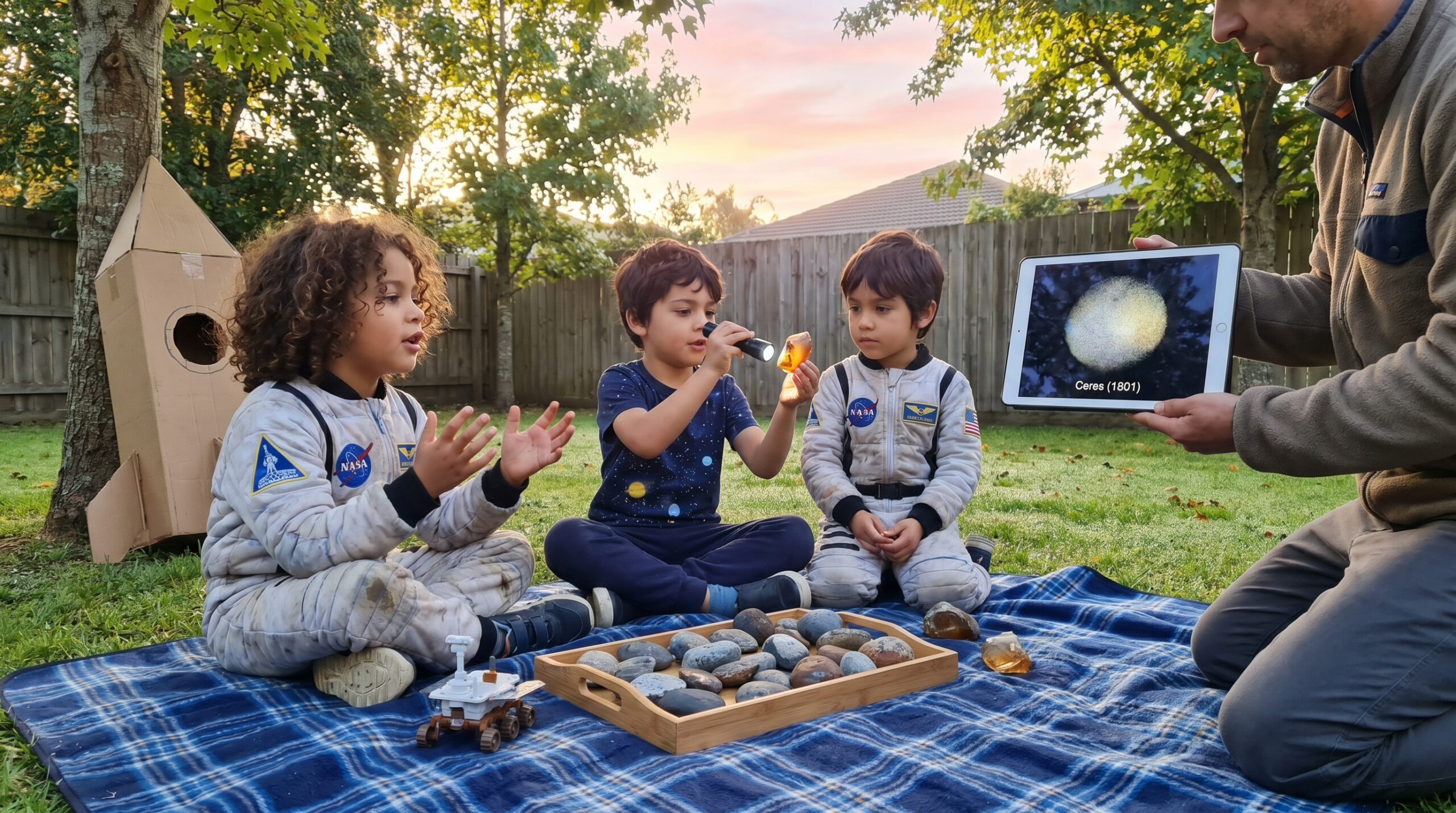
Try a short backyard space walk this weekend. Ask your child to imagine an asteroid interior. Then make a two-minute story about what is inside. Also, use binoculars or a star app to spot a bright asteroid or Vesta on a dark night. Finally, visit a local museum to see meteorites up close.
Keep explanations short and hands-on. A pebble becomes a planetesimal. A bowl of rocks shows diversity. For more playful tales and audio, search the Storypie app for asteroid stories. Visit Storypie to follow your child’s curiosity.
Read more and explore stories at Storypie.