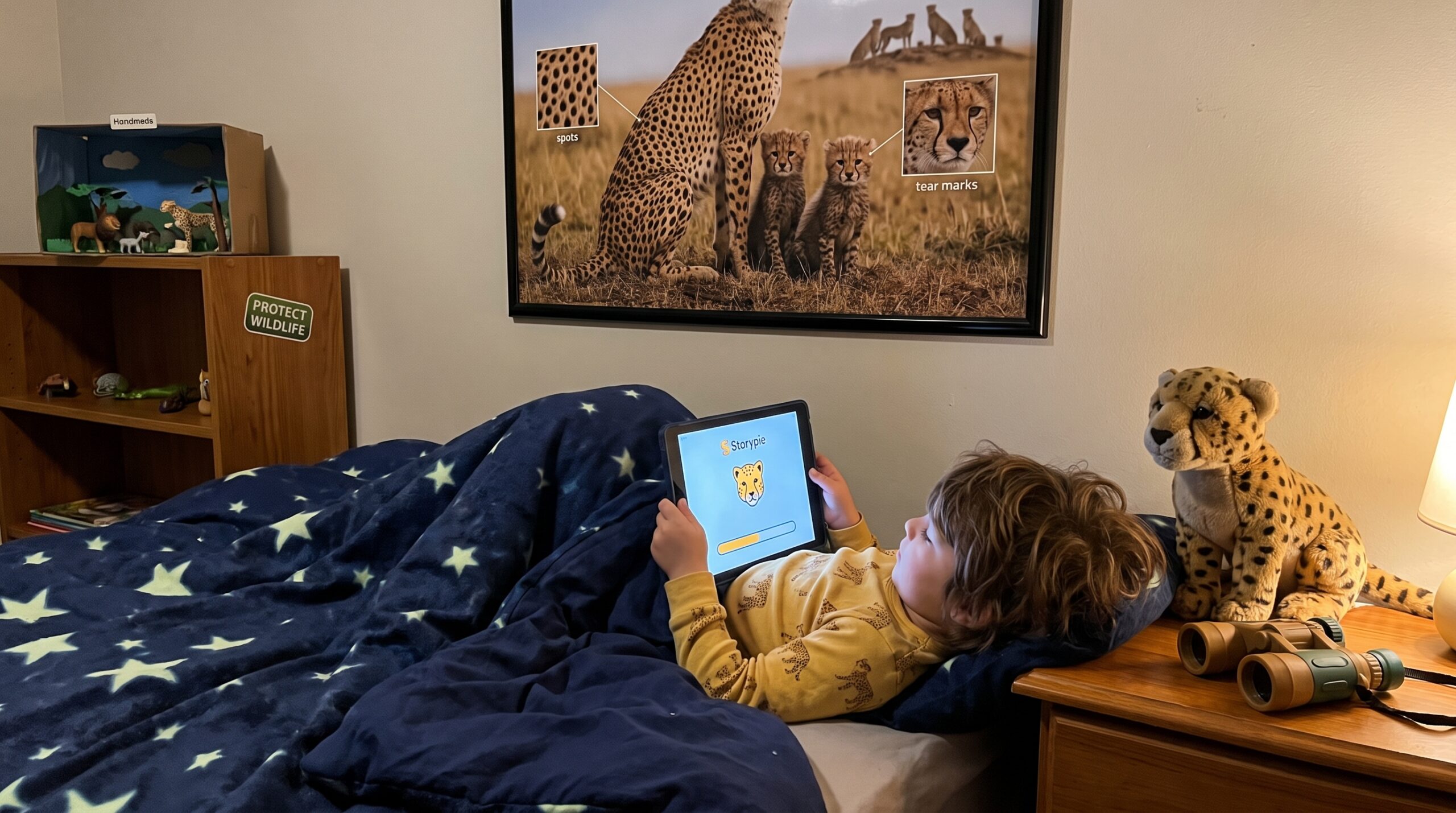
I love saying CHEE-tah with my kids because it makes cheetah facts for kids stick. The word cheetah comes from Hindi and Sanskrit roots, like chita, which means spotted. I whisper the name like a little drumroll and watch the facts settle in.
Quick cheetah facts for kids
Look at the face. Dark tear marks run from the inner eye to the mouth. I tell my child they act like sun shades for the eyes. They cut glare and help the cheetah focus on fast prey. The coat is tan with round black spots, and each pattern is unique like a fingerprint.
Speed and body built for sprinting
Now speed. A cheetah can sprint as fast as a car on a quiet street. They accelerate from zero to highway-like speed in just over three seconds, reaching about 70 miles per hour in bursts, though runs stay short. A chase usually lasts under 30 seconds and covers a few hundred meters. That is why cheetahs hunt by sight, stalk close, then explode into a sprint.
Built for speed, the cheetah’s body is skinny and long. Its flexible spine stretches each stride. Long legs and semi-retractable claws add traction. A long tail steers like a rudder. Big nasal passages, lungs, and a strong heart send oxygen to muscles during a sprint. I sketch these adaptations on a napkin while we whisper the story.
Life, family, and where they live
Cheetah life is layered. Females tend to be solitary except when raising cubs. Males sometimes form coalitions, often brothers, that hold territory and hunt together. After a 90 to 95 day pregnancy, mothers give birth to two to six cubs. However, in the wild, cheetah cub survival is extremely low—less than 5% of cubs survive—while most adult cheetahs live only between 6 and 8 years, with high mortality around age 2, illustrating the tough challenges they face.
Cubs have a silvery mantle and face many dangers. Predators like lions and hyenas take a heavy toll, and cub mortality can be as high as 90% even in protected areas like national parks and wildlife reserves, where proximity to large predators is greater than in non-protected areas. Wild cheetahs live mostly in sub-Saharan Africa. A tiny Asiatic population survives in Iran. They prefer open savanna where gazelles and impala roam. Also, cheetahs often hunt by day to avoid competition from lions and hyenas.
Conservation matters
Today cheetahs are listed as vulnerable and populations are fragmented. As of 2016, there were approximately 7,100 cheetahs left in the wild, occupying only about 6%–9% of their historical range; 77% of that remaining range lies outside protected areas. Families can help by learning and supporting reputable groups. When you visit reserves, stay in a vehicle and keep distance. Never feed or approach wild animals.
Three quick quiz facts before lights out
- What do tear marks do?
- Who might form a male coalition?
- What part of the cheetah acts like a steering wheel?
Read or listen to a story about Cheetah now: For 3-5 year olds, For 6-8 year olds, For 8-10 year olds, and For 10-12 year olds.
Also, try a tiny activity: ask your child to draw a cheetah and label the tail, spots, and tear marks. Short, playful, and sticky learning works best.
Finally, you can find more cheetah stories and resources on Storypie. For listening on the go, get the Storypie app.