Cold War for kids is a gentle way to explain a long, intense rivalry that shaped the modern world. This guide offers clear facts, bright examples, and hopeful context for families and teachers.
What was the Cold War for kids?
The Cold War was a global rivalry after World War II. It ran from March 12, 1947 to December 26, 1991, lasting approximately 44 years and 9 months. The United States and its allies faced the Soviet Union and its allies. It was mostly a contest of ideas, influence, and technology rather than one single battlefield.
Key moments and dates
Here are major events that mark the Cold War timeline. Each short line tells what happened and why it mattered.
- 1947 – Truman Doctrine and containment began. The United States aimed to slow Soviet influence.
- 1948 to 1949 – Berlin Blockade and Airlift. Planes brought food and fuel into West Berlin for nearly a year.
- 1949 – NATO formed. 1955 – Warsaw Pact formed. Europe split into rival defense groups behind an Iron Curtain.
- 1950 to 1953 – Korean War. This was a hot war that split Korea into North and South.
- 1957 and 1961 – Sputnik and Yuri Gagarin launched the Space Race. People felt both wonder and worry.
- 1961 to 1989 – The Berlin Wall stood as a strong symbol of division for 28 years. In 1989 people celebrated when it opened.
- 1962 – Cuban Missile Crisis lasted 13 tense days. Leaders negotiated to avoid nuclear war.
- 1960s to 1970s – Vietnam and other proxy wars tested influence around the globe.
- 1970s to 1980s – Détente and arms talks slowed parts of the arms race with treaties.
- 1985 to 1991 – Gorbachev introduced reforms called glasnost and perestroika. The Soviet Union fell in 1991, and the Cold War ended.
Why the Cold War mattered
The Cold War changed everyday life. People practiced civil defense drills. Movies and music reflected fear and hope. Meanwhile, science and technology moved faster because of the rivalry.
Also, the Cold War shaped computing and space research. Different countries remember the era in different ways. Look for local stories and voices for a fuller view. During this period, the Soviet Union allocated approximately 13.8% of its gross available resources to defense, compared to 6.5% in the United States, highlighting the significant economic commitment both superpowers made to military readiness.
Simple ways to notice the Cold War today
Short signs still appear in museums, books, and city landmarks. For example, old bunkers, museum displays, and space exhibits all hint at Cold War priorities.
Gentle prompts for family conversation
Try a few quick questions to spark curiosity. They can help children think about ideas, not just battles.
- Ask: How might people solve a big problem without fighting?
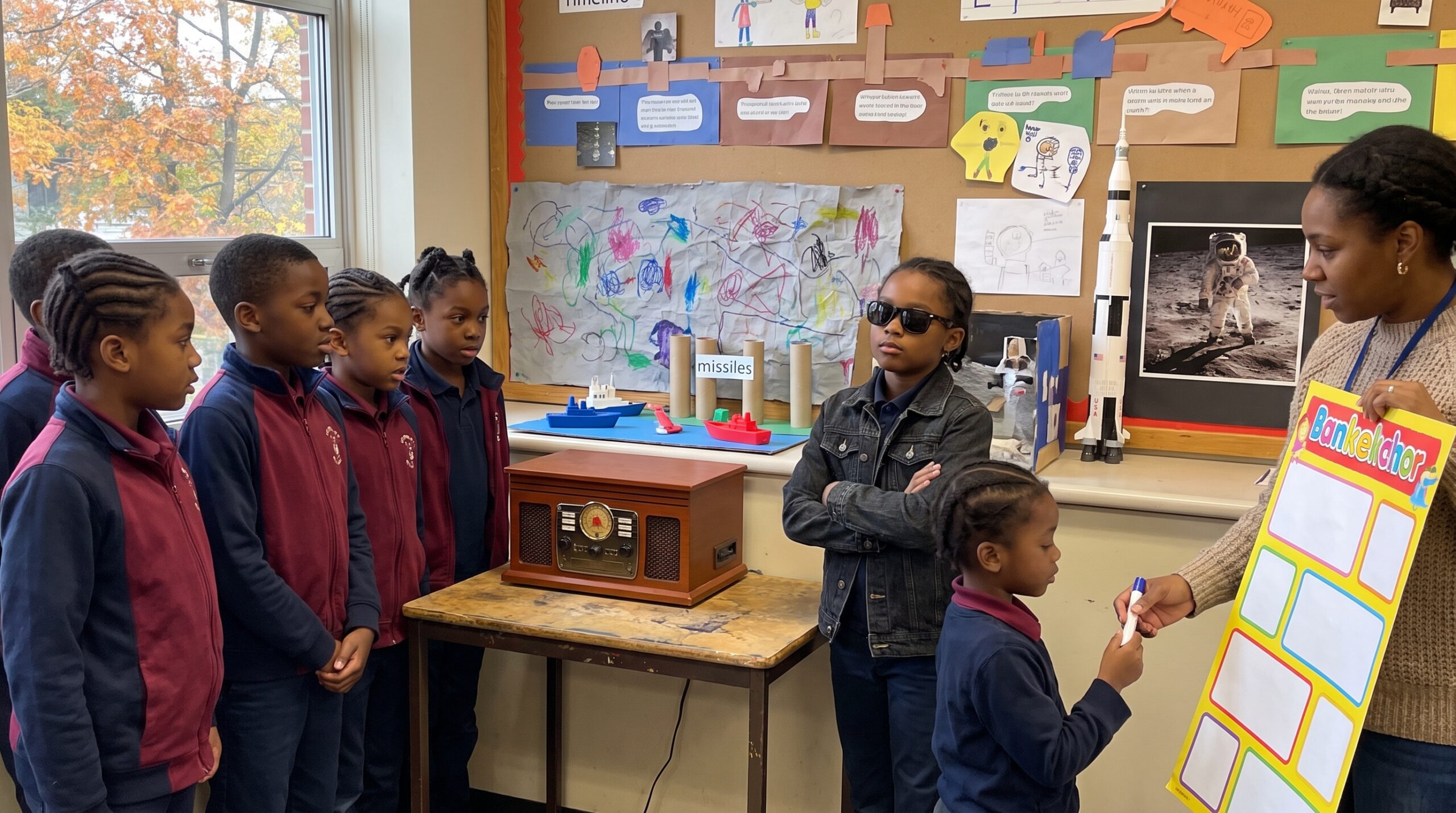
- Create a tiny timeline with stickers for 1947, 1957, 1962, 1969, 1989, and 1991.
- Compare diplomacy and arms in a simple two-column chart.
These short prompts invite empathy and calm reflection about a complex era.
Read or listen to a story about Cold War now: Read or listen to a story about Cold War now: For 3-5 year olds, For 6-8 year olds, For 8-10 year olds, and For 10-12 year olds.
Also explore Storypie for more age-appropriate history stories and listening options.
Final thought
Even long rivalries can end through ideas, negotiation, and change. The Cold War shows both danger and hope. Above all, it reminds us that choices and conversations shape history. At its peak, the global inventory of nuclear warheads reached approximately 70,300 in 1986; by the start of 2026, it is estimated to have declined to around 12,321 warheads, illustrating the long-term implications for global security.