
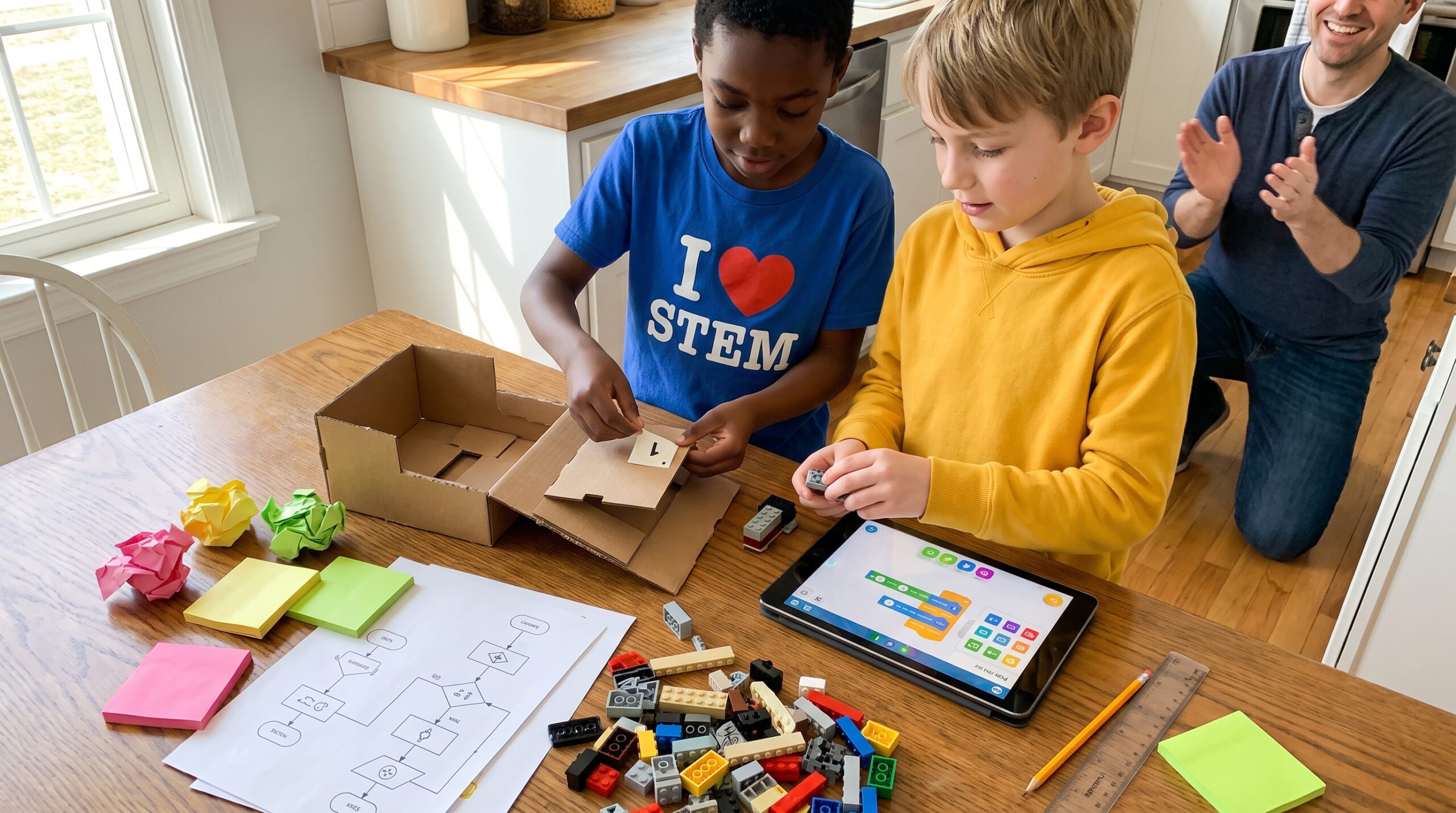
Computational thinking breaking problems into small steps helps children turn huge tasks into tiny, doable moves. It makes a scary job feel like a tiny adventure and a first step into a small triumph.
What is computational thinking breaking problems into small steps?
At its core, computational thinking breaking problems into small steps is a way to solve problems by making them smaller and clearer. The idea uses a few steady moves that kids can use every day. The International Society for Technology in Education (ISTE) and the Computer Science Teachers Association (CSTA) created an operational definition of computational thinking for K–12 education in 2011, emphasizing problem formulation for computer-based solutions.
Core characteristics
- Decompose: Break a big job into bite-sized parts. For example, cleaning a messy room becomes pick up books, sort toys, and put laundry in the basket.
- Pattern recognition: Spot repeats or similarities. For example, sorting socks by color shows a repeatable pattern.
- Abstraction: Keep only what matters. For example, a map might show the path and not every tree.
- Algorithm design: Make a clear step-by-step plan. For example, a morning checklist or a simple recipe.
A short history and why it matters
The phrase gained wide attention after Jeanette M. Wing popularized it in 2006. Earlier roots reach back to Seymour Papert and constructionist learning. Today it informs classrooms and standards worldwide. Research shows that project-based learning significantly enhances students’ computational thinking skills, as highlighted in a meta-analysis of 31 experiments and quasi-experiments published in January 2024.
Importantly, computational thinking breaking problems into small steps is not the same as coding. However, programming gives a great place to practice these core moves.
Everyday examples and age fit
Children see this thinking in small tasks. A child who names the first tiny step toward a chore is practicing decomposition. Building a LEGO model and then writing steps practices algorithm design.
Age guidance helps match activities to ability. Preschoolers benefit from sorting and sequencing cards. Early primary students enjoy short visual algorithms. Older kids can try block coding tools and basic robotics. Teens can reflect on planning and optimization. A recent study found that U.S. eighth-graders achieved an average computational thinking score of 461, which was lower than the international average of 483, indicating an area for improvement in educational strategies. Interestingly, 27% of U.S. students scored at Level 1, higher than the international average of 24%, according to a report by the National Center for Education Statistics.
Why parents and teachers value it
Computational thinking breaking problems into small steps builds persistence and planning. It also builds confidence with tiny, repeatable wins. Teachers use it to clarify tasks. Parents use it to reduce overwhelm. A study published in 2025 evaluated a four-day computational thinking program for secondary students in Melaka, Malaysia, finding an overall mean self-assessment score improvement from 2.45 to 3.71, reflecting a 51.3% improvement, showcasing the tangible benefits of structured educational interventions.
For more examples and age-specific stories, explore Storypie resources. Read or listen to a story about Computational Thinking (Breaking Big Problems into Small Ones) now: Read or listen to a story about Computational Thinking (Breaking Big Problems into Small Ones) now: For 3-5 year olds, For 6-8 year olds, For 8-10 year olds, and For 10-12 year olds.
Finally, computational thinking breaking problems into small steps is a transferable habit. With playful prompts and small cheers, tiny wins can grow into big learning and joyful confidence. The rapid expansion of research in the field of computational thinking is evidenced by a meta-review published in August 2026, which found that 128 systematic reviews and meta-analyses on computational thinking had been published to date, underscoring its growing importance in education.