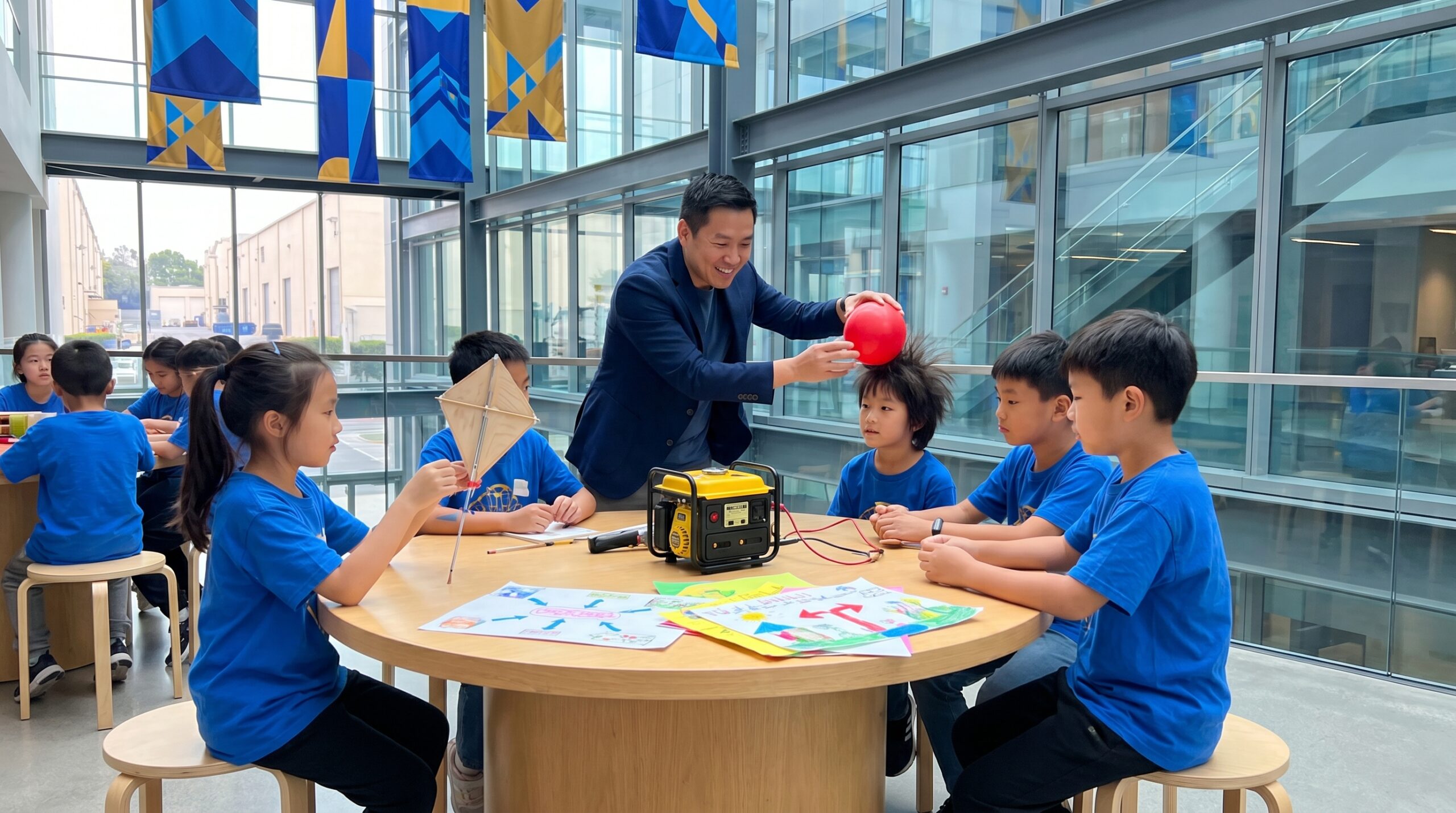
Discovery of electricity for kids opens a door to curiosity and wonder.
Small sparks, big ideas
First, people noticed strange pulls from rubbed amber. The Greeks named amber elektron. That tiny observation planted a seed. In 1600, English physician William Gilbert coined the term “electricity” from the Greek word “elektron” to describe the force that certain substances exert when rubbed against each other.
Next, early investigators made short, bold experiments. William Gilbert separated magnetism from static electricity. Otto von Guericke and Stephen Gray showed charge and conduction. Charles du Fay named two kinds of charge.
Then Benjamin Franklin linked lightning to electricity. On October 19, 1752, he published his account of the kite experiment in The Pennsylvania Gazette, demonstrating that lightning is an electrical phenomenon. He also invented the lightning rod to protect people. Later, Coulomb measured forces between charges. Galvani watched frog legs twitch, and Volta built the first steady battery in 1800, describing the construction of his “voltaic pile” in a letter to Sir Joseph Banks. Ohm gave us the link between voltage, current, and resistance. Faraday showed that moving magnets make electricity through his experiments on electromagnetic induction on August 29, 1831. Finally, Maxwell put electricity and magnetism into one elegant theory. Much later, J. J. Thomson found the electron, and Millikan measured its charge. Tiny electrons explain charge and current today.
Discovery of electricity for kids: Key ideas to keep handy
Also, there are a few simple ideas to tuck into your pocket. Say them out loud. They stick.
- Charge makes things push or pull.
- An electron is a tiny particle with negative charge.
- Current is a flow of charge.
- Voltage is the push that drives current.
- Resistance fights the flow.
- Conductors like copper let charge move easily. Insulators like rubber do not.
Everyday magic and why it matters
Today, lighting, heating, motors, phones, and the web all trace back to electricity. Electrification changed towns, factories, and homes. It became a super-important tool for daily life. In 1882, Thomas Edison opened the Pearl Street power station in New York City, one of the world’s first central electric power plants, capable of powering 5,000 lights.
Moreover, curiosity and hands-on moments build agency and memory. Kids who touch and try remember better. Small wins make big confidence boosts.
Simple, safe demos to spark curiosity
For example, a static balloon-and-hair trick is wonder-filled and safe. Rub a balloon on hair and watch paper bits leap up. Also, a lemon battery can light a small LED. Keep voltages low and adult hands on the tools. Never try kite or lightning experiments in storms.
I tried the lemon battery with my child. We cheered when the LED blinked. That short moment turned an abstract idea into something we both touched.
Read or listen to a story about Discovery of Electricity now: For 3-5 year olds, For 6-8 year olds, For 8-10 year olds, and For 10-12 year olds.
Try a mini-experiment tonight and tell me what you saw. Little sparks of curiosity lead to lifelong wonder.