
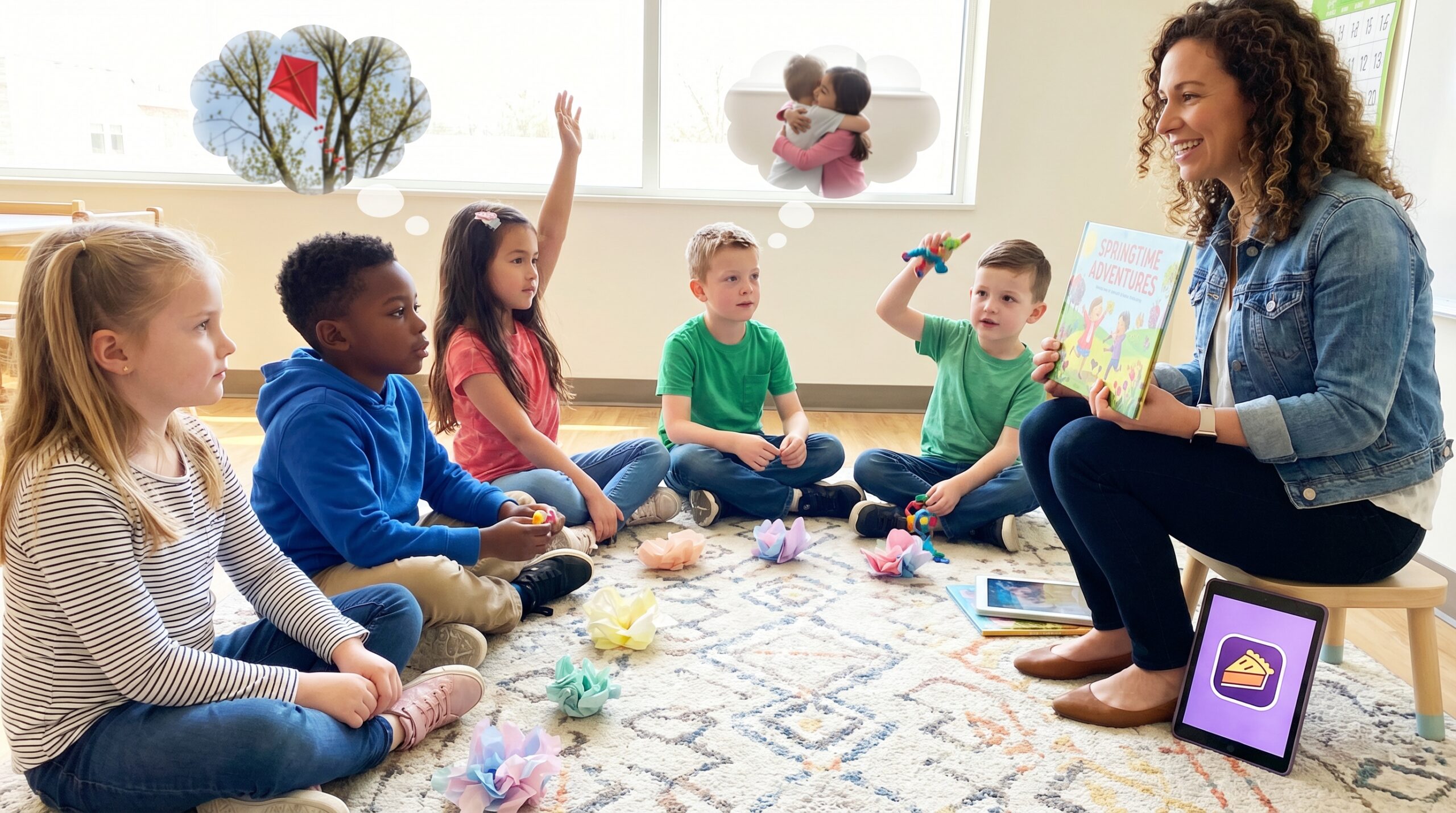
Education through storytelling ages 3-12 helps kids learn and remember. Parents and teachers see how stories shape facts into memorable moments. In short, narratives turn ideas into people and choices into steps a child can imagine.
Why education through storytelling ages 3-12 works
Stories match how the young brain stores events. For example, a clear beginning, a problem, and a solution fit episodic memory. Emotion makes moments stick. When characters feel scared or proud, the brain tags the scene as important. A 2023 study found that children who learned through storytelling retained 70% of the information compared to just 10% when taught through traditional methods, highlighting the effectiveness of storytelling in enhancing information retention.
Research and science in brief
Jerome Bruner argued that people naturally encode experience as story. Later studies supported this idea. Neuroimaging finds a network that tracks event order, perspective, and emotion. Therefore, narrative aligns with brain systems for memory and meaning. Additionally, a longitudinal study published in May 2024 found that storytelling connectedness in children ages 5–8 predicted phonological awareness and reading comprehension measured 3–4 months later, demonstrating the long-term benefits of storytelling on literacy skills.
Benefits across development
Education through storytelling ages 3-12 shows consistent gains. Also, each benefit maps to classroom and home learning.
- Memory: Children recall story events better than isolated facts.
- Language: Exposure to varied sentences builds vocabulary and grammar.
- Comprehension: Narratives train kids to follow cause and effect.
- Social skills: Characters let children explore others feelings safely. Research shows that storytelling contributes 68.2% to the improvement of early childhood empathy skills, especially at the age of 5–6 years, making it a valuable practice for social development.
- Identity and morals: Stories let children imagine choices and values.
Age by age: characteristics and readiness
Ages 3 to 5
Young children prefer short, concrete stories. Bright characters and clear emotions help recall. Repetition reinforces recognition and language patterns.
Ages 6 to 8
Children begin to follow longer plots. They can infer simple causes and predict outcomes. Consequently, stories link facts and reasoning more clearly at this stage.
Ages 9 to 12
Older children juggle multiple viewpoints and abstract themes. In addition, they use narrative to test moral dilemmas and complex problem solving.
Formats and modern context
Oral storytelling, picture books, read alouds, audiobooks, and apps all carry narrative power. For this reason, educators and families use multiple formats to reinforce learning.
Storypie brings age-aligned content and features that support story-based learning. Explore Storypie features for examples and content suited to different ages. Also, find the app to sample narrated stories.
Limits and careful notes
Not every learning goal fits a tale. Some facts need explicit practice to transfer beyond a story. Also, cultural relevance matters. Stories should reflect the child audience and context.
Why it matters
Education through storytelling ages 3-12 is efficient and joyful. For parents and teachers, stories invite attention, build language, and shape social thinking. Therefore, the narrative remains one of the most enduring tools in child learning. Furthermore, a 2024 systematic review of storytelling interventions concluded that storytelling interventions in school settings enhanced psychological resilience in children, reporting reductions in anxiety/depression symptoms and improved emotional regulation and coping.
Learn more on Storypie: Storypie features and Get the Storypie app.