Introduction
Education through storytelling ages 3-12 explains why narrative helps children learn. Stories have guided learning far longer than formal schools have existed. For centuries, families and communities used tale and example to pass on knowledge.
The science behind the keyphrase: Education through storytelling ages 3-12
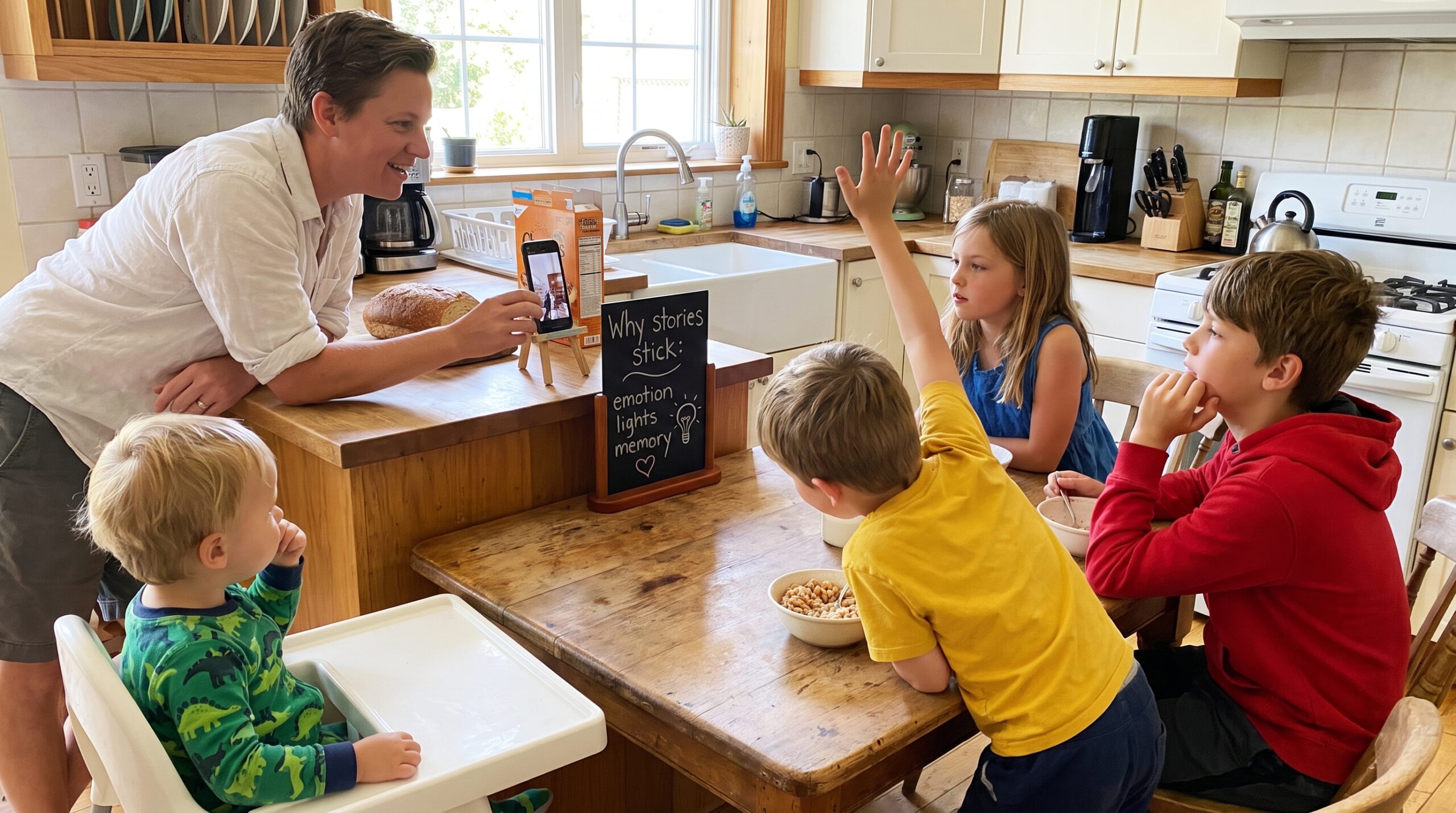
Researchers call narrative a core human way of thinking. Jerome Bruner named story as central to how people organize facts. Neuroscience shows that emotion and memory link tightly. As a result, vivid moments become easier to recall. A 2024 intervention study found that first graders at risk for language-based reading difficulties who received 30-minute narrative-based vocabulary instruction four days a week for 12 weeks showed consistent improvement in definitional knowledge and retention, highlighting the effectiveness of storytelling in enhancing vocabulary retention in early education.
How stories structure information
Stories create clear cause and effect. Therefore they reduce cognitive load and boost comprehension. Also, narrative transportation makes listeners absorb and remember material better. In fact, a 2023 study found that children who learned through storytelling retained 70% of the information, compared to just 10% when taught through traditional methods, emphasizing the superior retention rates associated with storytelling as a teaching method.
How stories fit ages 3 to 12
Education through storytelling ages 3-12 matches developmental stages. Each age group gains different benefits from narrative learning.
Ages 3 to 5
Young children build vocabulary and sequence sense at this stage. Simple plots, repetition, and vivid verbs help words stick. Short audio tales increase listening stamina and attention. A 2023 study found that storytelling contributes 68.2% to the improvement of early childhood empathy skills, especially at the age of 5–6 years, underscoring the role of storytelling in developing essential social-emotional skills in young children.
Ages 6 to 8
Children begin to juggle motives and consequences. Character-focused stories support theory of mind and early moral thinking. In short, narratives scaffold reading and comprehension skills.
Ages 9 to 12
Older children follow multi-threaded plots and themes. Narrative helps them generalize ideas and connect facts to life. Consequently, stories support abstract thinking and deeper understanding.
Cognitive and social benefits
Stories strengthen vocabulary, comprehension, and episodic memory. Repeated characters and motifs reinforce concepts without boring drills. Fiction also builds empathy. Following a character becomes practice in imagining another mind. Additionally, a 2023 study with 62 families found that prompting parents to tell a story before a tinkering activity significantly increased children’s talk about STEM during the activity and in subsequent reflections, illustrating how storytelling can enhance engagement and discussion in STEM learning.
- Vocabulary growth
- Better recall and comprehension
- Enhanced social cognition and empathy
Formats and accessibility
Education through storytelling ages 3-12 works across formats. Picture books, read-alouds, and short audio tales all succeed. Audio-only stories prompt children to imagine scenes, which strengthens mental imagery and listening skills.
Also, radio plays and modern children’s audio follow a long oral tradition. However, not every child has equal access to story-rich environments. Equity matters for learning outcomes.
Evidence and limits
Psychology, education, and neuroscience converge on narrative benefits. Studies show better recall and stronger social-cognitive outcomes than disconnected facts. Still, some goals require direct practice and feedback. Story alone does not replace hands-on learning.
Practical notes and what to expect
Use stories as an engine for learning, not as the entire curriculum. For meaningful gains, pair tales with conversation and activity. Also, repetition matters: returning characters help reinforce ideas over time.
Conclusion
Education through storytelling ages 3-12 offers a simple, stubbornly effective way to organize learning. It connects feeling to meaning, which helps children remember and care. For more story resources and age-focused audio, visit the Storypie homepage.