
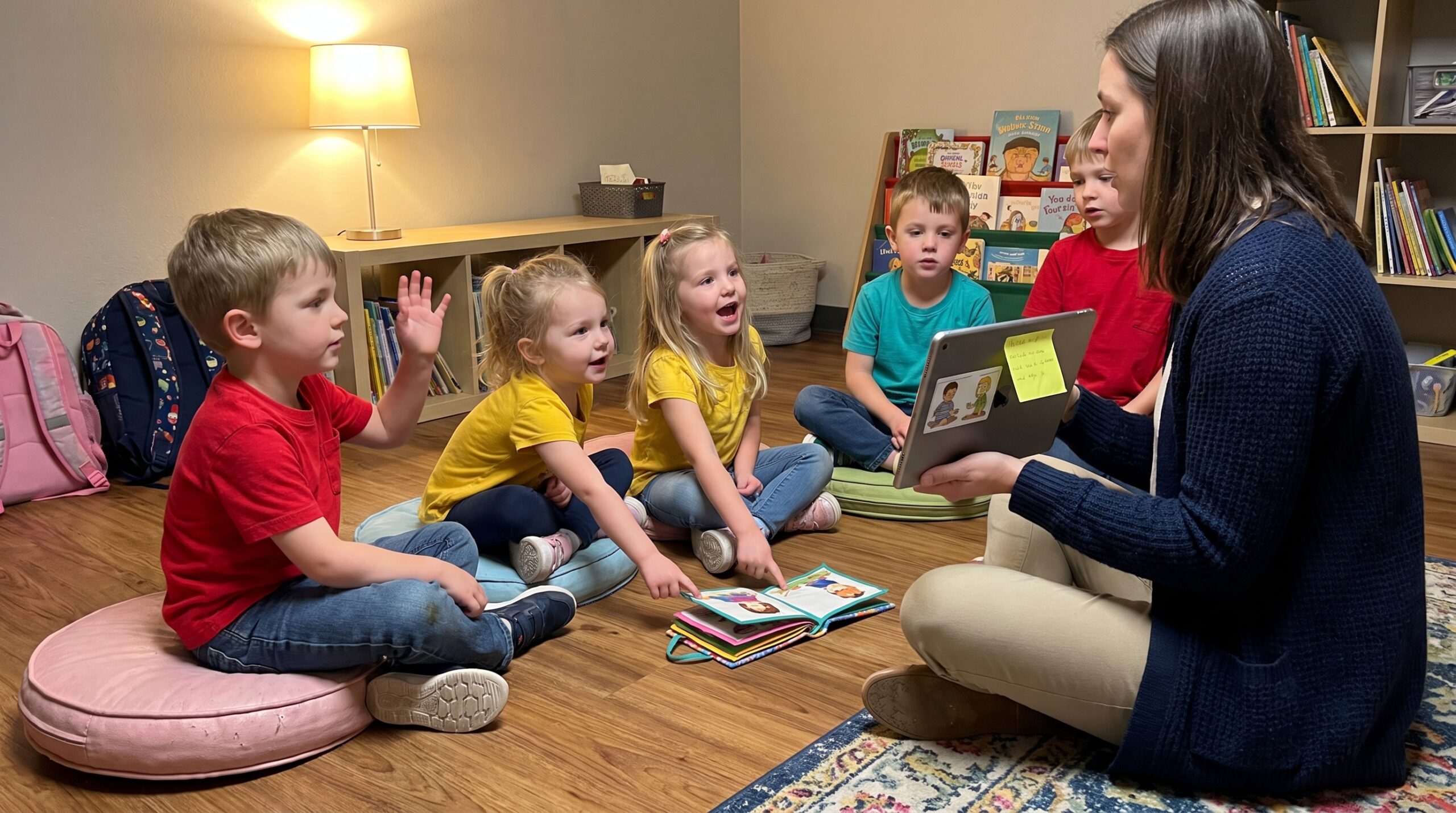
Education through storytelling ages 3-12 works across cultures and time. For centuries, people used stories to pass knowledge. Stories make facts human. They add sequence, reason, and emotion. That mix helps children remember and care.
How narrative fits child development
Stories align with how young minds organize information. A clear plot gives a simple scaffold. Characters, setting, and sequence make natural hooks for memory. Children store episodes better than isolated facts. So a short tale becomes memorable real estate for a growing brain. In fact, a 2023 study showed children who learned through storytelling retained 70% of the information, compared to just 10% when taught via traditional methods.
Key ways narrative helps
- Memory improves. Causal chains show why things happen, which aids recall.
- Language grows. Repeated phrases and varied sentences expand vocabulary. A 2025 meta-analysis of 29 oral narrative intervention studies found a medium-to-large overall effect on language learning outcomes (speaking, reading, grammar, vocabulary), with no significant difference between traditional and digital storytelling formats.
- Social thinking develops. Characters let kids explore feelings and perspective.
- Emotion anchors learning. When a story moves a child, it often stays with them.
Developmental patterns from ages 3 to 12
For young children, narrative complexity should match their thinking. Ages 3 to 5 favor clear, short sequences. Also, ages 6 to 8 begin to link cause and effect. Then ages 9 to 12 can weigh motives and consequences. Across these stages, education through storytelling ages 3-12 supports each step in growth. Notably, an analysis of the 2020–21 National Survey of Children’s Health showed that 50% of children aged 3–5 who were read to, told stories to, or sung to daily met all four domains of school readiness—compared to only 19% who received these activities 0–3 days per week.
Examples by age band
Children aged 3 to 5 respond to simple sequences. They follow start, problem, and resolution. Next, kids aged 6 to 8 grasp cause and effect. They notice how actions lead to outcomes. Finally, ages 9 to 12 consider motives and trade offs. They compare choices and consequences, leading to improved academic performance as evidenced by a 2021 study that found students taught with storytelling scored 33% higher in science tests compared to those taught through lectures.
Why this matters now
Modern brain research echoes these patterns. Stories recruit episodic recall and causal reasoning. Also, they serve as gentle retrieval practice. A small prompt after a tale boosts memory. Therefore, tiny rituals and repeated exposure make a big difference. In fact, a 2021 study found that storytelling increases literacy rates by 28% in primary school students, highlighting its importance in early education. In short, narrative is a compact teaching tool that bundles facts and meaning.
Simple ways to follow up
After a story, ask one brief question that invites comparison. For example, ask what changed. That prompt sparks recall and builds comprehension. Also, repeating a story on another day helps memory. Finally, mix sensory details and short rituals to make repetition feel playful.
At Storypie, we collect age-filtered picks that match developmental stages. If you want a gentle place to explore curated stories, try the Storypie app. For app details and curated lists, visit our get app page and browse age picks in the Stories section.
Bottom line: education through storytelling ages 3-12 bundles facts, causes, and feeling. Because stories tie meaning to events, children are more likely to remember. Try a small follow up tonight and see what sticks.