
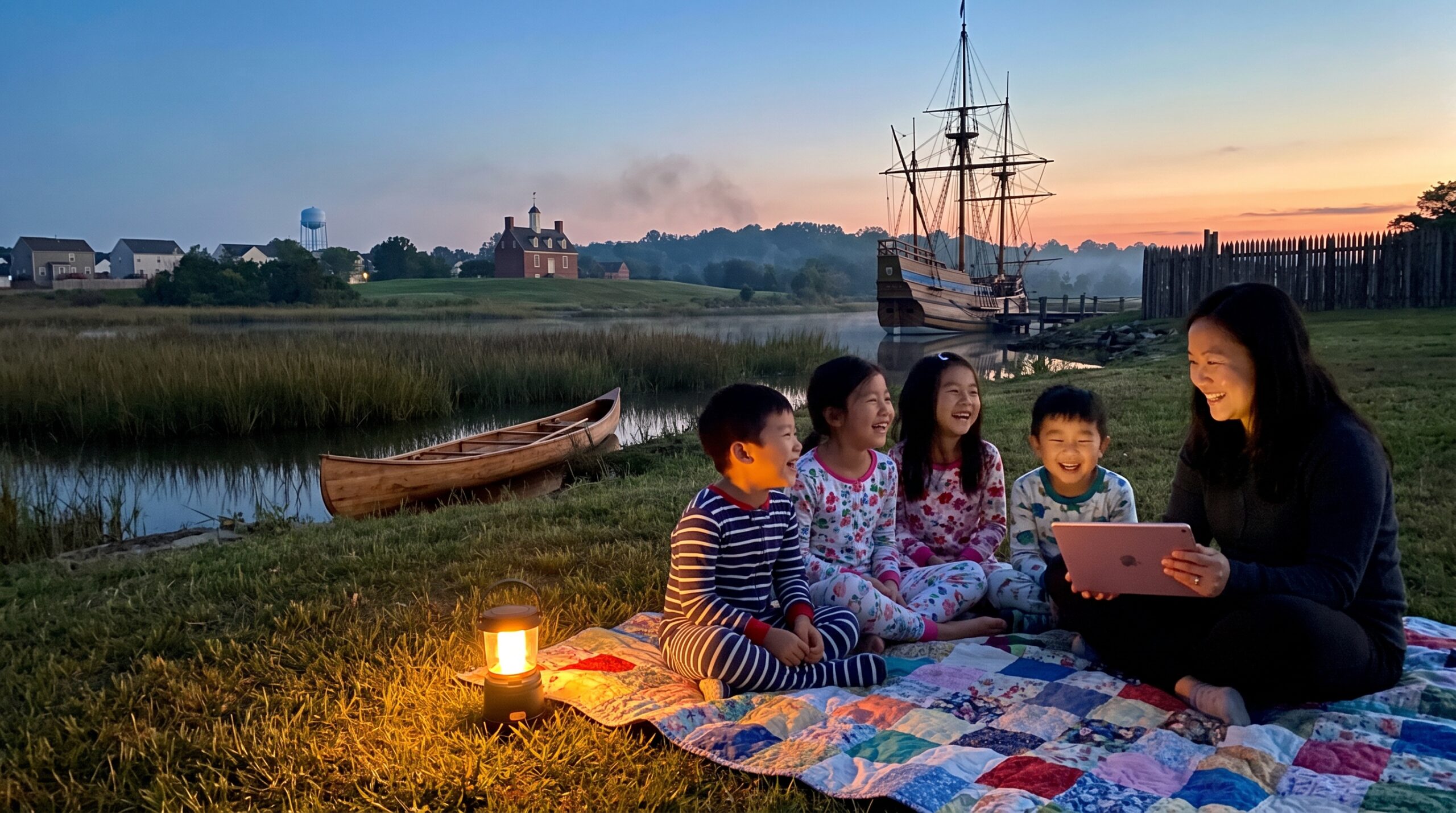
Virginia history for kids: A quick welcome
Virginia history for kids begins along the Atlantic coast where beaches meet mountains. First, the land feels full of stories. In just 15 minutes, children can meet Powhatan leaders, sail into Jamestown, and stand where Yorktown helped change a nation. This is a brisk, child-friendly tour of landscapes, people, and big moments. Read on and imagine.
Virginia history for kids: Regions and rivers
Virginia sits on the mid-Atlantic coast and reaches west into the Appalachian Mountains. The Tidewater or Coastal Plain includes the Chesapeake Bay and many barrier islands. Next, the Piedmont offers rolling farms and growing cities. Meanwhile the Blue Ridge and Ridge and Valley regions hold the Shenandoah Valley and scenic peaks. Mount Rogers is Virginia’s highest point.
Also, rivers shape life here. The James, the Potomac, and the Shenandoah run through towns and stories. They fed early communities and still invite summer adventures.
First peoples and early English settlement
Long before 1607, Algonquian-speaking peoples formed the Powhatan Confederacy along the coast. They tended the land, fished rivers, and lived in close communities. Then English settlers arrived and built Jamestown in 1607. Jamestown became the first permanent English settlement in North America. Soon, tobacco grew into a powerful cash crop and shaped labor systems.
Importantly, 1619 marks the arrival of people of African descent. We tell this beginning honestly because it begins a difficult, lasting history.
Revolution, founders, and a new nation
Virginia gave the new nation leaders like George Washington, Thomas Jefferson, and James Madison. In 1781 the surrender at Yorktown helped end major fighting in the Revolutionary War. Also, Virginia was one of the original thirteen colonies. Finally, Virginia ratified the Constitution in 1788. These places saw big ideas about liberty argued loudly and sometimes painfully.
War, struggle, and change
Virginia played a central role in the Civil War. Richmond served as the Confederate capital. Battles from Manassas to Fredericksburg affected countless lives. Then Appomattox Court House saw Robert E. Lee surrender in 1865. After the war came Reconstruction and later Jim Crow segregation. However, brave people pushed for change. For example, student activism in Prince Edward County helped advance civil rights.
We name slavery and struggle. Yet we also celebrate courage and progress.
Today and tomorrow
Modern Virginia feels layered and lively. Cities such as Virginia Beach, Norfolk, Richmond, and Arlington sit beside quiet mountains and farms. The economy mixes shipbuilding, defense, technology, agriculture, and tourism. In 2023, Virginia’s tourism industry generated a record $33.3 billion in visitor spending, marking a nearly 10% increase from 2022. Naval Station Norfolk remains one of the largest bases. Meanwhile, aerospace research and tech jobs link Virginia to broader science stories. Additionally, in fiscal year 2024, Virginia added 74,100 nonfarm payroll jobs, bringing total employment to over 4.2 million—a new high for the state.
Moreover, places like Shenandoah National Park, the Blue Ridge Parkway, Monticello, Colonial Williamsburg, Jamestown, and Yorktown give families tangible places to learn. Conservation work for the Chesapeake Bay and efforts to preserve history help build a fairer future. There is room for wonder here. And yes, one more little tale please.
Listen on Storypie
Storypie offers a warm, narrated 15-minute story that brings Virginia to life. Play the short tale at bedtime to spark curiosity in young listeners.
Read or listen to a story about Virginia now: For 3-5 year olds, For 3-5 year olds, For 6-8 year olds, For 8-10 year olds, and For 10-12 year olds.
Enjoy discovering Virginia together.