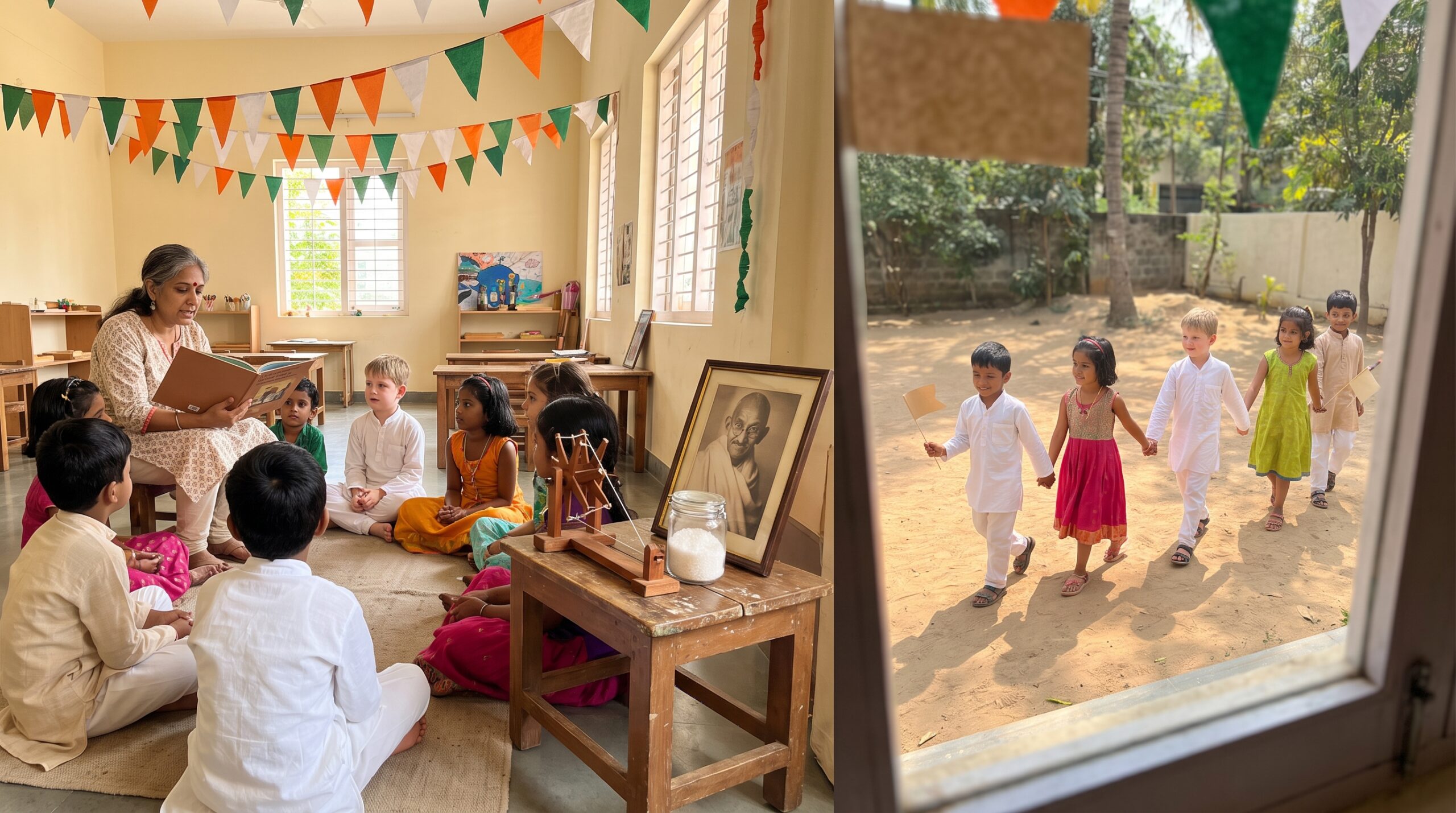
I tell the Indian Independence Movement for kids like a short, living story. First, I pick a clear thread. Then, I choose fairness and courage. That keeps children listening and asking questions.
Short timeline in one breath
The Indian Independence Movement spanned 62 years, from 1885, with the formation of the Indian National Congress, to 1947, when India and Pakistan gained independence. 1857 began the first big uprising. By 1858 the British Crown ruled directly. The Indian National Congress formed in 1885 as a platform for self rule. In the early 1900s people tried Swadeshi and local protests. Gandhi returned from South Africa in 1915 and led mass nonviolent campaigns. The Non Cooperation movement ran from 1920 to 1922. The Salt March in 1930 was a small walk that became a giant idea. Next, the Quit India call came in 1942. During the Quit India Movement (1942–1945), British estimates reported 1,028 Indians killed, while Congress estimates ranged from 4,000 to 10,000 killed. Finally, independence and partition arrived in 1947. That year brought huge joy and deep sorrow.
Read or listen
Read or listen to a story about Indian Independence Movement now: For 3-5 year olds, For 6-8 year olds, For 8-10 year olds, and For 10-12 year olds.
Why people resisted
Start with fairness. Kids feel fairness right away. Economic rules made life hard. British policies favored distant factories and taxed everyday things. Social and political limits shut many voices out. Also, the global wars and new ideas about self rule lit fires in hearts across India.
How people tried to change things
I like the Salt March as a small act that sparkled into a giant idea. Gandhi taught Satyagraha, truth force, and Ahimsa, gentle nonviolence. People boycotted goods, refused taxes, went on strikes, and held peaceful protests. However, others chose different paths. Brave revolutionaries and organized groups acted more forcefully. Many women, students, peasants, workers, tribal leaders, and soldiers joined in. That mix made the movement powerful and messy. In truth, that mix also made history alive.
People to know
- Mohandas Gandhi led nonviolent mass action.
- Jawaharlal Nehru imagined a democratic future.
- Sardar Patel worked to keep unity on hard days.
- Subhas Chandra Bose formed the Indian National Army.
- Bhagat Singh inspired young people to act bravely.
- B. R. Ambedkar fought for equal rights and wrote the constitution.
- Muhammad Ali Jinnah argued for a separate nation.
Sharing one small scene
When I share a scene with children, I pick one moment. I keep sentences short. I ask one clear question. Then we try a tiny, peaceful act the next day. For example, we might mix salt and water and remember why that little act mattered. I praise the effort. Kids become tiny heroes when they try.
A gentle closing
Talk about consequences honestly yet simply. Stress compassion and recovery. Suggest a short book, a nearby museum visit, or an audio story. Also visit Storypie for more family friendly history and audio stories. History can be a beautiful bit of truth and kindness that children carry forward.