Nuclear power for families starts with a simple idea: tiny fuel makes big energy. For parents and teachers, this idea feels a little like a short science poem. Read on to share that wonder with kids.
What it is, simply
A small pellet of uranium holds enormous energy. Neutrons strike atoms. Atoms split. Heat appears. Then steam forms and spins a turbine.
Finally, a generator turns and electricity flows. Imagine this tidy chain:
- fuel
- reactor core
- heat
- steam
- turbine
- generator
- electricity
A short timeline
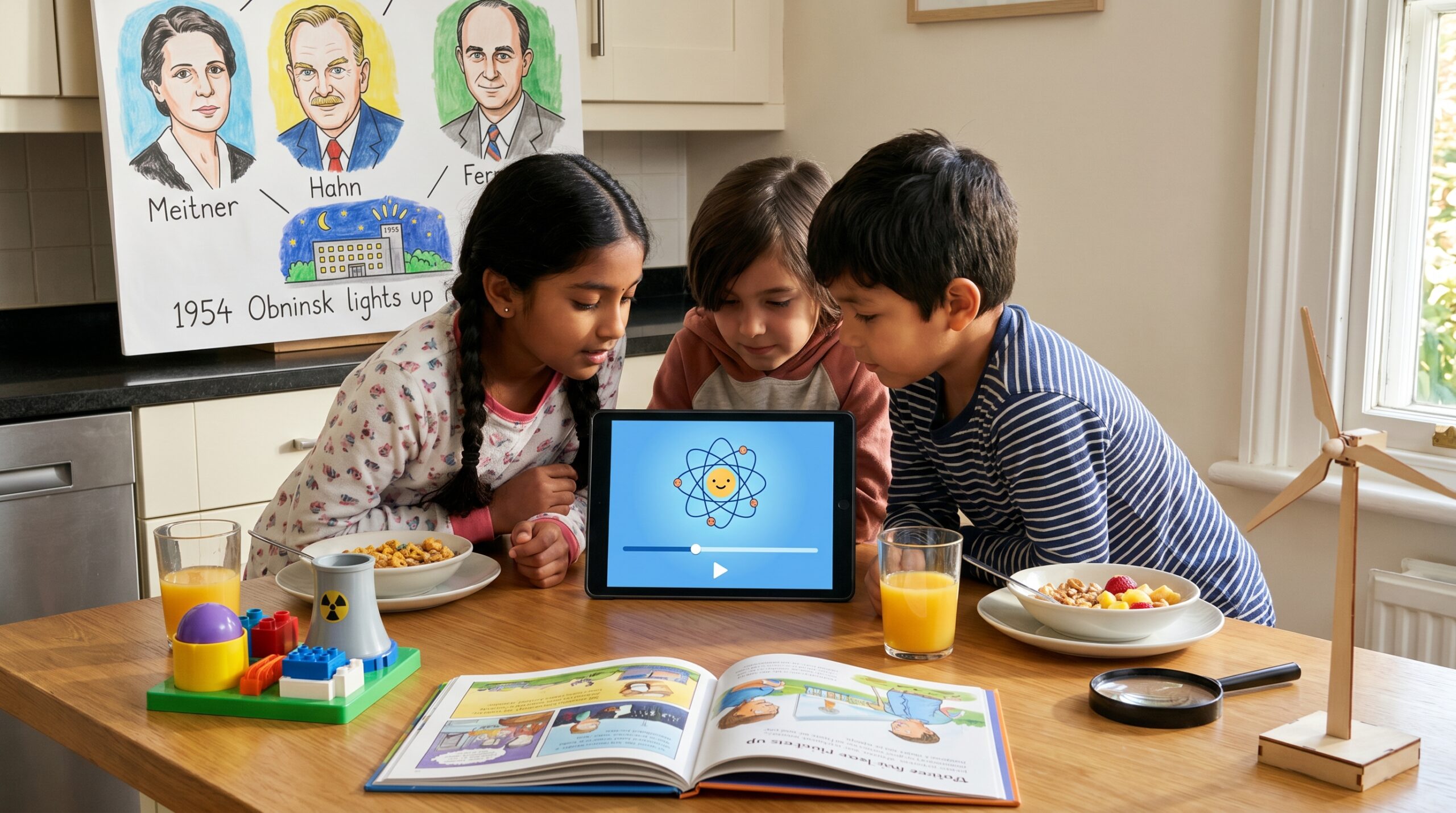
Science and history give nuclear power a human face. In 1938 chemists saw uranium split. Then in 1942 Enrico Fermi ran the first controlled chain reaction in Chicago. Next came Obninsk in 1954, the first plant to send power to a grid. By 1956 Calder Hall began commercial work in the UK. These dates and names help stories feel real and friendly.
How Nuclear Power for Families Works
Think of a reactor like a large cooking pot. Fuel pellets sit inside. Control rods act like spoons. They slow the reaction when needed.
Cooling systems move heat away. Thick containment walls keep the site safe. Also, modern plants use many safety layers. These layers make systems cautious and careful.
Common reactor types, short and sweet
Most plants use one of several common designs. Each design follows the same basic steps above.
- Pressurized Water Reactors (PWR)
- Boiling Water Reactors (BWR)
- CANDU with heavy water
- Fast reactors or older Soviet designs
Why people choose nuclear
Nuclear packs huge energy into tiny fuel. In 2024, global nuclear reactors generated a record 2,667 terawatt-hours (TWh) of electricity, surpassing the previous record of 2,660 TWh set in 2006. It also produces low greenhouse gas emissions when running. For families, this means steady power at home. A large reactor can supply electricity to hundreds of thousands of houses. In fact, as of June 2025, five countries—United States, France, China, Russia, and South Korea—accounted for 71% of the world’s total nuclear electricity generation capacity. So many communities rely on it to keep lights on at night.
Risks, plainly
Waste requires careful, long-term handling. Accidents have happened and shaped strict rules. Radiation is measured and kept within limits. Building plants takes time and money. Still, the industry treats these issues seriously with strong regulations and oversight.
Waste and the future
Spent fuel often starts in pools. Then many sites move it to dry casks for storage. Some countries reprocess fuel. Others plan deep geological disposal for the long run. For example, Finland leads work on permanent repositories. Meanwhile, new ideas aim for smaller, faster builds. In 2024, over 7 gigawatts (GW) of nuclear power capacity were brought online globally, a 33% increase compared to 2023, bringing the total installed nuclear capacity to 420 GW. Small modular reactors or SMRs may reduce upfront costs and add flexibility.
Spark curiosity at home
Try a two-question breakfast ritual. Ask who and how questions. For example: Who was Lise Meitner? How does steam make a turbine spin? Keep it short, playful, and warm. Little rituals make big learning moments.
Read or listen to a story about Nuclear Power now: For 3-5 year olds, For 6-8 year olds, For 8-10 year olds, and For 10-12 year olds.
Also explore more on Storypie. Discover kid-friendly audio and stories at Read or listen to a story about Nuclear Power now. For extra family listening, visit Storypie.
Keep the tone hopeful and curious. Nuclear power can feel quiet and mighty at once. In 2024, nuclear generation avoided an estimated 2.1 billion tonnes of CO2 compared with equivalent coal generation. Share that feeling with the children you know.