
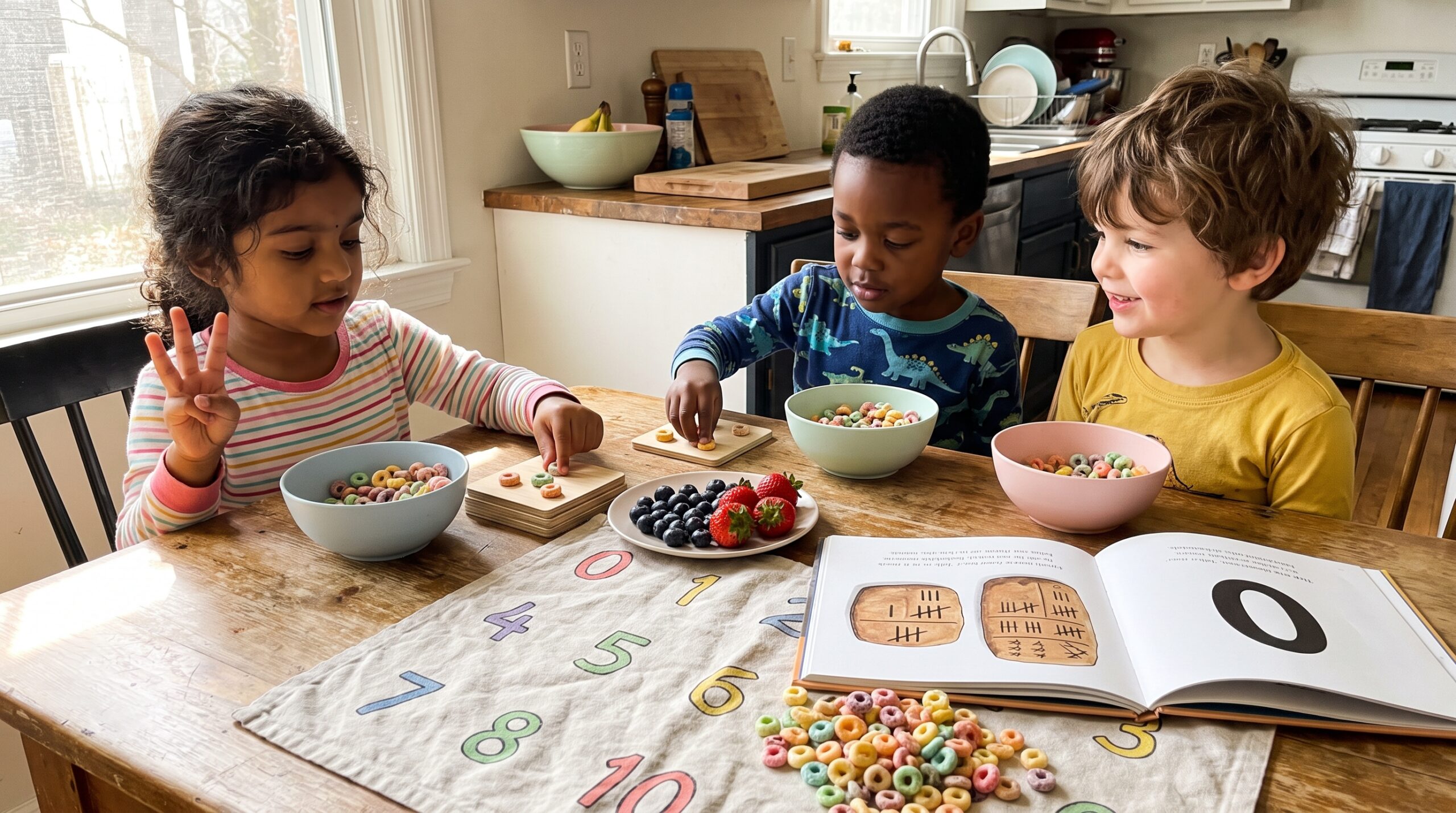
Numbers and numerals 0-10 help children name and match quantities. At Storypie we make learning playful and bright. Try counting at breakfast to spark curiosity and number sense.
What are Numbers and Numerals 0-10?
The digits 0 1 2 3 4 5 6 7 8 9 10 pair with number words zero through ten. Zero is both a digit and a number. It acts as a placeholder in place value and it also means none. Historically, zero grew in India before traveling to the Arab world and then Europe. Also, the base 10 system reflects counting on ten fingers. Place value plus digits builds every whole number beyond ten. Interestingly, in a large analysis of over 1.7 million number occurrences in the British National Corpus, the numeral ‘1’ is the most common integer token, appearing 302,676 times (18.1%), while ‘0’ appears only 4,216 times (0.3%), ranking 57th in frequency, which highlights the relative usage of these numerals in language according to a study on number use in English.
Quick facts and representations
Here are neat ways to show numbers from 0 to 10. For example, Roman numerals write I II III IV V VI VII VIII IX X. In binary, 0 is 0 and 10 is 1010. Even numbers in 0 to 10 are 0 2 4 6 8 10. Odd numbers are 1 3 5 7 9. Primes in this range are 2 3 5 7. Note that 1 is neither prime nor composite and zero is special.
How children learn 0 to 10
Young children first subitize small sets of one to four. Next, they learn five core counting principles: stable order, one-to-one correspondence, cardinality, abstraction, and order irrelevance. Typical milestones guide parents and teachers. For example, interest in counting may start by 12 to 18 months. By age two many children can recite number words. Then by age two to three they show reliable one-to-one counting to three to five. By three to four they often count to ten and match numerals. By four to five they begin recognizing numerals and simple addition.
Tools and playful activities
Use simple tools to make numbers and numerals 0-10 feel fun. Try fingers, ten-frames, dot cards, number lines, and small manipulatives. Also, breakfast items like cereal loops or berries make quick counters. For safety, supervise toddlers with small pieces. Instead, use larger counters for young children.
- Match numeral cards to quantities.
- Make patterns with cereal or stickers.
- Play dot-card races or counting songs.
Safety and language notes
Watch small-item hazards and choose age-appropriate materials. In English, note irregular words such as two, and ordinals like first, second, third. Also, zero appears as nought, naught, nil, or oh in different settings. Teach both digit and word forms. For handwriting, tracing numerals in sand works well.
Cultural notes and artifacts
Counting leaves traces in old tally bones, tokens, and clay tablets. Different cultures sometimes use bases other than 10. Also, finger counting patterns vary around the world. These artifacts show how universal counting truly is.
Final thought and resources
Small moments make big learning. Count berries at breakfast, clap as you count, and celebrate every correct answer. Read or listen to a story about Numbers and Numerals 0-10 now: For 3-5 year olds, For 3-5 year olds, For 6-8 year olds, For 8-10 year olds, and For 10-12 year olds.
Also, try Storypie for prompts and audio. Visit Storypie to explore more ideas and stories.









