
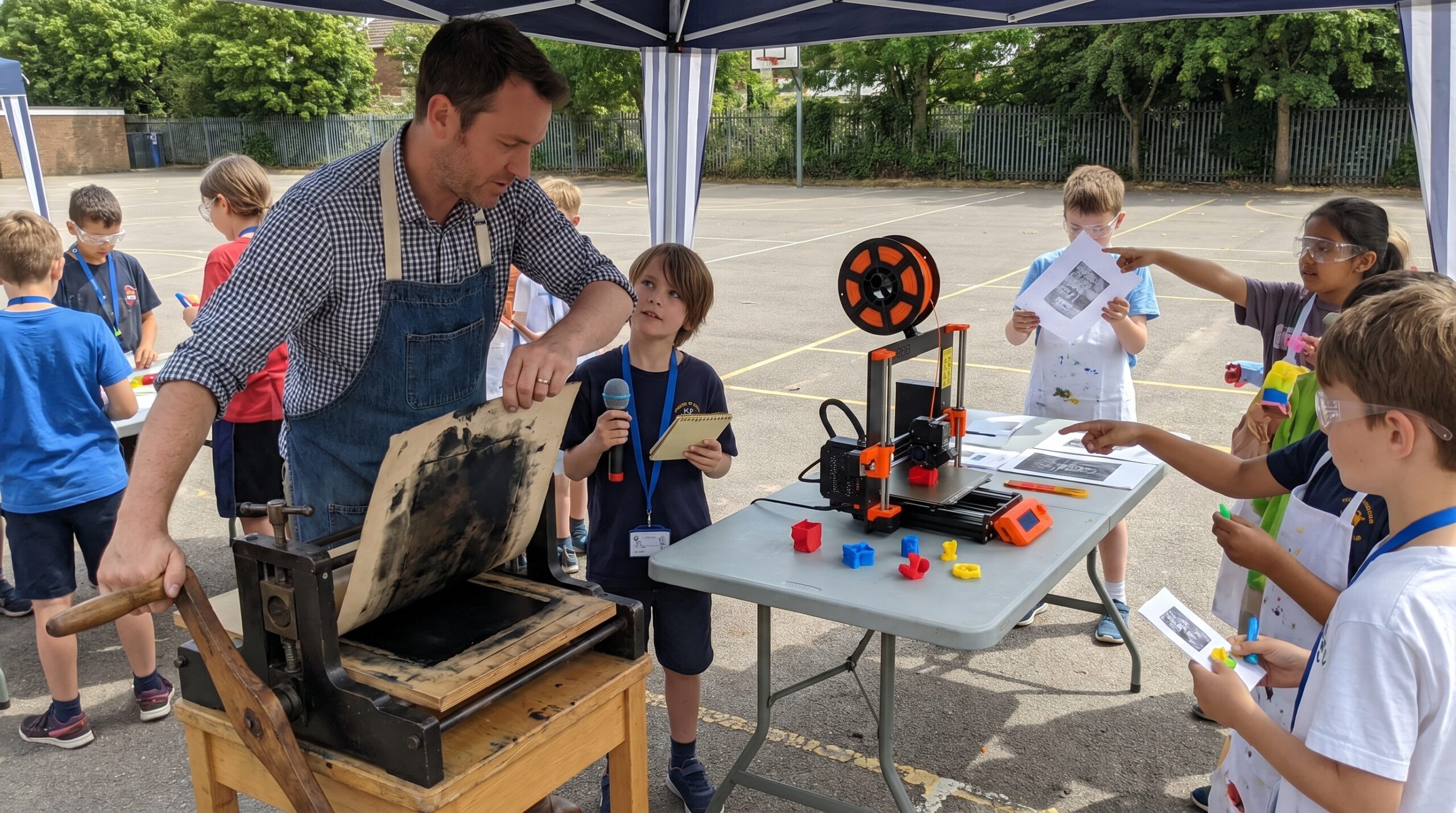
The printing press for kids is a simple, powerful idea. Imagine a giant stamp-maker that prints many identical pages. Johannes Gutenberg pulled together four clever tools in the 1450s to make this happen. Scholars estimate Johannes Gutenberg produced roughly 180 copies of his 42-line Bible around 1455; about 48–49 substantial copies survive today, of which roughly 21 are complete.
The printing press for kids: a simple picture
First, Gutenberg used movable metal type. Next, he used a hand mould to cast many twins of each letter. Then he used oil-based ink that stuck to metal and paper. Finally, he used a screw press to press ink evenly. Together these parts turned slow handwriting into tidy rows of identical letters.
Quick timeline and early makers
Long before Gutenberg, people printed in other ways. For example, the Diamond Sutra used a carved woodblock in 868. Bi Sheng tried movable clay type near 1040. Korea printed Jikji with metal type in 1377. Then Gutenberg set the European standard in the 1450s. William Caxton brought a press to England in 1476. By 1500, towns across Europe had many presses.
Why this matters
The printing press for kids changed how families saw books. Books became cheaper. More homes had stories to read and share. Schools got more materials. Soon ideas traveled faster across towns and borders. Language and spelling began to settle, and new businesses grew around printing. In fact, in 2023, the global printing press market was valued at $14.2 billion and is projected to reach $20.5 billion by 2030, growing at a compound annual growth rate (CAGR) of 5.2%.
How letterpress works, simply
Letterpress uses many tiny steps. Try to picture each step like a neat little machine. It repeats the same action again and again. That repetition makes copies tidy and reliable.
- Arrange single letter blocks into words and lines.
- Lock the arranged type into a frame.
- Spread ink over the raised letters.
- Press paper onto the inked type with steady pressure.
- Lift, dry, and repeat.
People and places to remember
The Gutenberg Bible stands out as one of the first major European books. Aldus Manutius in Venice made small, handy books and new type styles. William Caxton printed in England. Far to the east, Jikji shows earlier metal type. Printers opened shops that spread news and ideas quickly.
Big effects in small steps
Because printing made books cheaper, more people learned to read. New ideas moved faster. Some rulers and guilds tried to control printed words. Still, printing reshaped learning and daily life in dramatic ways. As of December 31, 2025, there were 142,000 employed printing press operators in the United States, marking a 7.58% increase from 132,000 in 2024.
Try a simple hands-on idea
For a playful taste of the press, make stamps from foam or potatoes. Arrange a short word and ink your stamps. Press gently and let the page dry. One tip: print one color at a time for calmer pages. Also try keeping one clear hero print per page for tidy results.
Read or listen to a story about The Printing Press now: For 3-5 year olds, For 3-5 year olds, For 6-8 year olds, For 8-10 year olds, and For 10-12 year olds.
If you can, visit a local printing museum. Seeing a screw press up close feels quietly thrilling. Or enjoy a short Storypie tale after lunch to spark curiosity with your child. For more, visit Storypie.