
Rama for kids: Who is Rama?
Rama for kids begins as a bright family tale. It offers a clear, gentle entrance to the Ramayana, which is traditionally attributed to the sage Valmiki and is considered one of the two major Sanskrit epics of ancient Indian literature. In many homes, Rama shines as an example of duty and kindness. Also called Maryada Purushottama, he stands for moral conduct. Rama is revered as the seventh avatar of the Hindu god Vishnu, recognized as the ideal king and model of virtue, duty, and honor.
Family and early life
Rama was the son of King Dasharatha of Ayodhya. Dasharatha had three queens: Kausalya, Kaikeyi, and Sumitra. Rama married Sita. His brothers were Bharata, Lakshmana, and Shatrughna. These family ties shape the tale. They also help children notice loyalty and responsibility in simple scenes.
Exile and challenge
Because of palace promises, Rama accepts exile for fourteen years. He chooses the forest life rather than take the throne unfairly. Sita and Lakshmana go with him. This period sets the stage for many dramatic and touching moments. For example, the brothers show quiet courage while facing hardship.
Abduction, allies, and the great battle
Sita is taken to Lanka by the rakshasa king Ravana. Rama gathers friends and allies to find her. He meets Sugriva, the vanara king, and Hanuman, the devoted helper. Hanuman’s search and loyalty bring wonder and hope. Also, the army builds a causeway called Rama Setu to reach Lanka. In the great battle, Rama defeats Ravana. These scenes show courage, friendship, and the cost of pride.
Return and rule
After the victory, Rama returns to Ayodhya. He is crowned king, and his reign becomes Rama Rajya. People call Rama Rajya an ideal of just rule. It stands for fairness and moral leadership. Parents and teachers often use this idea as a simple image of good governance.
Why the story matters today
The Ramayana works on many levels. It lives as devotion, literature, and moral teaching. Rama’s story has had a major socio-cultural and inspirational influence across South Asia and Southeast Asia, with the Ramayana being popular, influential, imitated, and successful over at least two and a half millennia. Additionally, performances like Ramlila and Diwali celebrations keep Rama’s story bright. Rama’s birth is celebrated annually on Rama Navami, which falls on the ninth day of the bright half (Shukla Paksha) of the lunar cycle of Chaitra, corresponding to March–April in the Gregorian calendar. Regional retellings across South and Southeast Asia add many local colors. Scholars note the epic grew over time, mixing oral and written layers. As a result, details vary by region and tradition.
Key characters and symbols
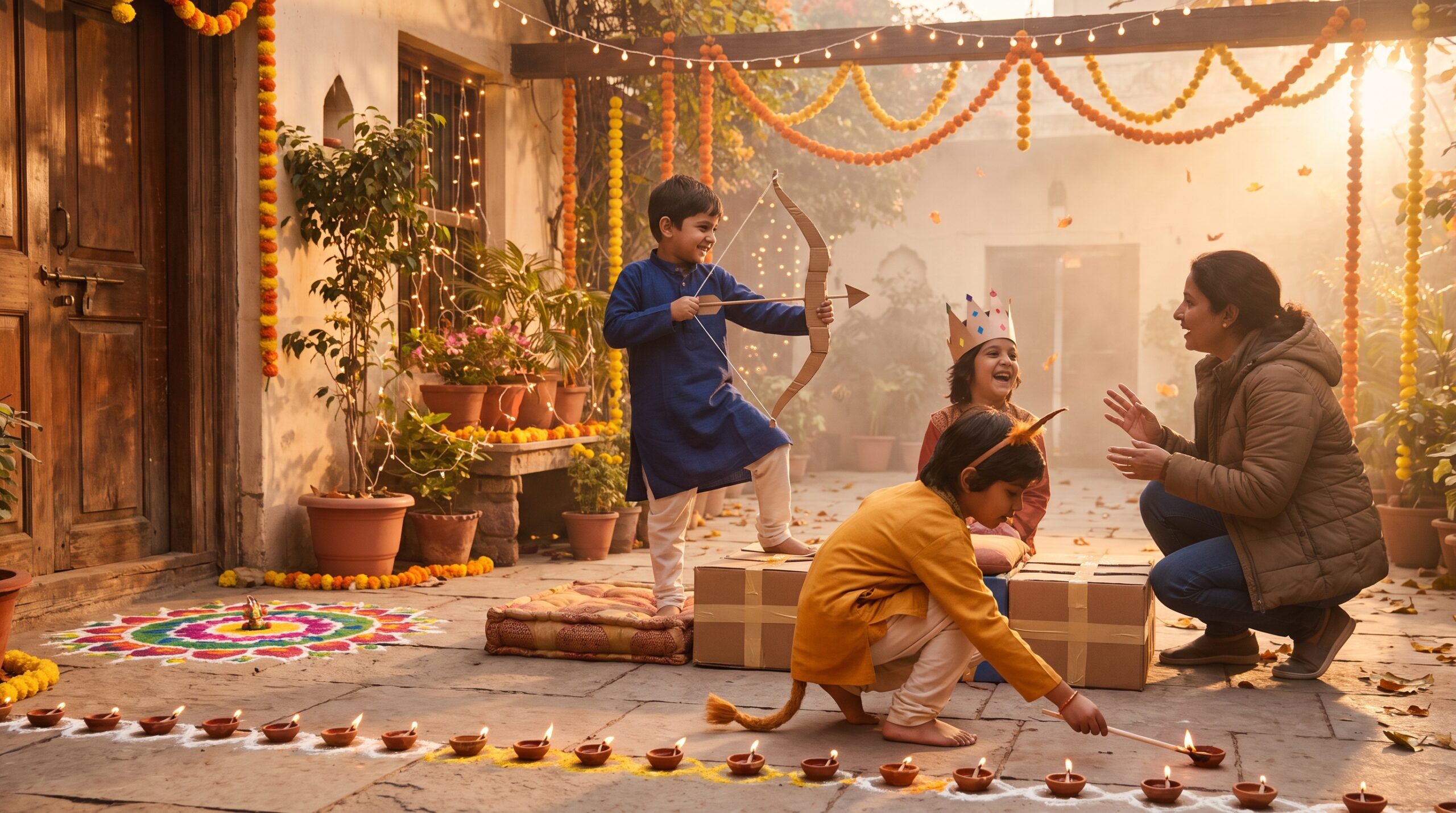
- Rama – the dutiful prince and ideal ruler, often depicted holding a bow and arrows, symbolizing his warrior nature, and shown with green or blue skin, wearing a yellow robe
- Sita – devoted partner and exemplar of virtue
- Lakshmana – loyal brother and protector
- Hanuman – devoted ally and symbol of devotion
- Ravana – powerful but fallen king, often shown with ten heads
A short family tip
Tip: tonight, play our 10-minute Rama retelling. Pause after the bridge scene. Then ask your child what courage means. Small questions like that spark big thinking.
Read or listen to a story about Rama now: Read or listen to a story about Rama now: For 3-5 year olds, For 6-8 year olds, For 8-10 year olds, and For 10-12 year olds.
Finally, Rama for kids brings a timeless story into the family circle. Read it gently. Ask simple questions. Then watch curiosity and kindness grow.
Explore more stories and guides on Storypie.









