
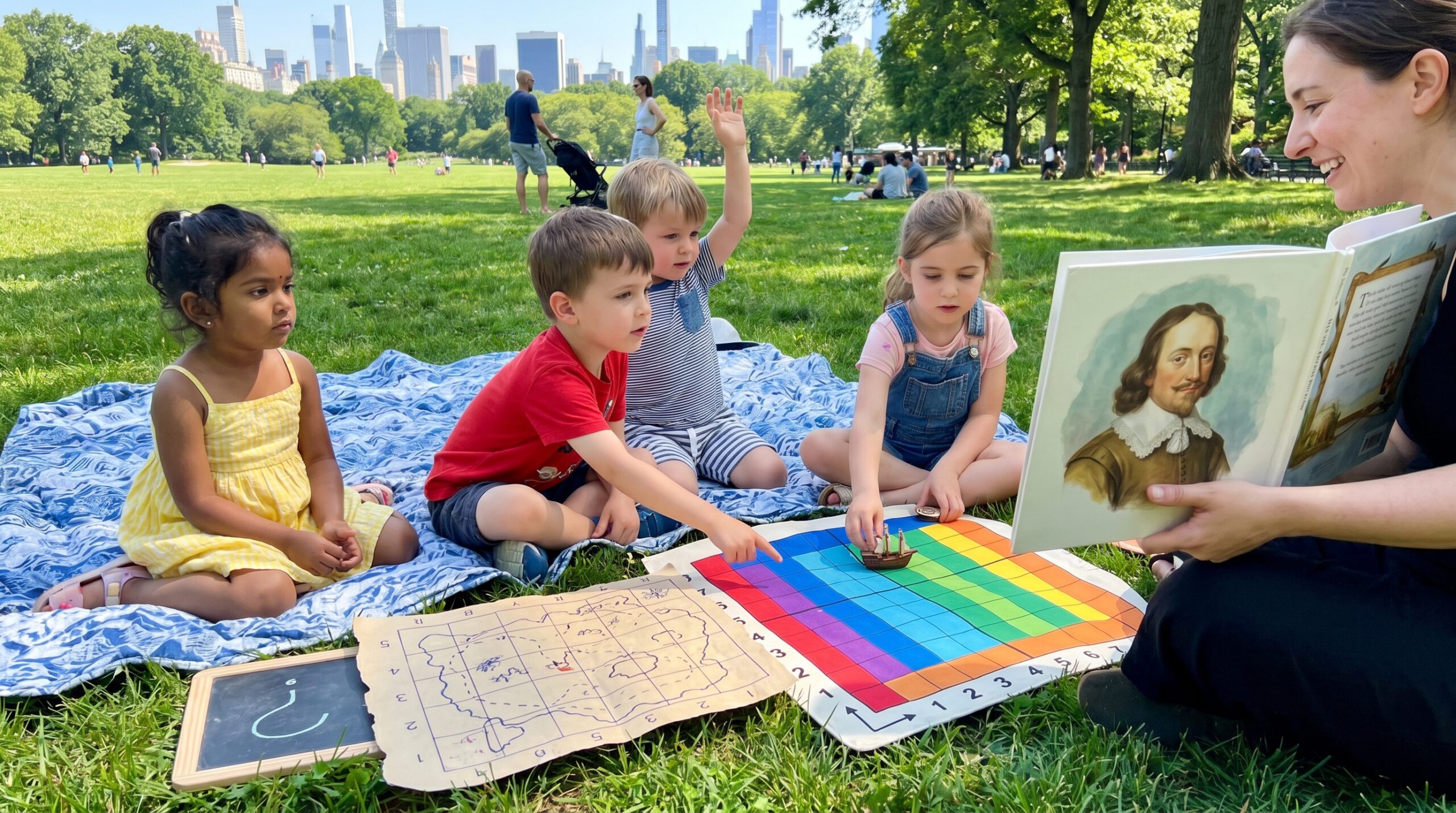
René Descartes for kids begins with a small question and big wonder. First, imagine a child tapping a pencil and asking how we know we exist. Next, that simple question opens a door to curious thinking. Tonight, try asking one thoughtful why to spark a lively conversation.
René Descartes for kids: Who he was
René Descartes was born on March 31, 1596, in La Haye en Touraine, France, a fact that provides essential biographical information about his beginnings.According to Encyclopaedia Britannica. Later the town took his name. He spent much of his adult life in the Dutch Republic. He wrote, traveled, and exchanged lively letters with other thinkers. He died on February 11, 1650, at the age of 53 in Stockholm, Sweden, marking the end of his influential life.This historical context highlights both his age and location at the time of his passing. Across his life, he mixed quiet study with bold ideas.
Big ideas made simple
Descartes gave us the phrase Cogito, ergo sum. In plain words, it means I think, therefore I am. For kids, this idea says: if you can doubt or imagine, you must exist as a thinking person. Also, Descartes helped create analytic geometry with his publication of La Géométrie in 1637, which established key equivalences between algebraic operations and geometric constructions, forming the basis of this mathematical field.As noted by Encyclopaedia Britannica. He joined algebra and geometry and drew curves with equations.
Cartesian coordinates and everyday play
His Cartesian coordinate system uses two number lines that cross at right angles. The x and y axes form a grid. This grid shows up in maps, video games, and treasure hunts. For example, mark a hiding place at (2,4) on a 5 by 5 grid. Then send a friend on a simple hunt.
Thinking clearly
Descartes wrote Discourse on Method in 1637, which coined the dictum ‘cogito, ergo sum,’ foundational to modern philosophy, and this concept also appears in his Meditations on First Philosophy, published in 1641.This idea is essential for understanding his contributions to philosophy. He taught a method of doubt. First, question what is not certain. Then rebuild ideas that remain true. He also proposed a mind-body distinction. He called mind the thinking thing and body the material thing in space. These ideas shaped later debates in psychology and philosophy. The Meditations was first published in Latin in 1641, with a revised second edition appearing in 1642, organized as six meditations, providing insight into one of Descartes’ most important works.According to the Stanford Encyclopedia of Philosophy.
Simple activities to try tonight
Try one or more of these playful experiments. They are quick, low-prep, and full of curiosity.
- Coordinate treasure hunt: Draw an x y grid on paper. Label points. Hide stickers at coordinates. Call out numbers and let children find the prize.
- Room coordinate game: Pick a shelf square or rug tile and name its coordinates. Older kids can map a toy using x and y and draw a simple map.
- One thoughtful why: After dinner ask, Why do you think the moon looks different at night? Pause and invite reasons. This habit builds reasoning and curiosity.
Read or listen to a story about René Descartes now: Read or listen to a story about René Descartes now: For 3-5 year olds, For 6-8 year olds, For 8-10 year olds, and For 10-12 year olds.
Final thought
Descartes gives a playful invitation: ask, draw, and test. Tonight, try the one thoughtful why and then listen together. Explore more stories and activities on Storypie to keep curiosity growing.
Gentle link: Storypie