
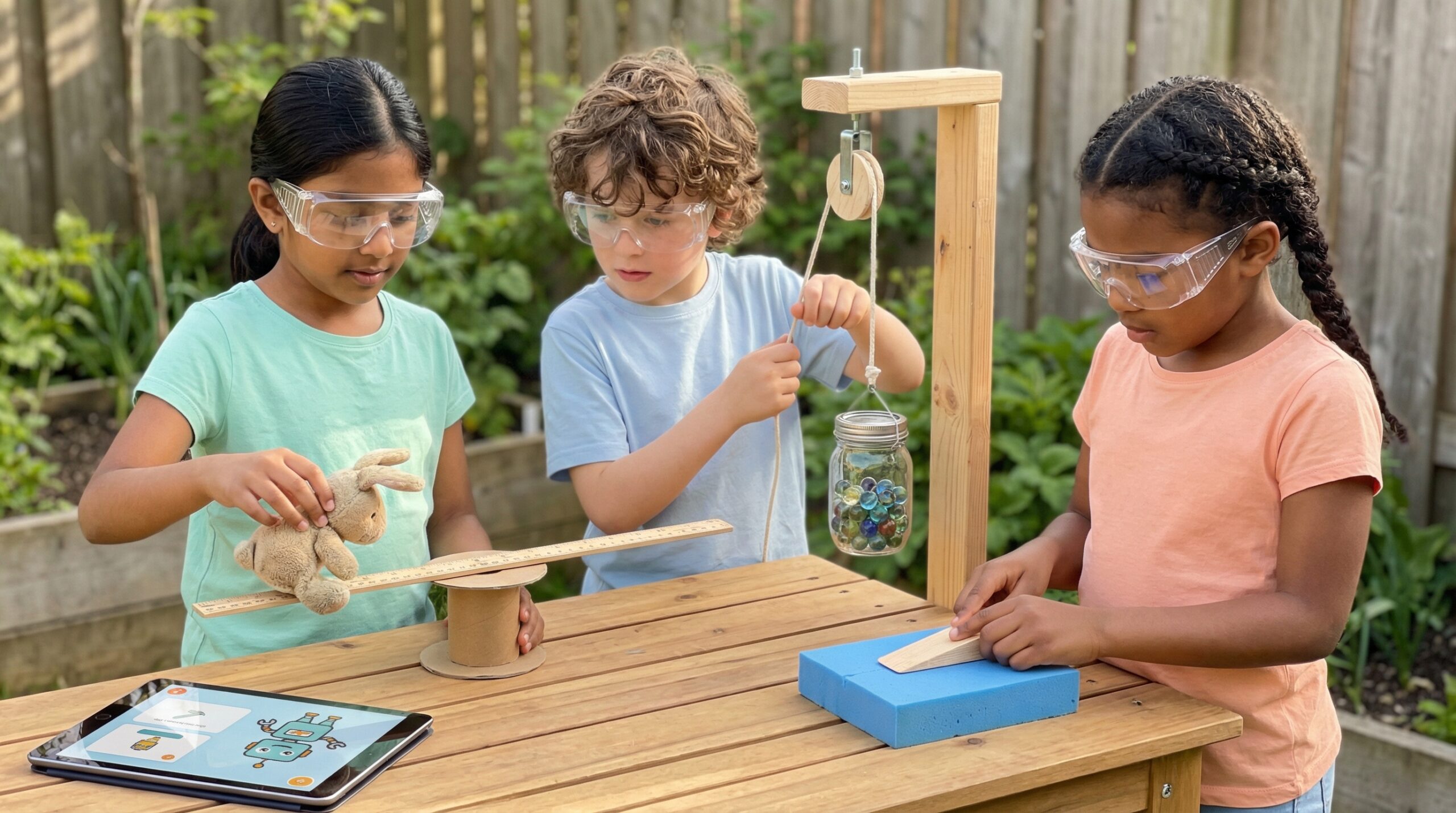
A simple machine for kids makes work feel easier. In short, it is any device with few or no moving parts that changes the size or direction of a force. Parents and teachers can use tiny experiments to invite curious repeat play.
What is a simple machine for kids?
Simple machines show how force, distance, and direction work together. For example, a seesaw, jar lid, or ramp demonstrates a clear idea. These devices trade effort for distance or change the direction of a push. The six classical simple machines are the lever, wheel and axle, pulley, inclined plane, wedge, and screw, providing a foundational understanding of these concepts for children learning about them. According to Encyclopaedia Britannica, these machines are essential in illustrating basic mechanical principles.
The six classic simple machines
There are six classic simple machines. Each one does a recognizable job. Try these playful examples with little hands.
- Lever — Think seesaw or scissors.
- Wheel and axle — Think doorknob or toy car.
- Pulley — Think a flagpole rope.
- Inclined plane — Think a ramp.
- Wedge — Think a knife.
- Screw — Think a jar lid.
How they help, simply
Levers pivot on a fulcrum. Move the fulcrum closer to the load and lifting gets easier. Wheels turn a large circle into a small axle. That multiplication makes turning easier. Pulleys change direction, and multiple pulleys share the load so you pull less. Ramps spread lifting over a longer distance. Wedges turn a push into a split. Screws wrap an inclined plane around a cylinder so twisting creates linear force.
Mechanical advantage, plain and visual
Mechanical advantage means how much a machine multiplies your effort. For a lever, it is the distance from effort to fulcrum divided by the distance from load to fulcrum. For a wheel and axle, it is the wheel radius divided by the axle radius. For a ramp, it is ramp length divided by ramp height. For pulleys, count the rope segments holding the load. These simple ratios are something children can feel, not only calculate. For example, a wheelbarrow with a load mass of 45.0 kg and lever arms of 0.0750 m (load) and 1.02 m (hands) yields an MA of 13.6, illustrating the concept of mechanical advantage in a relatable way. This information can be found in OpenStax, College Physics.
Quick hands-on activities
Keep experiments small and scaled to little hands. Also, make them tidy and repeatable. Try these quick demos.
- Seesaw in ten minutes: use a ruler and a spool as a fulcrum, and small coins as weights. Move the spool to feel the change.
- Ramp test: roll a toy car up two ramps of different slopes. Notice the effort difference.
- Pulley demo: hang a small bucket on a clothesline with one fixed pulley. Feel the direction change.
- Wedge demo: gently split a soft soap bar with a butter knife while supervising closely.
- Screw demo: compare jar lids and coarse bolts to see how thread pitch affects turning.
Short history notes
Archimedes wrote about levers and linked them to screws used for lifting water. Ancient Egyptians used ramps to move large stones. Hero of Alexandria described simple mechanisms that combine these devices. These stories make simple machines feel ancient and clever. The ideal mechanical advantage (IMA) of an inclined plane equals the length of the slope divided by its vertical height; for instance, a ramp 20.0 m long that rises 5.0 m has an IMA of 4.0, which can help kids visualize how inclined planes work in practical scenarios. This detail is explained in TeachEngineering.
Learning, safety, and next steps
Children learn about force, fulcrum, effort versus load, measurement, and design thinking. Use light weights, supervise tools, and work on a stable surface. Also, wear eye protection when needed. Measure with a ruler or coins and record what changes. Practical tip: keep experiments short, tidy, and repeatable. A tiny ritual makes learning stick. It’s also valuable for children to understand that in real-world applications, the efficiency of simple machines is always less than 100% due to energy losses primarily caused by friction, an important concept that can enhance their understanding of how things work. For further reading, check OpenStax Physics.
Read or listen to a story about Simple Machine now: For 3-5 year olds, For 6-8 year olds, For 8-10 year olds, and For 10-12 year olds.
For more activities and stories, visit Storypie. Enjoy the small joys of discovery with little engineers in your life.