
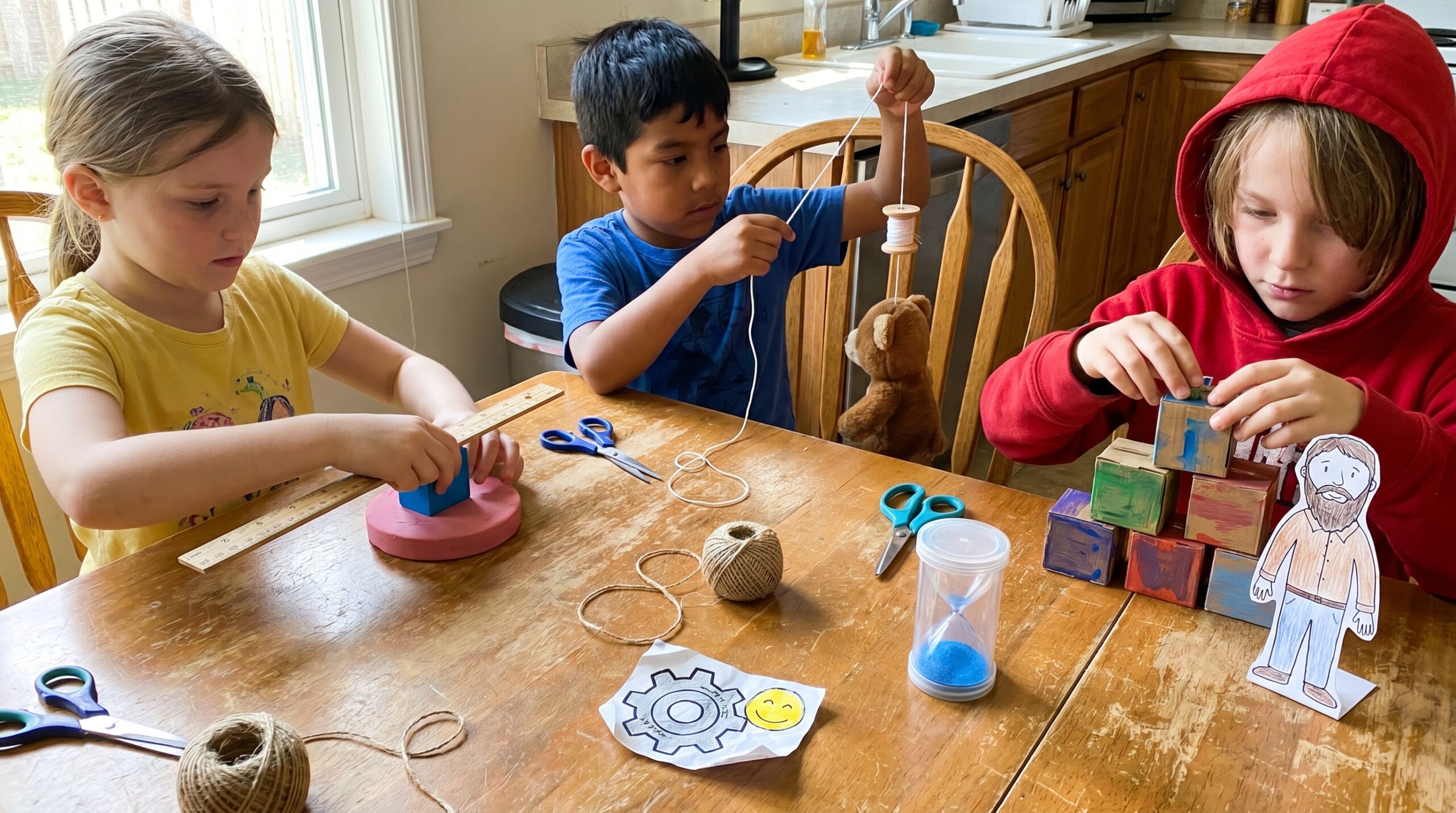
Start with a clear idea. A simple machine for kids means a basic device that changes force. It helps lifting, pulling, or moving feel easier and smarter. The six classic machines are lever, wheel and axle, pulley, inclined plane, wedge, and screw. In fact, these six classical simple machines are recognized widely in engineering and physics, as noted by NASA.
What a simple machine is
In plain words, a simple machine changes the direction or size of a force. So less grunt and more cleverness does the job. Children love seeing everyday tools act like little helpers. The mechanical advantage (MA) of a simple machine is calculated as the ratio of output force to input force; for example, in an ideal lever, MA equals the ratio of the lengths of the effort arm to the resistance arm, which is crucial for understanding how these machines work and reduce effort. This concept is explained in detail by OpenStax.
Meet the six simple machines
Here are the six simple machines, explained simply and playfully.
- Lever. A stiff bar that pivots on a fulcrum. Move the fulcrum and you change how hard you push. Think seesaws, tweezers, and wheelbarrows.
- Wheel and axle. A large wheel turning a smaller axle multiplies motion. Imagine doorknobs and rolling carts.
- Pulley. A rope over a wheel. More rope segments mean less effort. In fact, in pulley block-and-tackle systems, the ideal mechanical advantage equals the number of supporting rope segments; for example, a system with three movable pulleys (six supporting strands) has IMA = 6, meaning the required effort force is 1/6 of the load, as described by Khan Academy.
- Inclined plane. A ramp trades force for distance. Builders used ramps to move heavy stones long ago.
- Wedge. A moving ramp that splits things. Knives and axes are wedges at work.
- Screw. A spiral ramp. Turn it to lift or hold. Jar lids and bolts behave this way.
Key words to know about a simple machine for kids
Use tactile words to teach and explore. Effort is the push you give. Load is what you want to move. The fulcrum is the pivot point. Mechanical advantage shows how much easier the machine makes the task. Understanding the efficiency of machines is also important. It is calculated as the ratio of actual mechanical advantage to ideal mechanical advantage times 100. For instance, if IMA = 5 and AMA = 4, then Efficiency = (4 / 5) × 100% = 80%, which highlights the performance of simple machines and their effectiveness, as discussed by OpenStax.
Three quick ten-minute builds
Set a ten-minute timer. Keep things light, safe, and full of giggles.
Lever test
Materials: ruler, eraser, small toy. Put the eraser under the ruler as a fulcrum. Try lifting the toy. Next, move the fulcrum closer to the load. Notice which position feels easiest.
Ramp run
Materials: hardcover book, board or cardboard, toy car. Make a ramp and roll the car. Try different slopes. Then ask which slope needs less push.
Mini pulley
Materials: spool or small wheel, string, cup, light object. Loop string over the wheel and pull to lift. Count how many rope segments support the cup. Supervise closely.
Safety and short history
Safety first. Use light loads. Do not use sharp tools without adult help. Avoid small choking parts for toddlers. Keep fingers clear when testing wedges and screws.
A quick history. The concept of simple machines dates back to ancient Greece, with Archimedes (circa 287–212 BC) studying the lever, pulley, and screw, and discovering the principle of mechanical advantage in the lever, illustrating their long-standing significance in engineering and physics as noted on Wikipedia. Ancient builders used ramps and levers to move giant stones. Archimedes wrote about leverage. Galileo studied inclined planes and motion. These ideas shaped many tools we use today.
Why a simple machine for kids matters
Hands-on play builds physical intuition about forces. Kids learn words, measure change, make predictions, and test ideas. Compound machines combine parts. For example, scissors are levers plus a wedge. Bicycles mix wheels, axles, and levers.
Try these prompts
- What changed when we moved the fulcrum?
- Did it feel easier? Where was the load?
- How many rope segments held the cup?
Read or listen to a story about Simple Machine now: For 3-5 year olds, For 6-8 year olds, For 8-10 year olds, and For 10-12 year olds.
Finally, find the full Simple Machine concept page on Storypie for more resources and stories. Visit Storypie to explore and listen.