Welcome to the Song Dynasty for kids
The Song Dynasty for kids opens a lively chapter in Chinese history. It began in 960 under Zhao Kuangyin. Historians split the era into Northern Song, 960 to 1127, and Southern Song, 1127 to 1279. According to the Smithsonian’s National Museum of Asian Art, this division helps us understand the historical context of this remarkable period. The Jin took Kaifeng in 1127, and the court moved south to Linan, today’s Hangzhou. Finally, the Mongols completed the conquest in 1279. What a sweep of time and bright ideas.
Cities and daily life in the Song Dynasty for kids
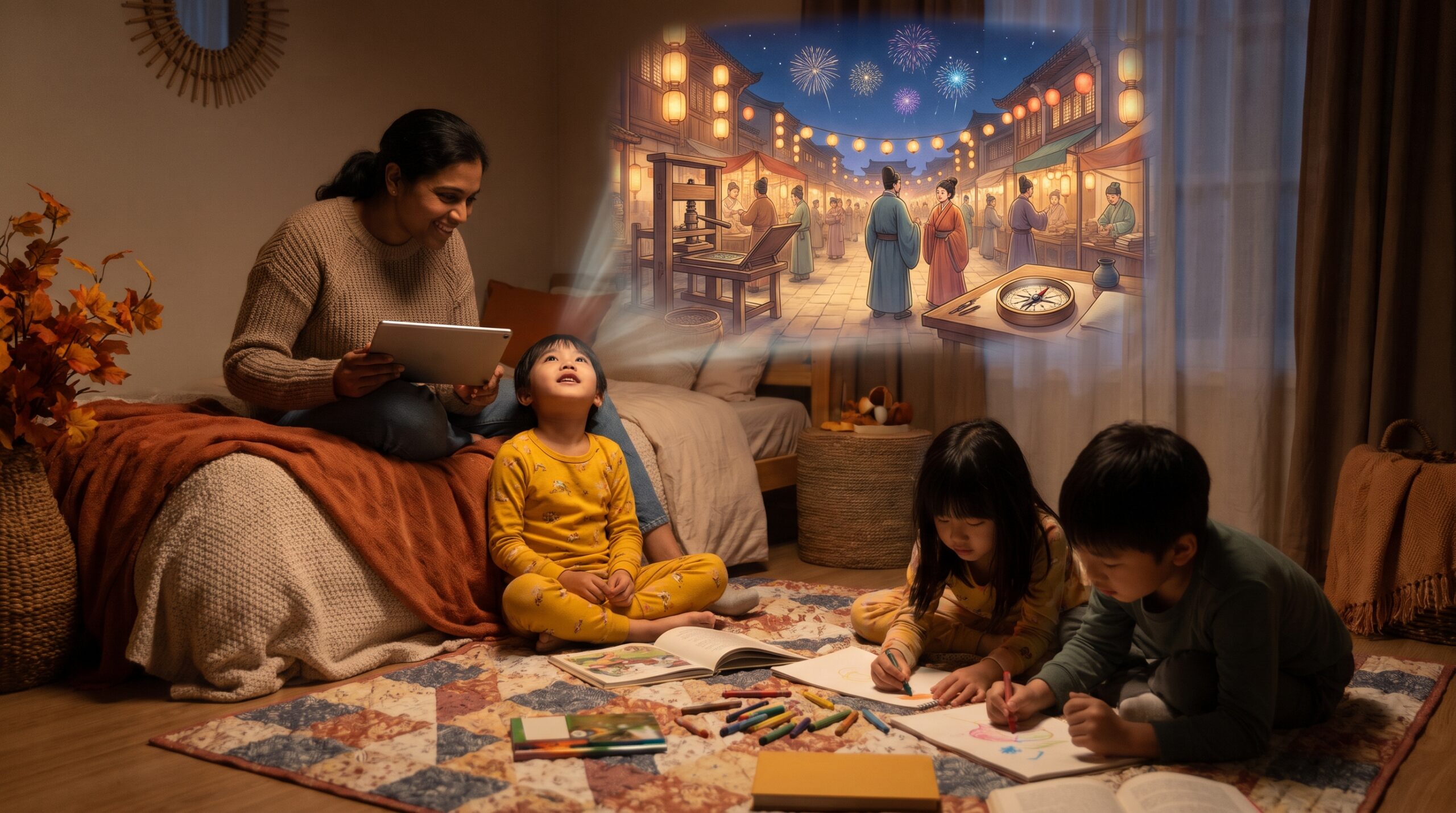
Cities hummed with activity. Kaifeng and later Hangzhou ranked among the world’s largest cities. In fact, in 1021, Kaifeng had a population of approximately half a million residents, with another half-million living in its nine designated suburbs—totaling about 1 million people, as noted by Wikipedia. Markets, teahouses, and busy streets filled them. Imagine spices, warm tea, lacquered boxes, and traders calling out. Shops specialized in silk, ceramics, and books. Families used credit and notes of exchange. By 1100, the Song Empire’s population reached approximately 100 million, far surpassing the peak levels of the Han and Tang dynasties, which stood at roughly 60 million, according to Cambridge University Press. As a result, more readers appeared and more books followed. Urban life changed how people lived and learned. It felt busy, colorful, and very human.
Inventions and science
Many Song inventions still matter today. For example, Bi Sheng invented movable type in the 11th century. Movable type made books cheaper and easier to copy. Also, Shen Kuo described the magnetic compass and wrote about rocks and stars. Gunpowder grew from fireworks into new military uses. The compass sent sailors farther than before. Night skies must have dazzled when fireworks flew. These inventions spread knowledge and travel in bold new ways.
Government, learning, and culture
The civil service examinations shaped official life. They let talented scholars rise by merit. Reformers like Wang Anshi changed taxes and state policy. During the Northern Song period (960–1127 AD), officially registered households increased from 6.2 million in 980 AD to 17.5 million by 1101 AD, representing a 280% growth over approximately 121 years, as detailed in a London School of Economics Working Paper. Debates ran hot and helped shape the future. Neo-Confucian thought, later shaped by Zhu Xi, began to influence schooling and daily ethics. At the same time, poets and painters thrived. Su Shi wrote with wit and feeling. Painters like Fan Kuan and Ma Yuan painted mountains and misty shores. Song ceramics and fine porcelains remain admired today.
Trade, ships, and family fun
After the court moved south, maritime trade grew fast. Southern Song merchants shipped silk, tea, and porcelain across East and Southeast Asia. In the late eleventh century, fully two-thirds (≈66.7%) of the Song Dynasty’s state revenues came from taxing non-agricultural sectors, particularly excise taxes on manufactured goods and trade, highlighting the economic structure of this vibrant era, as reported in the Economic History Review. Shipbuilding and metallurgy improved to meet demand. Meanwhile, military pressure from the Jurchens and the Mongols shaped state priorities. For families, these facts become playful prompts. Try a tiny museum at home. Gather a small bowl for ceramics, a ribbon for silk, and a compass drawing on paper. Let your child label each piece and tell its story.
Why the Song Dynasty matters
The Song married technology, trade, and learning in new ways. Its legacy appears in the books we read and the maps sailors used. Tiny marvels still make children gape and ask how things worked. For a warm, short story that brings these ideas to life, try Storypie. Read or listen to a story about Song Dynasty now: Read or listen to a story about Song Dynasty now: For 3-5 year olds, For 6-8 year olds, For 8-10 year olds, and For 10-12 year olds. You can also visit Storypie at Storypie for more stories and activities.
Try the market tale again. If your child asks for it, the story worked. Above all, enjoy the wonder.