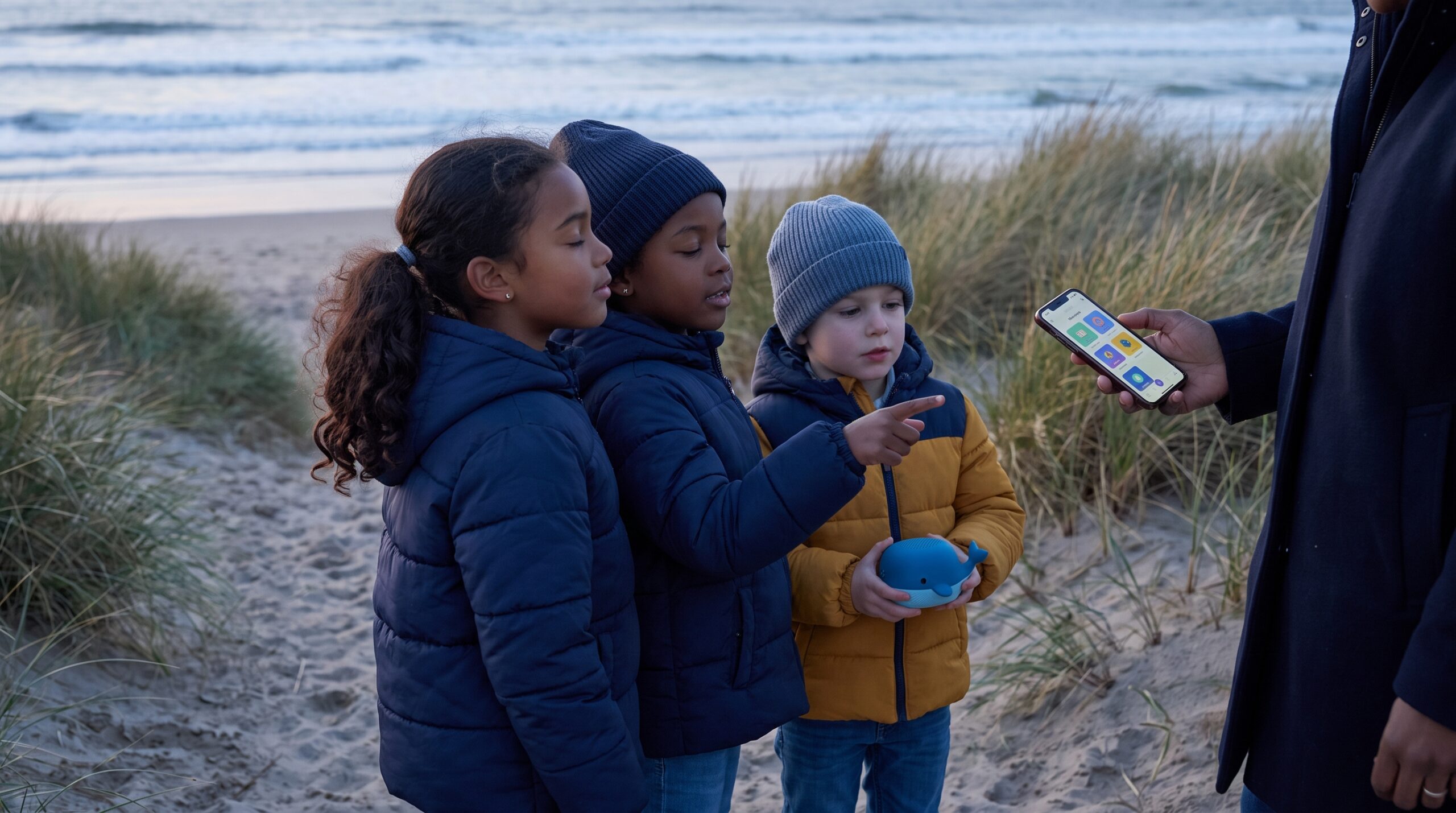
Sound waves for kids bring the science of sound to life. Tiny whispers and whale songs travel as vibrations through air, water, and solids. Also, these waves shape pitch, loudness, and echoes we notice every day.
Understanding Sound Waves for Kids
Sound happens when something vibrates. Those vibrations push air or water into zones of higher and lower pressure. Then the pressure moves outward as a wave. Because sound needs a material medium, there is no sound in a vacuum.
Frequency sets pitch and is measured in Hertz. Amplitude links to loudness and uses decibels. Wavelength is the distance between peaks. Speed tells how fast sound moves. For example, sound moves near 343 meters per second in air at 20 °C. In water, sound travels much faster, at about 1480 meters per second.
Sound Waves in Nature and History
Humans typically hear between about 20 Hz and 20,000 Hz, with peak sensitivity between 1000 and 6000 Hz. Also, animals extend the range. Bats and dolphins use ultrasound above 20 kHz for echolocation. Whales often sing below 100 Hz and travel long distances underwater. Interestingly, dogs can hear sounds ranging from 20 Hz to 45,000 Hz, indicating their ability to detect higher frequencies than humans.
Echoes happen when sound reflects off surfaces and returns. You can estimate distance by using speed and time. For example, a 0.6 second echo round trip at 343 m/s points to a wall near 51.5 meters away.
Resonance makes instruments sing. Strings, air columns, and membranes vibrate at resonant frequencies. Long ago Pythagoras noticed string length changes pitch. Later inventors created the phonograph, microphones, sonar, and ultrasound imaging to record and map sound.
How Rooms and Materials Change Sound
Rooms sound different because of reflection and absorption. Soft materials absorb sound. Hard surfaces reflect it. Sound also diffracts around corners and refracts between layers. Together these effects shape what we hear in homes and halls.
Listening Walk and Simple Experiments
Try a five minute listening walk to notice sound waves for kids in action. First, name five sounds. Next, mark soft or loud, near or far, and high or low. This short practice boosts focus and calm, especially before bed.
Simple experiments help too:
- Make a cup-and-string telephone to feel vibrations.
- Tap a tuning fork and touch it to water to see ripples.
- Stretch rubber bands across a box to make a simple guitar and compare pitches.
- Listen for echoes in a large empty hall or behind a cliff.
Safety note: prolonged exposure above about 85 dB can harm hearing. Use protection at loud events and seek a hearing check if sounds change. The threshold of hearing for humans is approximately 1 × 10⁻¹² W/m², while the threshold of pain is between 1 and 10 W/m².
Read or listen to a story about Sound Waves now: Read or listen to a story about Sound Waves now: For 3-5 year olds, For 6-8 year olds, For 8-10 year olds, and For 10-12 year olds.
Explore the Storypie tale to hear how sound waves move from whisper to whale echo. Also, try the listening walk tonight. You might hear something marvelous. Get the app to listen on the go.