The Space Shuttle for kids begins with one clear idea: a flying, reusable spaceship that carried people and cargo to space. Caregivers can use simple language to explain the Shuttle’s parts, missions, and legacy.
What the Space Shuttle looked like
The Shuttle stacked three main parts. First, the winged orbiter carried people and cargo. Next, the tall orange external tank held liquid fuel. Then, two white solid rocket boosters gave the main push at launch. The Space Shuttle orbiter, its three main engines, two solid rocket boosters, and external tank generated combined liftoff thrust of over 1.2 million pounds from the main engines and 5.8 million pounds from the solid rocket boosters, showcasing the impressive power and engineering behind its launch capabilities.
The orbiter measured about 122 feet long and had a 78 foot wingspan. Its cargo bay was near school-bus size. Typically, five to seven crew rode inside. The Shuttle could lift about 24,000 kilograms to low Earth orbit.
Launch to landing in simple terms
At liftoff, three main engines on the orbiter burned hydrogen and oxygen. Meanwhile, the two solid rocket boosters provided a huge push. After about two minutes, the boosters separated and were recovered from the sea for reuse.
Later, the external tank dropped away. Then the orbiter used smaller engines to reach orbit. For return, the Shuttle reentered with a fragile skin of heat tiles and carbon panels. Finally, it glided to a runway landing like a large, slow airplane.
How the Shuttle helped science and people
The Shuttle carried satellites, the Hubble Space Telescope, and parts of the International Space Station. It also flew science labs and tools. For example, the Shuttle deployed Hubble in 1990 and later serviced it many times.
Additionally, the Canadarm robotic arm and cargo bays helped assemble the ISS piece by piece. The program trained crews and inspired many future engineers and scientists. A total of 355 different individuals flew aboard Space Shuttle missions from 1981 to 2011, illustrating the human aspect of the program and its role in advancing human spaceflight.
Names, missions, and hard lessons
NASA flew 135 Shuttle missions from April 12, 1981 to July 21, 2011 . The orbiters were Enterprise, Columbia, Challenger, Discovery, Atlantis, and Endeavour. Enterprise never flew in space because it tested landings on Earth.
Tragically, Columbia and Challenger were lost in accidents. Fourteen astronauts died across those events. Use simple, respectful words with children. Explain that investigators learned hard lessons and that safety improved afterward.
Safety changes and lasting legacy
After the accidents, NASA changed inspection rules and safety checks. Also, engineers added new rules about debris and launch weather. Remarkably, since 1992, NASA made system improvements that tripled the safety of Space Shuttle flights, decreased in-flight problems by 70 percent, reduced operating costs by over $1.25 billion annually (a 40 percent reduction), and increased cargo capacity by 7.3 metric tons. Over time, NASA moved toward commercial crew vehicles and new spacecraft designs.
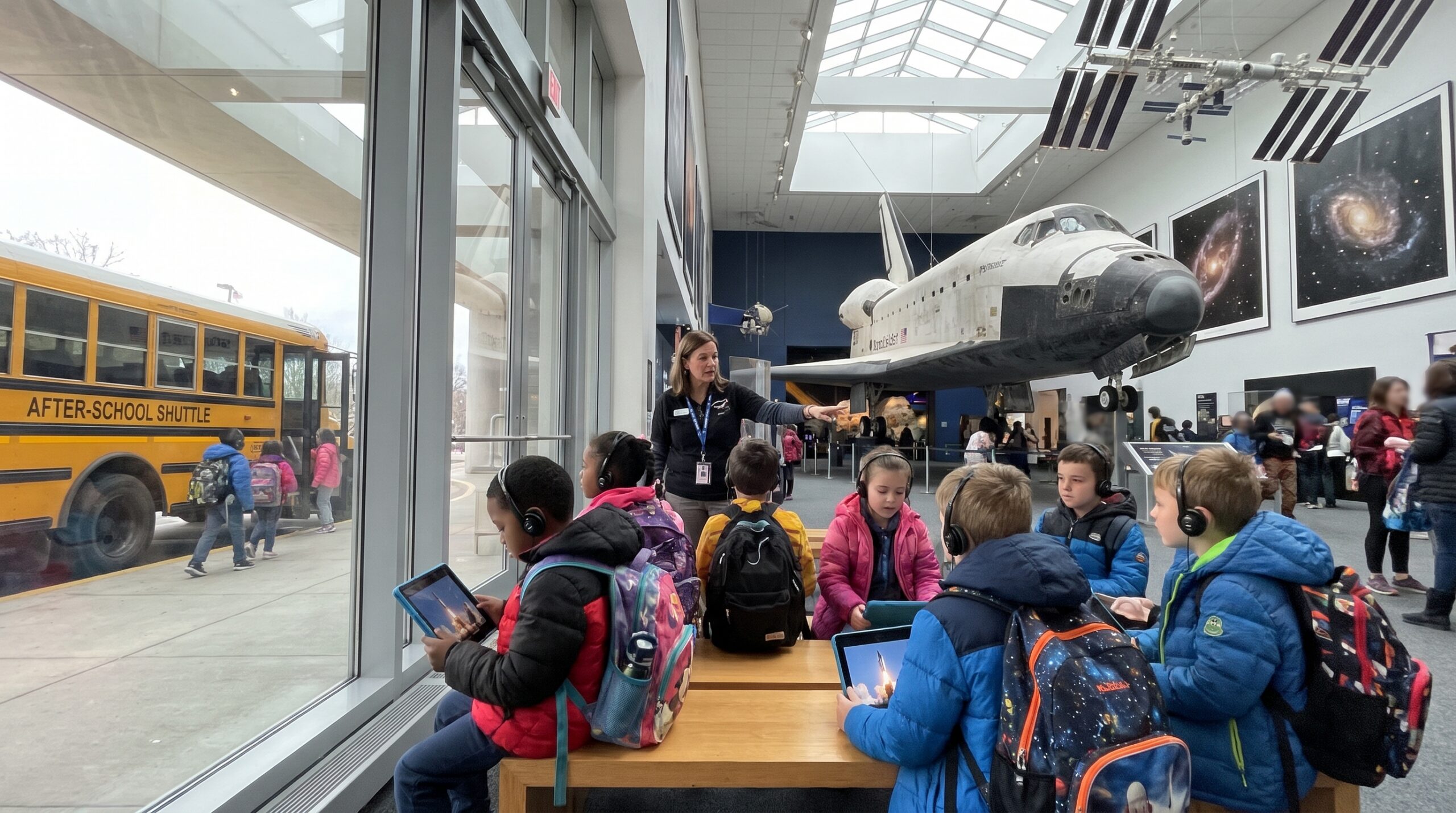
Today, retired orbiters live in museums where families can see them up close. Seeing a real orbiter sparks big, bright curiosity. It also reminds us that exploration costs courage and care.
Quick museum play and gentle activities
Before a museum visit, try a tiny ritual. For example, name the loudest launch sound or whisper a curious question. Then use a short checklist: what looks shiny, what seems soft, what surprises you.
Try a safe table craft to show how heat tiles worked. For instance, compare paper tiles to oven mitts. Keep it simple, hands-on, and playful to make learning stick.
Read or listen to a story about Space Shuttle now: For 3-5 year olds, For 3-5 year olds, For 6-8 year olds, For 8-10 year olds, and For 10-12 year olds.
Also, find this episode in the Storypie app to listen on the drive home. Get the app here: Storypie app. Try one quick question after a story and watch curiosity grow.