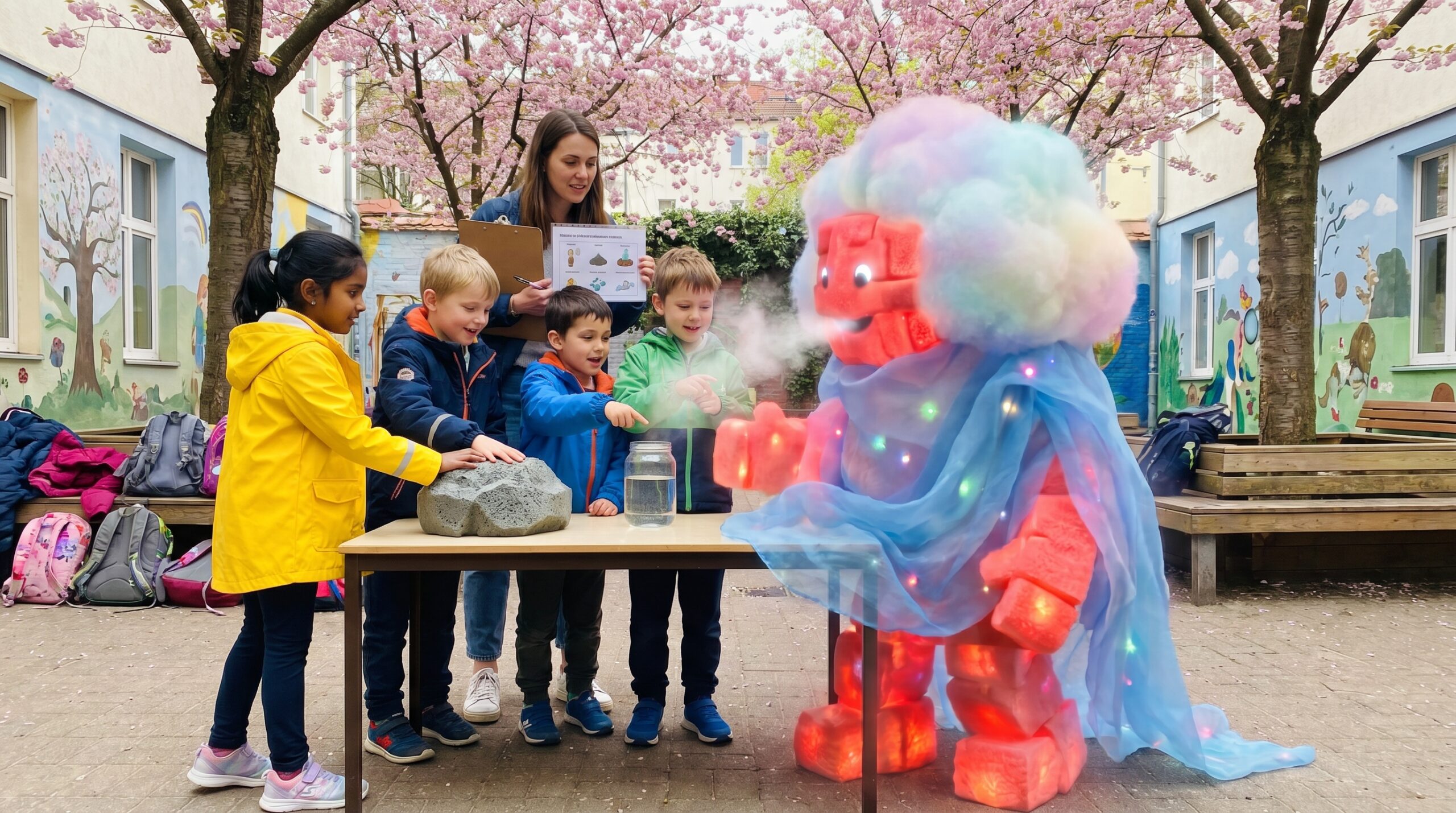
States of matter for kids can come alive in one morning. I showed my child how water can be a rock, a sip, and a cloud all in one day. That tiny moment turned a fact into a tiny science hero moment.
What states of matter mean
Matter is anything with mass that takes up space. The three classic states are solid, liquid, and gas. Solids hold their shape. Liquids take a container’s shape. Gases spread to fill their space. Interestingly, water is unique among substances because it naturally exists in all three common states of matter—solid, liquid, and gas—under Earth’s standard atmospheric conditions, making it a great example for children learning about these concepts according to the Science Learning Hub.
Quick particle picture
In solids particles sit close and vibrate. In liquids particles stay near but slip past each other. In gases particles move far apart and move freely. These simple images help kids imagine the tiny actors.
How heat and pressure change states of matter for kids
Heat adds energy and can melt solids into liquids. Heat can also vaporize liquids into gases. Cooling removes energy and does the reverse. These changes have names like melting and freezing.
Use these short words with kids:
- Melting and freezing
- Evaporation and condensation
- Sublimation and deposition
Pressure also changes behavior. For instance, higher pressure raises a liquid’s boiling point. Lower pressure lowers it.
Beyond the three: plasma and stranger states
There is a fourth common state called plasma. Plasma is an ionized gas and is the most common state of visible matter in the universe, comprising over 99% of it according to NASA. You see plasma in lightning, flames, and neon signs. Irving Langmuir named plasma in the early 20th century.
Other strange states exist too. Bose Einstein condensates act like one quantum object at very low temperatures. In 1995, scientists Eric Cornell and Carl Wieman created the first Bose-Einstein condensate by cooling a sample of rubidium to within a few degrees of absolute zero as noted by The Nobel Prize. Supercritical fluids blur liquid and gas above a critical temperature and pressure. In 2021, researchers discovered a new state of matter called ‘liquid glass,’ which exhibits properties between those of a solid and a liquid according to Live Science.
Simple, safe demos to spark curiosity
Short demos make the idea stick. Try these with adult supervision and care.
- Melt an ice cube in warm hands and listen for a tiny hiss.
- Watch condensation form on a cold glass.
- Make oobleck with cornstarch and water: one part water to two parts cornstarch. Press fast and it feels solid. Press slow and it flows.
Dry ice is dramatic because it sublimates. Yet handle dry ice only with heavy gloves and adult care. Never touch steam. Never let experiments go near mouths, plugs, or hot pans. Safety first, always.
Everyday detective walk
On a five minute walk, ask kids to point to a solid, a liquid, and a gas. You will hear the crisp snap of ice and the hiss of tiny steam. Small observations build big curiosity.
Tools for little scientists
Use particle diagrams and a simple phase change animation. Keep a small notebook for observations. Draw what you see and the words will follow. These tiny steps help children learn and remember.
Read or listen to a story about States of Matter now: For 3-5 year olds, For 3-5 year olds, For 6-8 year olds, For 8-10 year olds, and For 10-12 year olds.
Try this tonight: be a tiny science detective and share what you notice. For more kid-friendly concepts and stories, explore Storypie’s learn section.