
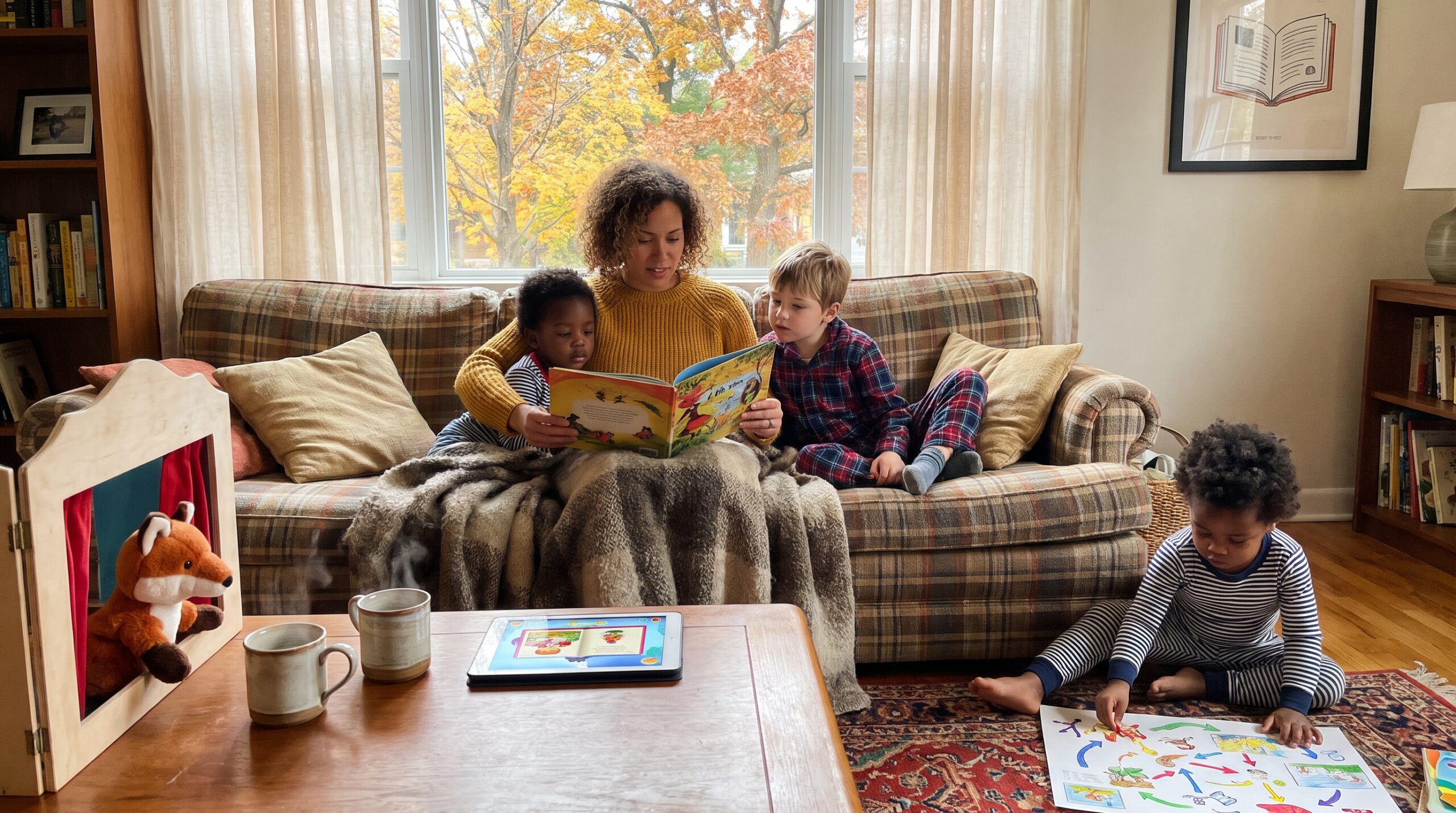
Storytelling for ages 3-12 explains why stories help children learn, remember, and grow. Stories give shape to facts. They link cause, character, and journey so the brain can hold ideas.
Why storytelling for ages 3-12 works
Children make sense of life through narrative. First, a story creates a causal chain: cause, action, consequence. That chain sits neatly in memory. Second, stories attach emotion to events. Emotions boost recall and vocabulary. Finally, characters and goals create meaning. Kids care about what happens to people, so facts stick. Research has shown that engaging in storytelling can significantly enhance narrative skills in children. A 2026 meta-analysis involving over 1,800 preschool children found a large positive effect on overall narrative skills, particularly in narrative macrostructure and causal language reasoning.
Developmental stages and narrative gains
Different ages take different things from a tale. For ages 3 to 5, vocabulary blooms. Young children follow simple plots and notice character goals. Short, sensory-rich scenes work best. A 2021 randomized-controlled study found that interactive elaborative storytelling produced the greatest gains in both receptive and expressive vocabulary, highlighting the importance of storytelling in early literacy development.
From ages 6 to 8, attention and working memory grow. Children hold multi-step plots and enjoy problem solving. They remember sequences better, too. Studies indicate that narrative-based instructional materials can enhance learning in various subjects; a 2024 meta-analysis found a small but significant performance improvement in science education when stories were used as a teaching tool.
By ages 9 to 12, abstract thinking appears. Older children like complex motives, moral nuance, and identity threads. They compare characters to themselves and learn inner lessons. A 2021 systematic review indicated that narrative interventions significantly improve both production and comprehension skills in school-age children, reinforcing the value of storytelling in education.
Key characteristics across ages
- Concrete plots help preschoolers link words to actions.
- Multi-step problems suit early elementary children.
- Complex themes engage older elementary learners.
What neuroscience and research say
Brain science shows why narrative sticks. Listening to stories activates language centers and the hippocampus. The amygdala responds to emotional scenes and helps consolidate memory. According to the U.S. National Survey of Children’s Health, approximately 36% of families with preschool-aged children engage in reading, singing, or storytelling daily, significantly increasing the likelihood of children being ‘healthy and ready to learn’ across various developmental domains.
Researchers call this narrative transportation. When a child becomes absorbed, recall and even behavior change more easily. Studies also show that story exposure boosts vocabulary and retelling skills. In classrooms, story-based lessons often improve retention more than dry facts.
History and cultural role of storytelling
Storytelling is humanity’s oldest classroom. For millennia, adults taught children through tales. Oral stories passed norms, skills, and culture from one generation to the next. Today, digital story apps continue that long tradition.
Conclusion and a gentle invitation
Education through storytelling is simple and powerful. Stories shape memory, language, and moral sense for children ages 3 to 12. They make learning human, vivid, and lasting. For a cozy family moment, try a short Storypie story tonight and notice how a child lights up.
Learn more on Storypie: Storypie home and explore stories on the get the app page.