
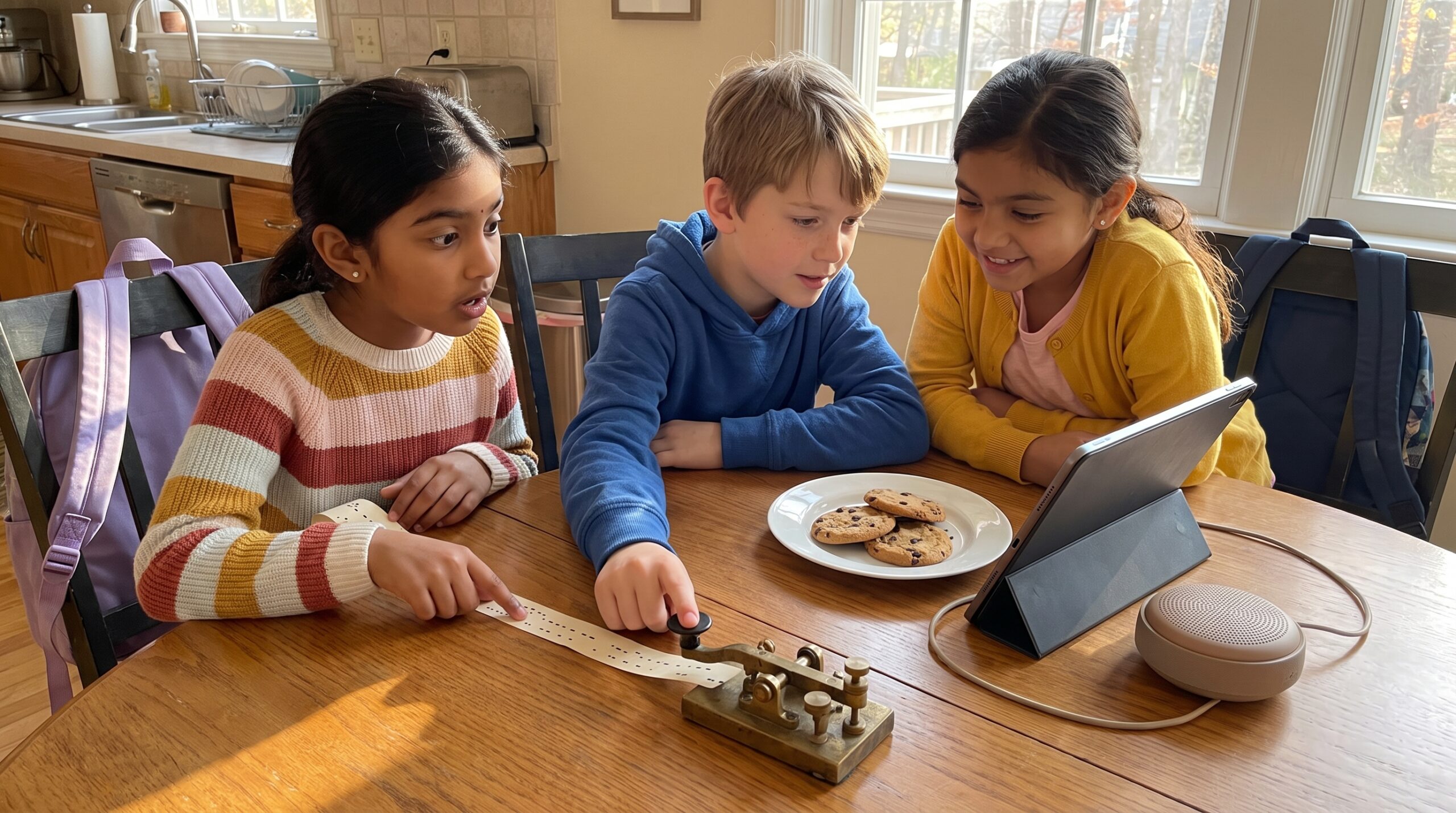
The telegraph for kids opens a tiny door to a huge change. First, short and long taps travelled as electrical pulses along wires. To people in the 1800s it felt like a small kind of magic.
What is the telegraph for kids?
A telegraph turns words into electrical signals. An operator tapped a key to make short signals called dots. They made long signals called dashes. Next, those pulses ran through a circuit powered by batteries. At the far end, a receiver clicked or marked inked paper.
On very long lines, relays boosted the signal. So messages could travel hundreds or thousands of miles. In short, the telegraph let people send news fast across big distances. In fact, in 1844, Samuel Morse sent the first telegraph message from Washington, D.C., to Baltimore, Maryland, marking a significant milestone in communication history.
How the telegraph worked
An operator pressed a key to open and close the circuit. Then the receiver at the other end heard clicks or saw marks on paper. Also, a code turned letters into dots and dashes. International Morse became the standard by the 1860s.
Because messages cost money, senders wrote short, sharp lines. For example, telegrams often used few words. That habit changed how people wrote and spoke about news.
Who made the telegraph?
Many hands shaped the telegraph. Samuel F. B. Morse and Alfred Vail refined a code. In 1844 they sent the famous message “What hath God wrought.” In Britain, Cooke and Wheatstone built a needle telegraph for railways. Meanwhile, engineers like Cyrus W. Field helped lay cables under the sea. By 1866, a telegraph line had been laid across the Atlantic Ocean from the United States to Europe, linking continents and changing the world, as explained by HISTORY.com.
Why the telegraph mattered
The telegraph sped news and made markets act faster. Railways used it to time trains and to keep people safer. Governments, newspapers, and traders reacted to news in minutes instead of days. In other words, the telegraph helped shrink the world. The influence of the telegraph extended to the media, leading to the first publication of the *Daily Telegraph and Courier* on June 29, 1855, founded by Colonel Arthur B. Sleigh, demonstrating the profound impact of telegraphy on news dissemination (Wikipedia).
Legacy and museums
Telegraphy left a long legacy. Morse code still appears in amateur radio. For example, the distress signal SOS survived. Museums keep keys, sounders, and cable sections on display. Visit collections to see real pieces and to hear the clicks that once crossed oceans.
Activities that spark curiosity
Keep it playful and safe. Try simple activities with children to show how signals work.
- Tap a table with fingers for dots and dashes.
- Flash a torch for short and long signals.
- Decode a secret message and swap replies.
- With an adult, build a low-voltage circuit using a battery and LED or buzzer.
Mini glossary
- Dot: a short tap or flash.
- Dash: a long tap or flash.
- Key: the switch an operator presses.
- Relay: a booster for weak signals.
- Cable: many wires bundled, sometimes under the sea.
- Operator: the person who reads and sends code.
Conversation prompts
- How would you send a message if there were no phones?
- Why do you think telegrams were so short?
A small ritual helps curiosity grow. Pick one Morse letter after snack. Keep a tiny card with a hero word on a shelf. When a child taps the pattern, the experiment is working. Make it warm, brief, and playful.
Read or listen to a story about Telegraph now: For 3-5 year olds, For 3-5 year olds, For 6-8 year olds, For 8-10 year olds, and For 10-12 year olds.
If you want to explore more, get the Storypie app for stories and playful learning.
Finally, the telegraph feels surprisingly speedy and delightfully simple today. It is a small tool with a very big story. That story helps children touch the place where our modern messages began.