
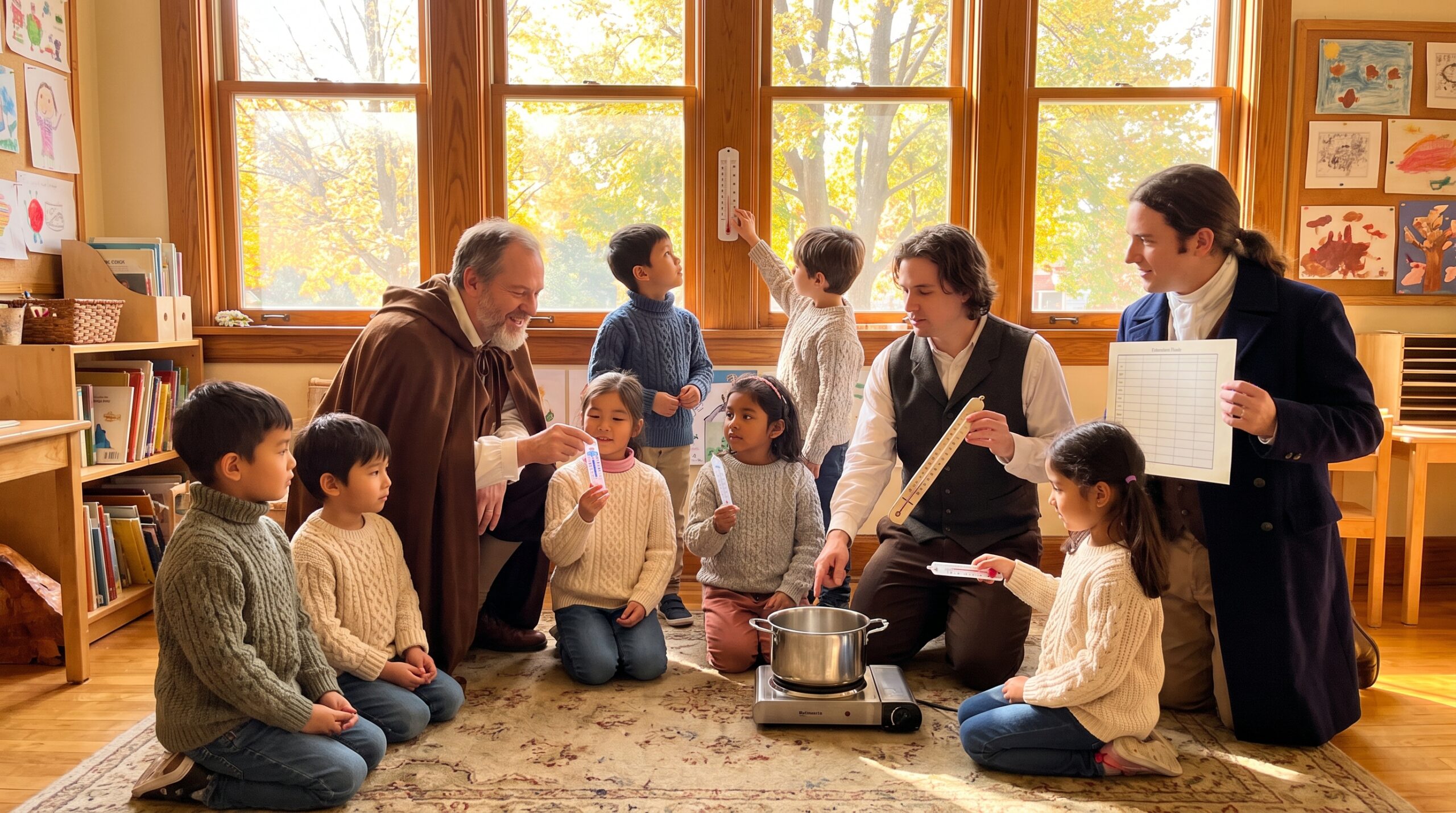
Temperature for kids can feel like a tiny magic trick. It turns hot and cold into simple numbers. Right away, children can see why ice melts and soup cools.
Short history of temperature
Long ago, Galileo made a glass tube that showed warmth and cold. Then Santorio added a simple scale. In 1714, Fahrenheit used mercury and a new thermometer. In 1742, Celsius suggested a 0 to 100 scale. Later, Lord Kelvin created an absolute scale where 0 K is absolute zero. In 2019, scientists redefined the kelvin using the Boltzmann constant. These small stories make names easy to remember.
What Temperature for Kids Means
Temperature measures the average motion of tiny particles. Imagine tiny balls bouncing faster when warmed. Therefore, faster motion means a higher temperature. Heat is different because heat is energy that moves from hot things to cold things. When two objects share the same temperature, they stop swapping heat.
Everyday temperature examples
- Freezing water: 0°C = 32°F
- Room comfort: 20 to 22°C = 68 to 72°F
- Body temperature: about 37°C = 98.6°F
- Boiling water: 100°C = 212°F
- Fridge: about 4°C = 39°F
Major scales and simple conversions
People use Celsius and Fahrenheit every day. Scientists use kelvin most often. To convert, add 273.15 to Celsius to get kelvin. And use F = C times 9/5 plus 32 to find Fahrenheit. These quick rules help parents and teachers explain numbers easily.
How thermometers work
Many thermometers show expansion. For instance, mercury or colored alcohol rises as it warms. Gas thermometers change pressure. Bimetal strips bend and move a needle. Digital thermometers use thermistors or thermocouples. Infrared tools read surface radiation without touching. Also, never use a broken mercury thermometer around children. Mercury is toxic. Choose alcohol or digital types instead.
Everyday uses and safety
We check temperature for weather, cooking, health, and comfort. Food safety warns about a danger zone between 4 and 60°C. Usually, a fever is 38°C or higher. For ovens or baby baths, pick the correct thermometer. To read a room thermometer, place it at eye level away from sun and vents. Then wait until the number stabilizes.
Simple experiments for home
Try comparing sun and shade temperatures. Then touch metal and wood that are the same temperature to feel thermal conductivity. You can build a homemade thermometer using colored alcohol in a sealed tube under adult supervision. Ask children to predict, record, and celebrate their tiny discoveries.
Why temperature matters for climate
Small changes in average temperature change weather patterns and habitats. In fact, according to the World Meteorological Organization, in 2023, the global average temperature was 1.45 ± 0.12°C above pre-industrial levels (1850–1900), making it the warmest year on record. This idea makes science feel meaningful and hopeful. The Met Office notes that the ten warmest years on record have all occurred since 2015, with 2023 surpassing the previous record set in 2016 by 0.17°C. These alarming trends highlight the urgency of understanding climate change and its effects on our environment.
Read or listen to a story about Temperature now: For 3-5 year olds, For 6-8 year olds, For 8-10 year olds, and For 10-12 year olds.
Finally, ask your child to read a room thermometer and describe what they see. Try this today and celebrate the tiny discovery together. Explore Storypie for tools, prompts, and audio to make temperature playful.









